Your digging level
Description
Mevlevi Sufi music is the sacred repertoire of the Mevlevi (Whirling Dervish) order in Anatolia, closely bound to the Sema ceremony founded on the teachings of Jalāl al-Dīn Rūmī in Konya.
It belongs to the Ottoman–Turkish art music tradition and is built on the makam system (modal scales and pathways) and usûl (long, cyclical rhythmic patterns such as devr-i kebir). The core form is the Ayin-i Şerif, a multi-movement suite that accompanies the ritual stages of Sema—from the opening Naat-ı Şerif in praise of the Prophet to a ney (end-blown reed flute) taksim (improvisation) and four “selam” sections representing spiritual ascent.
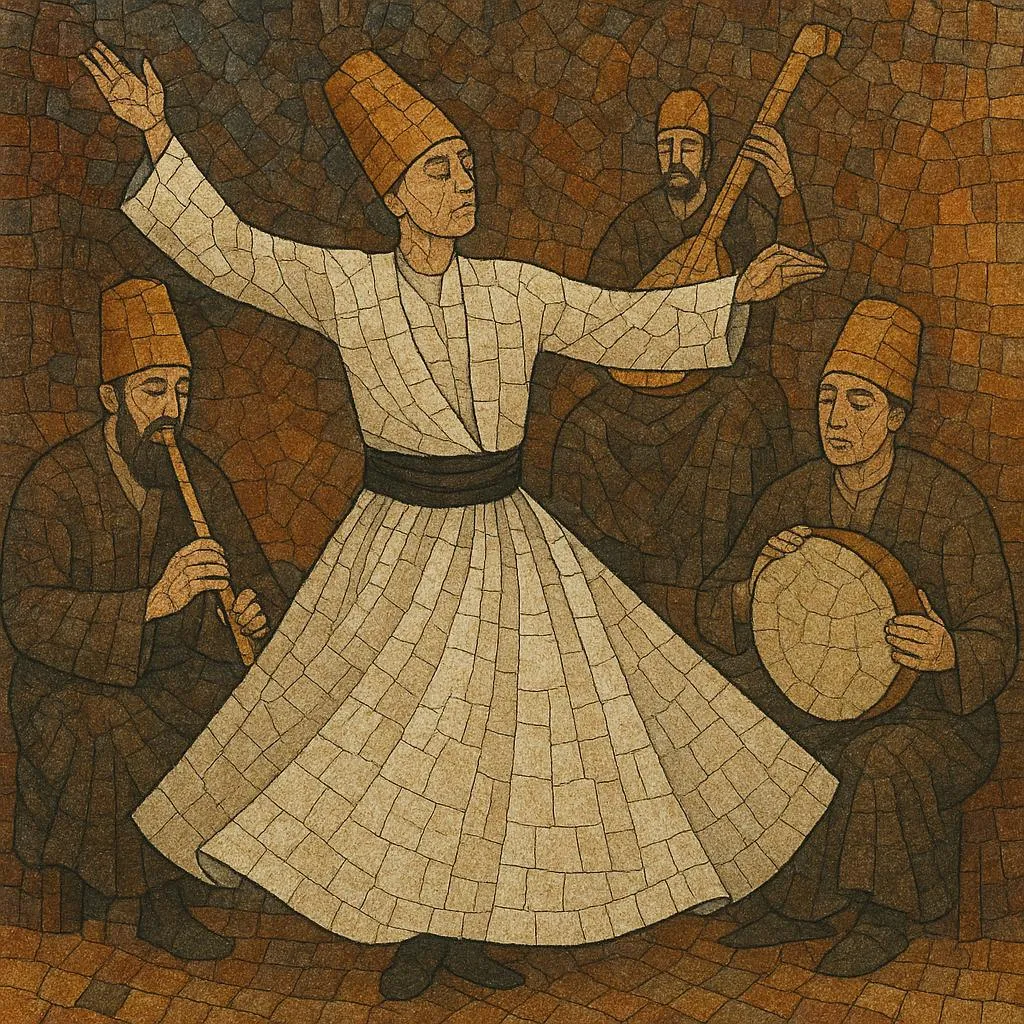
Its quintessential timbre comes from the ney, supported by tanbur and kemence, with small kettledrums (kudüm), frame drums (bendir/def), and often choral or solo chant. The music is contemplative, microtonally inflected, melismatic, and designed to guide breath, movement, and remembrance (dhikr) rather than to dazzle with virtuosic display.
History
The musical practice associated with the Mevlevi order crystallized in 13th‑century Konya (present‑day Turkey) under the spiritual authority of Rūmī and his successors. Early Mevlevi lodges (mevlevihane) nurtured poet‑musicians who fused devotional poetry with evolving Anatolian and Perso‑Arabic modal practices, giving the ney and sung ilahi a central role in worship.
Across the Ottoman era, Mevlevi music became a pillar of Ottoman classical culture. The Ayin‑i Şerif was formalized as a multi‑section suite in specific makams and extended usûl cycles. Major composer‑dervishes, court patrons, and sultans advanced the art: the ritual often opened with Itrî’s famed Naat‑ı Şerif, followed by ney taksim, procession (Devr‑i Veled), and four selams that mirror stages of spiritual ascent. Composers wrote Ayins in diverse makams, notating and transmitting them orally and via systems like Hamparsum notation.
After the 1925 closure of Sufi institutions in the Turkish Republic, public ritual waned, yet the repertoire survived through master–apprentice lines and concert practice. From the mid‑20th century, neyzen and scholar–performers recorded, published, and taught the Ayin tradition worldwide.
In the 21st century, the Mevlevi Sema Ceremony and its music gained international visibility through festivals, conservatories, and documentation, and are recognized by UNESCO as Intangible Cultural Heritage. Today, performances balance devotion, scholarship, and presentation on the concert stage while maintaining the music’s ritual ethos.