Your digging level
Description
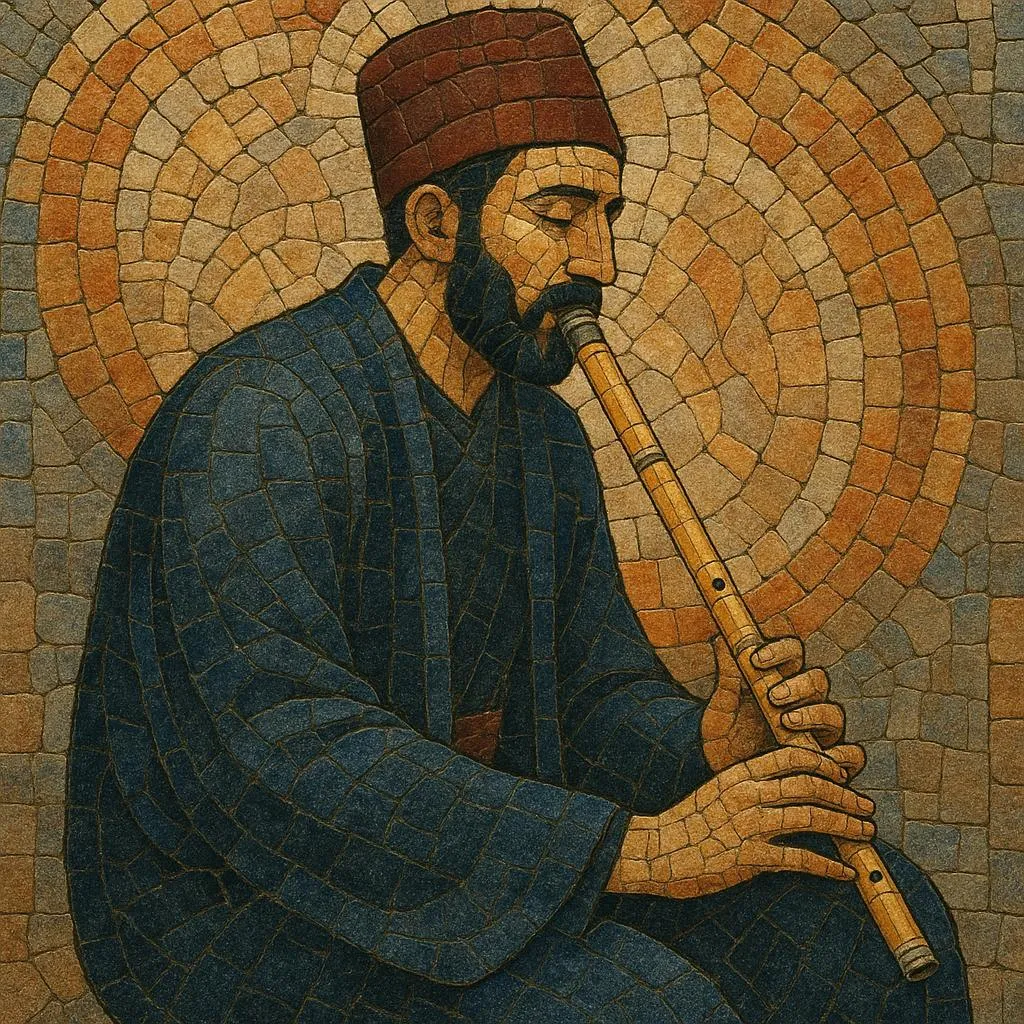
Ney is a genre centered on the expressive end-blown reed flute of Anatolia and the broader Middle East, featuring solo improvisations (taksim) and composed pieces within modal systems (makam/dastgāh/maqām).
In Turkish practice the ney has a mouthpiece (başpare) and metal rings (parazvane); in Persian practice the ney is blown between the teeth, yielding a distinctly breathy, vocal timbre. Across traditions the instrument’s microtonal inflections, dynamic breath control, and melismatic phrasing evoke a contemplative, often spiritual character closely linked with Sufi ceremony and Ottoman/Persian classical repertoires.
Performances range from intimate solo improvisations to chamber-sized classical ensembles (ney with tanbur, kanun, kemençe, kudüm, bendir, etc.), and can include ritual forms (e.g., Mevlevi ayin) or instrumental suites (peşrev, saz semai).
History
Archaeological and textual evidence places end-blown reed flutes in the Ancient Near East for millennia, but the recognizable ney tradition coalesced in medieval Anatolia and Iran. By the 13th century, the ney had become emblematic of Sufi spirituality (especially in Mevlevi circles founded around Jalal al-Din Rumi), where its breathy voice symbolized the soul’s yearning.
From the 15th–19th centuries, the ney became a principal melodic voice in Ottoman court and urban music, sharing the modal language of makam and the rhythmic cycles (usul). In Persian courts and later urban salons, the ney was likewise central to dastgāh practice. Canonical composed forms (peşrev, saz semai in the Ottoman realm) and long-form improvisations (taksim/avaz) codified ney technique and repertoire.
The late Ottoman and early Republican eras in Turkey produced master neyzen (ney players) who preserved lineages of embouchure, fingerings, and ornamentation. Parallel revivals in Iran documented regional embouchure variants and teaching methods. Recording technology and conservatory programs spread the instrument’s reach, while luthiers standardized size families (e.g., Kız, Mansur, Süpürde) for different tonalities.
From the late 20th century onward, ney migrated into new settings: chamber jazz, film scores, ambient/world fusion, and intercultural sacred music. While remaining rooted in makam/dastgāh, contemporary artists explore extended techniques (overtone control, subtle multiphonics, circular breathing), electroacoustic processing, and dialogue with Western harmony, expanding the instrument’s expressive map without losing its contemplative core.
Choose a modal framework:
•Turkish makam (e.g., Uşşak, Hicaz, Rast, Segâh) using microtonal accidentals and characteristic seyir (melodic pathways).
•Persian dastgāh/āvāz (e.g., Shur, Homāyūn, Segāh), with gusheh (motivic kernels) guiding the improvisational arc.
•Arabic maqām (e.g., Bayātī, Ḥijāz, Rāst) if working in Levant/Egyptian aesthetics.
•Select or imply a usul (rhythmic cycle) for composed sections (e.g., 10/8 aksak, 6/8, 4/4), while allowing free-rhythm rubato for taksim/avaz.
-
•
Drone practice (tonic/dominant) to internalize intonation.
•Learn seyir/gusheh pathways from canonical models.
•Alternate short taksim studies with metric compositions.
•Rehearse modulations (geçki/forud) that suit your chosen mode and performance length.