

Your digging level

For this genre
0/8
🏆
Sign in, then listen to this genre to level up

Description

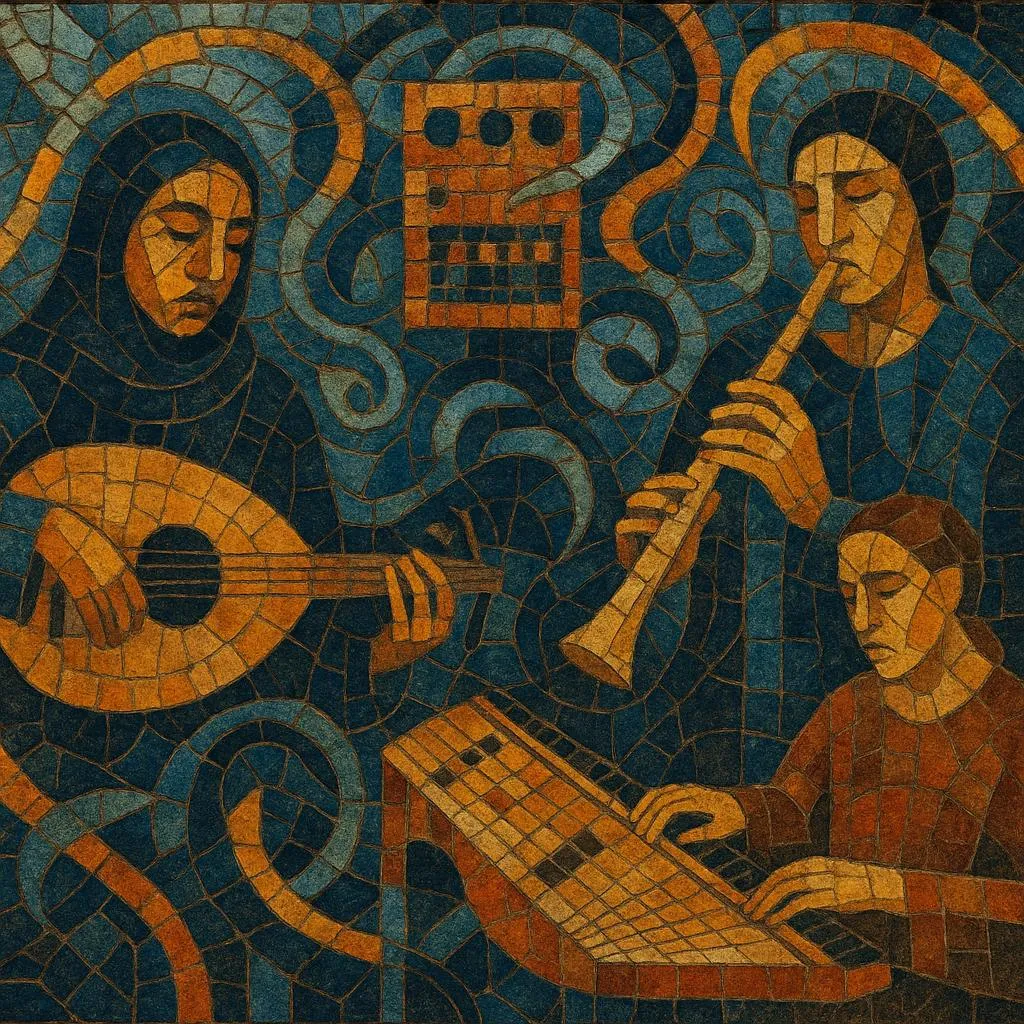
Arab experimental is an umbrella term for exploratory and boundary‑pushing music made by artists from the Arab world and its diaspora. It spans electroacoustic composition, noise, free improvisation, sound art, deconstructed club, ambient, and drone, while often engaging with Arabic modal systems (maqām), rhythmic cycles (iqāʿāt), and regional instruments such as the oud, nay, and qanun.

A hallmark of the style is its willingness to interrogate place, memory, technology, and politics through non‑linear forms, extended techniques, microtonal tunings, and extensive use of electronics and field recording. The resulting works sit between concert music, installation and performance art, and adventurous club culture, with as much emphasis on texture and process as on melody or groove.

Sources: Spotify, Wikipedia, Discogs, RYM, MB, user feedback and other online sources

History

Early sparks (1940s–1970s)
•   The experimental impulse in the Arab world can be traced to mid‑20th‑century electroacoustic and tape practices, alongside modernist composers and studio tinkerers who adapted early recording technology and radio infrastructure. These artists explored sound manipulation, microtonality, and non‑Western scales well before "world music" marketing existed. •   Parallel currents included organ/synth experiments, film and television scoring laboratories, and conservatory circles where maqām theory met European avant‑gardes.
Underground infrastructures (1990s–2000s)
•   In the 1990s, post‑war and post‑civil‑war urban rebuilding (notably in Beirut) catalyzed DIY venues, festivals, and labels devoted to free improvisation, noise, and electroacoustic work. Community radio and cassette/CD‑R networks connected scenes across the Levant, North Africa, and the Gulf. •   In the 2000s, independent labels, weekly concerts, and regional festivals nurtured cross‑disciplinary collaborations between sound artists, improvisers, and club producers. Artists began to hybridize live electronics with oud, buzuq, and hand percussion; extended techniques and feedback systems became common.
Consolidation and global dialogue (2010s)
•   Affordable laptops, modular and semi‑modular synths, and platforms like Bandcamp enabled a boom in self‑released material. Curators and festivals from Cairo to Tunis, Ramallah, and Amman foregrounded experimental practices; residencies and academic exchanges linked artists with European and North American institutions. •   A distinct sonic grammar emerged: microtonal or just‑intonation systems mapped onto software and hardware; iqaʿ cycles stretched or atomized; field recordings from markets, protests, and deserts layered into drones and granular textures; club frameworks were deconstructed into asymmetrical pulses and heavy sound design.
2020s and beyond
•   The scene now spans galleries, black‑box theaters, and adventurous club nights, with strong diaspora nodes (Berlin, Paris, London, Montreal, New York) feeding back into MENA hubs. Multichannel diffusion, ambisonics, and installation work blur lines between concert and exhibition. •   The genre remains porous: collaborations with contemporary dance, cinema, and visual arts are common; themes of displacement, climate, heritage, and futurity recur. Arab experimental has become a reference point for broader Middle Eastern undergrounds and left‑field pop.

How to make a track in this genre

Materials and timbre
•   Combine regional instruments (oud, buzuq, qanun, nay, riq) with electronics (modular/semi‑modular synths, samplers, live coding, Max/MSP, SuperCollider). •   Build palettes from field recordings (markets, rituals, streets, deserts), contact mics, feedback loops, and prepared instruments. Embrace noise floors, tape hiss, and mic bleed as musical matter.
Pitch and tuning
•   Explore maqām‑based pitch spaces beyond equal temperament: jins groupings, neutral seconds/thirds, and microtonal inflections. Map custom scales to MIDI/MTS‑ESP/MPE or retune synth oscillators; consider just‑intonation variants to stabilize micro‑intervals.
Rhythm and form
•   Rework iqāʿāt (e.g., maqsūm, samāʿī thaqīl, masmūdī, dawr hindī) via polymeter, augmentation/diminution, or granular slicing. Alternate pulse‑based sections with free‑time drones and silences. •   Favor process‑driven forms: gradual transformations, tape‑loop phasing, spectral filtering, feedback accretion, and stochastic events. Let form emerge from system behavior rather than verse‑chorus templates.
Techniques and processing
•   Use convolution (spaces and objects from your environment), granular time‑stretching of vocal melismas, ring‑mod/frequency‑shifting on plucked strings, and side‑chained spectral gates to "breathe" drones. •   Employ extended techniques: eBow or threaded strings on oud, key‑clicks and overblowing on nay, prepared percussion (springs, foil, beads) on frame drums.
Performance and space
•   Design sets for multichannel diffusion; move sounds through the room to mirror the call‑and‑response of traditional music in space. Integrate live visuals, text, or movement when relevant to the concept. •   Keep improvisation central: set constraints (scale, motif, noise color), then respond to room acoustics and audience. Record rehearsals; curate the best system behaviors into a final structure.
Ethos
•   Anchor abstraction in place and story. Let archival voices, local acoustics, and social realities inform sonic choices. Credit collaborators and communities; document tunings and methods for future reuse.

Top tracks

Locked
Share your favorite track to unlock other users’ top tracks

Upcoming concerts

in this genre
Influenced by

Download our mobile app

Get the Melodigging app and start digging for new genres on the go
© 2026 Melodigging
Melodding was created as a tribute to Every Noise at Once, which inspired us to help curious minds keep digging into music's ever-evolving genres.
Buy me a coffee for Melodigging
