Your digging level

For this genre
0/8
🏆
Sign in, then listen to this genre to level up

Description

Arab electronic is a broad, transnational electronic-music movement that blends contemporary production (house, techno, trip hop, bass, ambient) with the melodic modes (maqāmāt), rhythms (iqāʿāt), languages, and timbres of Arabic musical traditions.

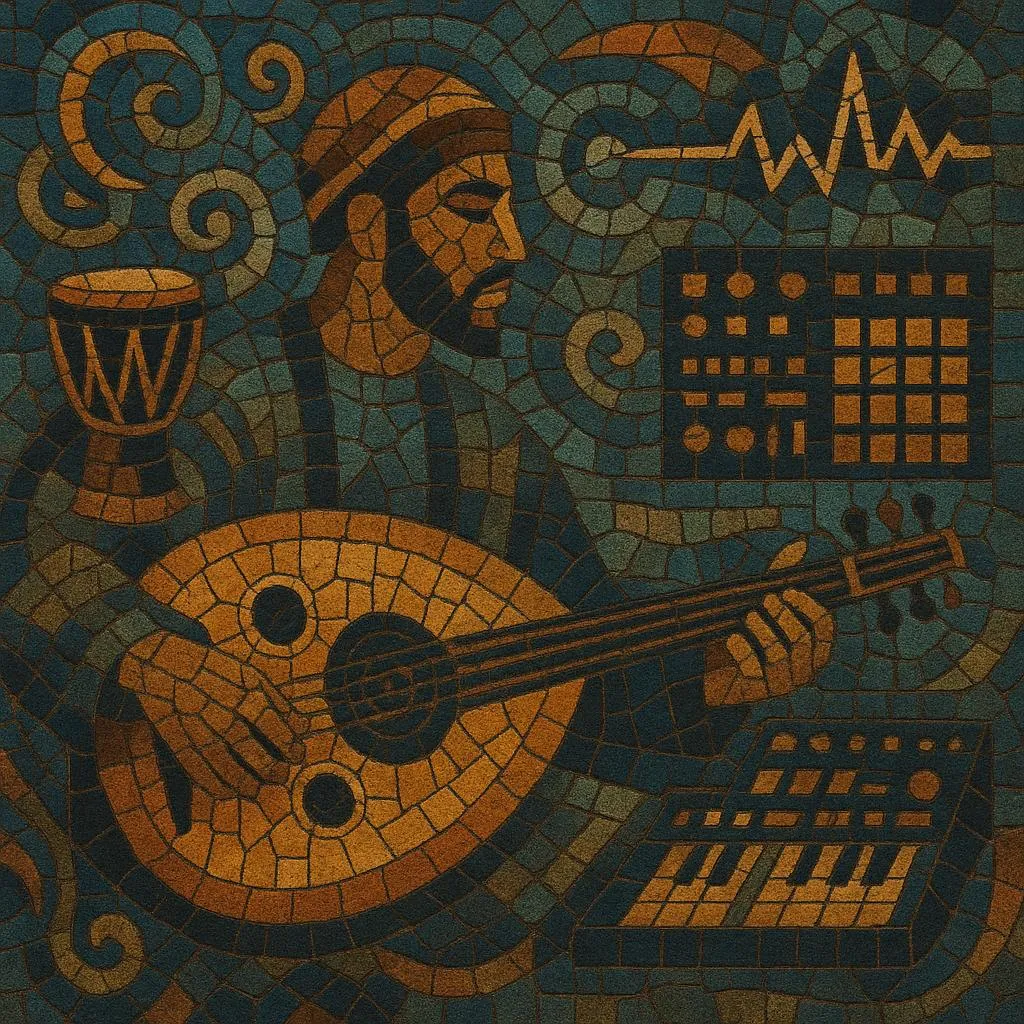
It typically features microtonal melodies (Hijāz, Rāst, Bayātī, Nahāwand), Arabic percussion (darbuka/tabla, riqq, bendir) rendered with drum machines and samplers, as well as synths and processed oud, qanun, and nay. Vocals may be sung or rapped in diverse dialects (Levantine, Egyptian, Maghrebi, Gulf), often with melismatic phrasing.

Stylistically, the scene ranges from club-oriented techno and house to experimental and ambient works, anchored by polyrhythms like maqsūm, baladī, and sa‘īdī, and by hypnotic, modal grooves that translate the aesthetics of Arabic music into electronic dance and listening contexts.


Sources: Spotify, Wikipedia, Discogs, RYM, MB, user feedback and other online sources

History

Roots and early experiments (1940s–1990s)
•   The technical possibility of fusing Arabic musical ideas with electronics reaches back to Egyptian-American composer Halim El-Dabh’s tape experiments (1940s), and later to synth-adopting Arabic pop and jazz in the 1970s–80s. •   By the late 1990s, Beirut’s underground helped crystallize a distinctive approach: projects like Soapkills pioneered Arabic-language trip hop and downtempo textures over modal melodies and programmed beats, foreshadowing a wider regional turn to electronic production.
Scene formation and global visibility (2000s–2010s)
•   Across Cairo, Beirut, Amman, Tunis, Casablanca, and Ramallah, DIY producers and indie labels embraced laptops, samplers, and club systems. Artists folded maqām scales and iqāʿ rhythms into house/techno, bass, and experimental forms. •   Parallel hybrids surfaced: electro-chaabi/mahraganat in Egypt, Levantine dabke fused with techno (“shamstep”), and Maghrebi club mutations. Collectives, festivals, and online platforms amplified circulation and cross-border collaboration, with diaspora hubs (Paris, Berlin, London) acting as crucial bridges. •   Acts like Acid Arab, 47SOUL, Hello Psychaleppo, Deena Abdelwahed, and SAMA’ Abdulhadi brought Arab electronic aesthetics into European clubs and global festivals, reframing Arabic timbre and modality as drivers of contemporary dance music.
Diversification and consolidation (2010s–present)
•   The genre diversified into club-functional techno/house, experimental IDM/noise, ambient/filmic electronica, and bass-driven rap crossovers. Producers leaned into microtuning, live electronics with traditional instruments (oud, qanun, nay), and field recordings. •   Scenes professionalized through boutique labels, community studios, and educational workshops, while political upheavals and diasporic experience informed lyrical/sonic narratives of displacement, resistance, and futurity. Today, "Arab electronic" functions as both an umbrella scene and a production approach that keeps evolving with new tools, platforms, and regional voices.

How to make a track in this genre

Tonal palette and tuning
•   Center melodies in Arabic maqāmāt (e.g., Hijāz for a tense/exotic feel, Rāst for grounded majesty, Bayātī for warmth, Nahāwand for minor/romantic). Use microtuning: set synths/samplers to 24-TET or custom scales via MTS-ESP/TUN files, or retune oscillators by cents.
Rhythms and groove
•   Build grooves from iqāʿāt: maqsūm (4/4), baladī (4/4), sa‘īdī (4/4), malfūf (2/4). For experimental sections, reference samā‘ī thaqīl (10/8) as a motif or breakdown. •   Layer acoustic percussion (darbuka/tabla, riqq, bendir) with electronic drums. Combine swung doum–tek patterns with a steady 4-on-the-floor kick for club traction.
Sound design and instrumentation
•   Pair analog/digital synths (detuned saws, FM plucks, wavetable pads) with processed oud, qanun, nay, or sampled takht textures. Use formant filters and resonant band-pass sweeps to echo reed/flute color. •   Employ granular/looped field recordings (markets, calls, street ambience) as atmospheric beds.
Harmony and arrangement
•   Keep harmony modal and drone-based; use pedal tones and ostinati rather than Western functional progressions. Accentuate tonic–dominant drone shifts aligned with maqām pathways (sayr). •   Arrange in DJ-friendly arcs: intro (texture/percussion), build (melodic hook), peak (full rhythm/microtonal lead), breakdown (drone/voice), and reprise. Automate filters, delays, and reverb to shape transitions.
Vocals and lyrics
•   Favor melismatic lines, call-and-response, or chant-like hooks. Write in dialect (Levantine, Egyptian, Maghrebi, Gulf) or Modern Standard Arabic depending on context. For rap crossovers, lock flows to iqāʿ accents and leave space for percussive fills.
Mixing and performance
•   Carve space for hand percussion transients (2–6 kHz) and low-end doum (60–120 Hz). Tame harshness in microtonal leads with gentle saturation. Sidechain pads to kick for club mixes. •   Live sets can blend CDJs with frame drums or live oud/qanun, and real-time microtuning on MPE controllers; use FX (echo/reverb/delay) rhythmically to converse with iqāʿ patterns.

Top tracks

Locked
Share your favorite track to unlock other users’ top tracks

Upcoming concerts

in this genre
Influenced by
Has influenced

Download our mobile app

Get the Melodigging app and start digging for new genres on the go
© 2026 Melodigging
Melodding was created as a tribute to Every Noise at Once, which inspired us to help curious minds keep digging into music's ever-evolving genres.
Buy me a coffee for Melodigging