

Your digging level
Description
Arabic instrumental refers to the largely non-vocal traditions of the Arab world that foreground the modal (maqām) system, cyclical rhythms (iqāʿāt), and finely shaded ornamentation.
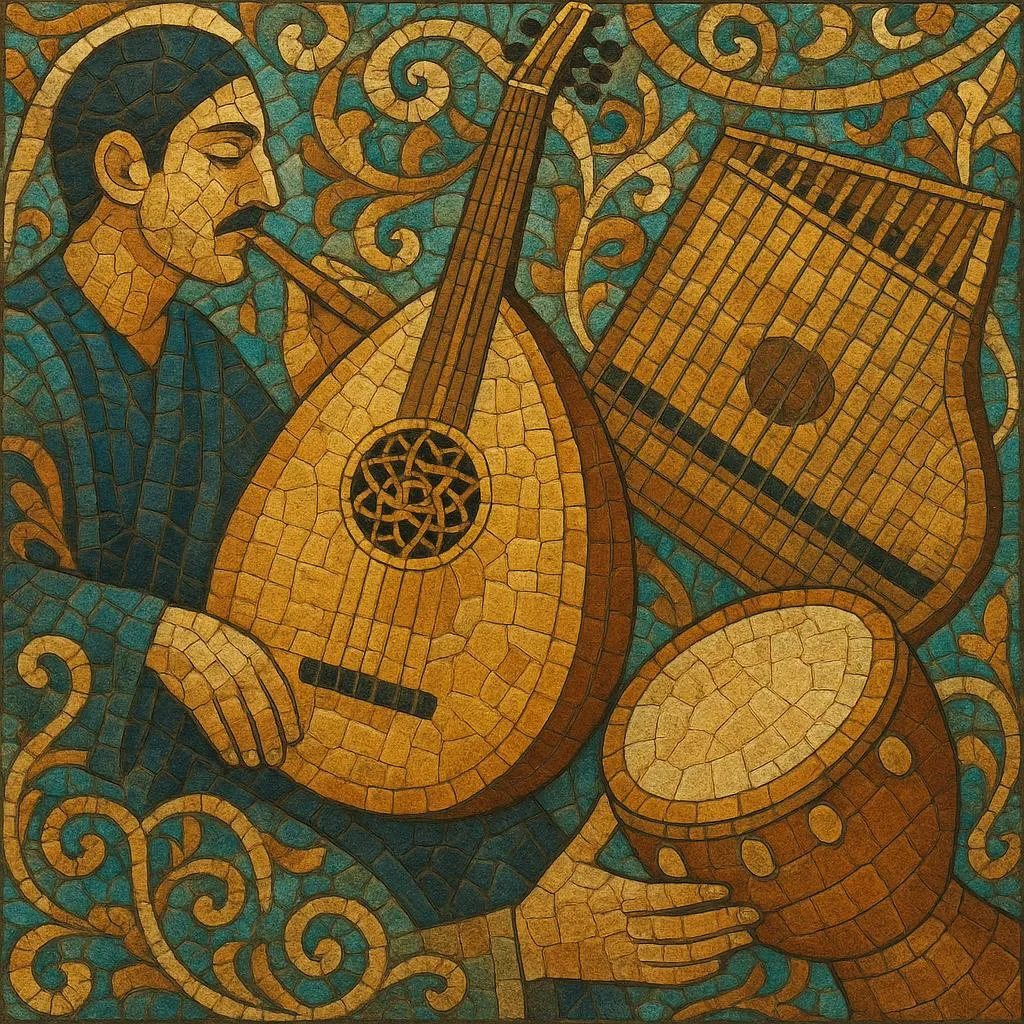
It centers on solo improvisations (taqsīm), chamber small-ensemble (takht) pieces, and composed instrumental forms such as samāʿī, bashraf, longa, dulāb, and tahmīla. Typical instruments include the oud (fretless lute), qanun (zither), nay (end-blown flute), violin adapted to Arabic intonation, riqq and darbuka (frame and goblet drums), along with bass and regional lutes (buzuq). While deeply rooted in 19th‑century Cairene, Syrian, Iraqi, and Ottoman-Arab court and urban music, the style has evolved to include orchestral film scores and modern jazz/electronic fusions—always retaining its maqām-based melodic grammar and heterophonic ensemble texture.
History
Instrumental practice in the Arab world matured out of courtly and urban repertoires in Cairo, Damascus, Aleppo, Baghdad, and across the Ottoman sphere. The small takht ensemble—oud, qanun, nay, violin, riqq—crystallized, and instrumental forms (samāʿī in 10/8, bashraf in even meters, longas in brisk 2/4, and short dulāb preludes) became concert staples. The modal grammar of maqām (built from ajnās, or tetrachordal segments) and microtonal intonation underpinned both composition and improvisation (taqsīm).
The 78‑rpm era captured taqsīm artistry and composed instrumental suites, often as preludes and interludes for star vocalists. Egyptian studios and radio cultivated large audiences for instrumental pieces, spreading standardized versions of iqāʿāt (rhythmic cycles) such as maqṣūm, baladī, waḥda, and masmūdī.
Radio orchestras and film studios in Egypt and the Levant expanded instrumental color with strings and winds while preserving maqām logic. Composers and virtuosi (e.g., Riyāḍ al‑Sunbāṭī, Farid al‑Atrash) wrote instrumental samāʿī and longas and featured taqsīm as set pieces. In Iraq, the oud school culminated in highly developed solo traditions linked to the Iraqi maqām.
Solo oud artistry was revitalized by Munir Bashir, Jamil Bashir, and Naseer Shamma. In parallel, Tunisian and Lebanese innovators (Anouar Brahem, Rabih Abou‑Khalil, Simon Shaheen) wove jazz, contemporary classical, and Mediterranean idioms into maqām-based instrumentals, bringing Arabic instrumental music to international concert halls and labels.
Modern projects range from historically informed takht to film/game scoring and ambient/electronic fusions. While production values and crossovers have broadened, the core identity—improvisation within maqām, rhythmic cycles, heterophony, and ornamented phrasing—remains the anchor that identifies the music as recognizably Arabic and instrumental.



