Your digging level for this genre

0/8
🏆
Sign in, then listen to this genre to level up

Description

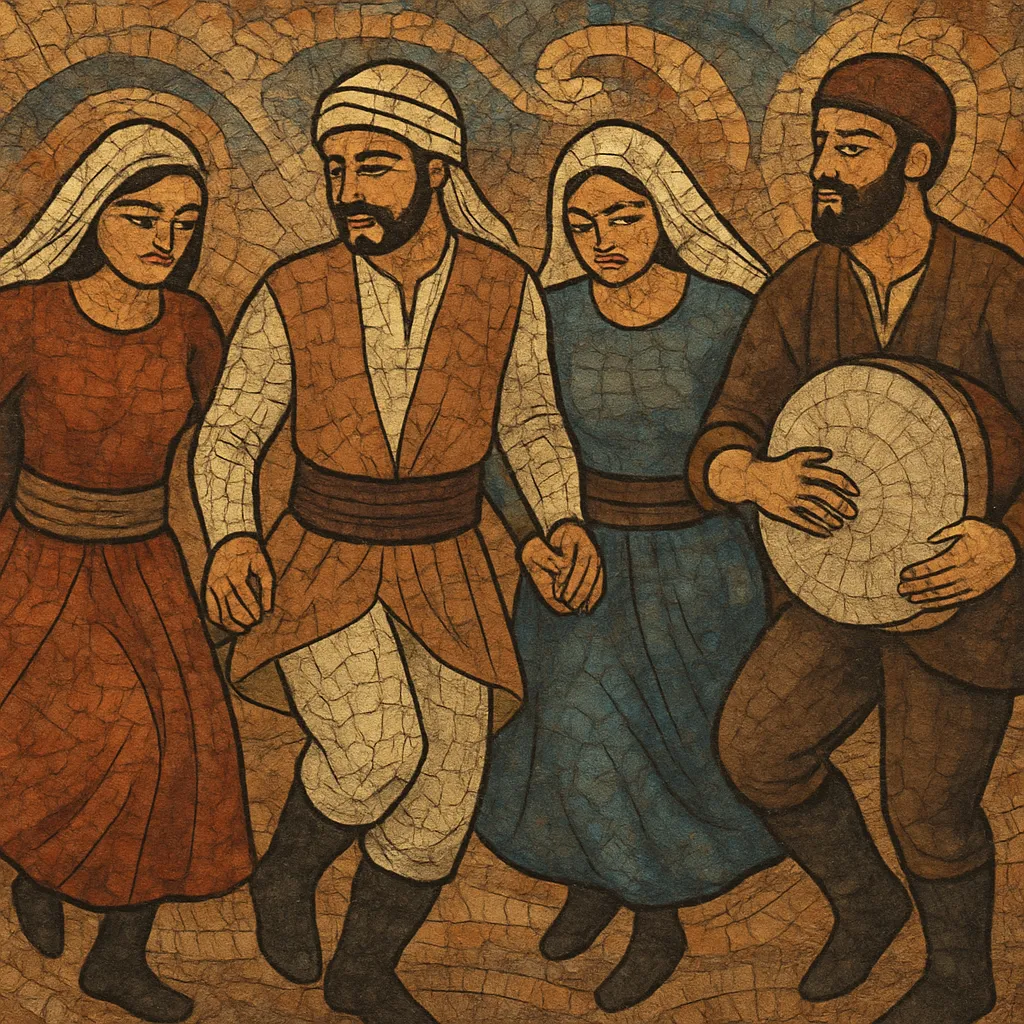
Dabke is a high‑energy Levantine line‑dance music associated with communal celebration, especially weddings and village festivals. It is driven by stomping rhythms and call‑and‑response vocals that cue and propel the dancers, who hold hands or shoulders in a line led by a raas (leader).

Musically, dabke sits in the Arabic maqam system, with melodies often built on Bayati, Hijaz, Kurd, or Nahawand. Traditional ensembles feature reed pipes such as the mijwiz and yarghul, piercing double‑reed zurna, and hand percussion like the darbuka (tabla), riqq, and daff. Since the late 20th century, electronic keyboards with quarter‑tone tuning have become central, creating the distinctive modern “wedding keyboard” sound that powers contemporary dabke‑pop and electro‑dabke.

History

Rural roots and early 20th‑century formation

Dabke emerged in the rural Levant (historically Greater Syria) as a communal line dance and accompanying music used to mark seasonal labor, house‑building, and life‑cycle celebrations. Its core musical elements—stomping pulse, responsorial singing, and modal melodies in the Arabic maqam system—coalesced into recognizable forms during the early 1900s as village traditions met urban theater and emerging recording/radio culture.

Mid‑century popularization

From the 1920s–1960s, urban orchestras and popular singers adapted dabke rhythms for stage and radio. In Lebanon and Syria, folkloric troupes standardized steps and costumes, while wedding bands blended traditional pipes (mijwiz/yarghul) and zurna with hand percussion, helping the genre travel across cities and diasporas.

Keyboard era and wedding circuits

By the 1980s–1990s, affordable electronic keyboards with quarter‑tone scales transformed the sound. Solo keyboardists and small ensembles dominated wedding circuits, especially in Syria, Lebanon, Palestine, and Jordan. The relentless 4/4 and 6/8 grooves, synth leads, and mic’d crowd hype shaped a modern, electrified dabke distinct from orchestral folkloric renditions.

Globalization and electro‑dabke

In the 2000s–2010s, artists and producers fused dabke with electronic dance music, rock, and hip hop, pushing it to international stages and clubs. This electro‑dabke/shamstep wave preserved the stomping groove and maqam flavor while embracing sequencers, bass, and global festival aesthetics, making dabke a symbol of Levantine identity and contemporary creativity.

How to make a track in this genre

Rhythm and groove
•   Start with a driving, danceable pulse. Common feels are 4/4 (around 95–115 BPM) and 6/8 (lilting, 120–150 BPM). Use maqsum/baladi‑type 4/4 patterns or a galloping 6/8 for traditional flair. •   Percussion anchors the energy: layer darbuka (dum–tek articulations), riqq for crisp accents, and daff/frame drum for body. Add handclaps and crowd calls to energize transitions.
Melody, scales, and phrasing
•   Compose in Arabic maqamat such as Bayati, Hijaz, Kurd, or Nahawand. Exploit microtonal degrees (e.g., the neutral third in Bayati) to keep the Levantine color. •   Write short, hooky motifs that can cycle for minutes, allowing dancers to lock in. Use call‑and‑response phrases (singer ↔ chorus or lead synth ↔ responses).
Instrumentation and timbre
•   Traditional colors: mijwiz/yarghul (buzzy reed pipes), zurna (piercing double‑reed), kawala/ney, plus hand percussion. •   Modern setup: a quarter‑tone‑capable arranger keyboard (e.g., Korg PA series) for leads, octave‑doubled synth hooks, and thick bass. Map custom scales to play maqam precisely. •   Sonic character: bright, nasal leads, occasional overdriven/chorused reed timbres, and a forward, mid‑rangy mix so the beat and melody cut through a loud hall.
Vocals and lyrics
•   Use colloquial Levantine Arabic, focusing on celebration, place, pride, weddings, and playful teasing. Incorporate a short mawwal (unmetered intro) to set the maqam. •   Integrate hype shouts and ululations (zalghouta) to cue dancers and lift sections.
Arrangement and performance tips
•   Structure in long grooves with gradual intensity ramps, periodic breaks, and re‑entries for the raas (line leader) to show steps. •   Alternate between 4/4 bangers and 6/8 numbers during a set. Use drum fills and shouted cues (e.g., “Yalla!”) to signal step changes. •   Keep the kick/dum tight with the dancers’ stomp; slight swung/back‑phrased percussion can enhance lift without losing precision.

Top tracks

Locked
Share your favorite track to unlock other users’ top tracks
Influenced by
Has influenced
Challenges
Digger Battle
Let's see who can find the best track in this genre
© 2025 Melodigging
Melodding was created as a tribute to Every Noise at Once, which inspired us to help curious minds keep digging into music's ever-evolving genres.
Buy me a coffee for Melodigging