Genres
Artists
Albums
Make Music
Sign in
Sign in
Artists
Choral
Artists
Choral
Frank Martin
1991
·
1 album
Listen
1
/5
Genres
Modern Classical
Modern classical is a contemporary strand of instrumental music that applies classical composition techniques to intimate, cinematic settings. It typically foregrounds piano and strings, is sparsely orchestrated, and embraces ambience, repetition, and timbral detail. Rather than the academic modernism of the early 20th century, modern classical as used today refers to accessible, mood-driven works that sit between classical, ambient, and film music. Felt pianos, close‑miked string quartets, tape hiss, drones, soft electronics, and minimal harmonic movement are common, producing a contemplative, emotionally direct sound that translates well to headphones, streaming playlists, and screen media.
Discover
Listen
Contemporary Classical
Contemporary classical is the broad field of Western art music created after World War II. It embraces an array of aesthetics—from serialism and indeterminacy to minimalism, spectralism, electroacoustic practices, and post‑tonal lyricism—while retaining a concern for notated composition and timbral innovation. Unlike the unified styles of earlier eras, contemporary classical is pluralistic. Composers freely mix acoustic and electronic sound, expand instrumental techniques, adopt non‑Western tuning and rhythm, and explore new forms, from process-based structures to open and graphic scores. The result is a music that can be rigorously complex or radically simple, technologically experimental or intimately acoustic, yet consistently focused on extending how musical time, timbre, and form can be shaped.
Discover
Listen
Classical Piano Duo
Classical piano duo refers to repertoire and performance for two pianists, either at one instrument (piano four hands: primo and secondo sharing a single keyboard) or at two instruments (two‑piano literature). The genre grew out of late‑18th‑century domestic music-making and salon culture, then blossomed in the 19th century when composers treated the medium as both an intimate chamber vehicle and a symphonic surrogate. Its sound world ranges from delicate, interlocking textures to orchestral power and color achieved through doubled keyboards. Core repertoire spans Mozart and Schubert’s four‑hand fantasies and sonatas; Romantic dances and transcriptions by Brahms, Dvořák, and others; and 20th‑century originals by Ravel, Debussy, Stravinsky, Rachmaninoff, Poulenc, Lutosławski, Shostakovich, Reich, and Ligeti. Today, piano duos commission new works, revive historic transcriptions, and bring orchestral canvases to the recital stage.
Discover
Listen
Classical
Classical music is the notated art-music tradition of Europe and its global descendants, characterized by durable forms, carefully codified harmony and counterpoint, and a literate score-based practice. The term “classical” can refer broadly to the entire Western art-music lineage from the Medieval era to today, not just the Classical period (c. 1750s–1820s). It privileges long-form structures (such as symphonies, sonatas, concertos, masses, and operas), functional or modal harmony, thematic development, and timbral nuance across ensembles ranging from solo instruments to full orchestras and choirs. Across centuries, the style evolved from chant and modal polyphony to tonal harmony, and later to post-tonal idioms, while maintaining a shared emphasis on written notation, performance practice, and craft.
Discover
Listen
Choral
Choral refers to music written for and performed by a choir—an ensemble of voices organized into sections such as soprano, alto, tenor, and bass (SATB), or same-voice groupings (SSA, TTBB). It encompasses both sacred and secular repertoire and may be sung a cappella or with accompaniment by organ, piano, or full orchestra. Stylistically, choral music ranges from chant-like monophony to intricate polyphony and rich homophonic textures. Texts are drawn from liturgy, scripture, poetry, and vernacular sources, and are set in many languages. Performance contexts include church services, concert halls, and community events, making choral one of the most socially embedded and widely practiced forms of ensemble music. Across history, choral music has served as a laboratory for vocal counterpoint, word painting, and text-driven form, while functioning as a cultural bridge among religious rites, national traditions, and contemporary concert practice.
Discover
Listen
Albums
1991
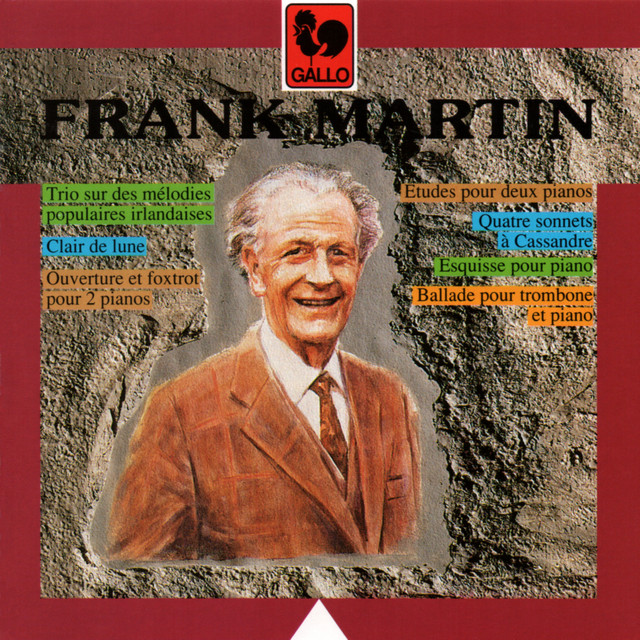
Frank Martin: Etudes - Clair de lune - Quatre sonnets à Cassandre - Esquisse - Trio sur des mélodies populaires irlanda…
Frank Martin, Duo Beer-Sheva
Classical Piano Duo
Similar artists
3
/5
Igor Stravinsky
Ballet
Neoclassicism
Classical
3
/5
Arvo Pärt
Minimalism
Classical
Holy Minimalism
3
/5
Kronos Quartet
Classical
Chamber Music
Latin American Classical Music
2
/5
Alfred Schnittke
Classical
Choral Concerto
Chamber Music
2
/5
György Ligeti
Classical
Avant-Garde
Electroacoustic
4
/5
Johann Sebastian Bach
Baroque
Classical
Baroque Suite
4
/5
Wolfgang Amadeus Mozart
Classical
Requiem
Classical Period
4
/5
Berliner Philharmoniker
Classical
Symphony
Romantic Classical
4
/5
Herbert von Karajan
Classical
Symphonic Poem
Symphony
4
/5
Johannes Brahms
Classical Clarinet
Classical Piano Quartet
Concerto
Download our mobile app
Get the Melodigging app and start digging for new genres on the go
Download on the App Store
Get it on Google Play
© 2026 Melodigging
Give feedback
Legal
Melodding was created as a tribute to
Every Noise at Once
, which inspired us to help curious minds keep digging into music's ever-evolving genres.