Your digging level
Description
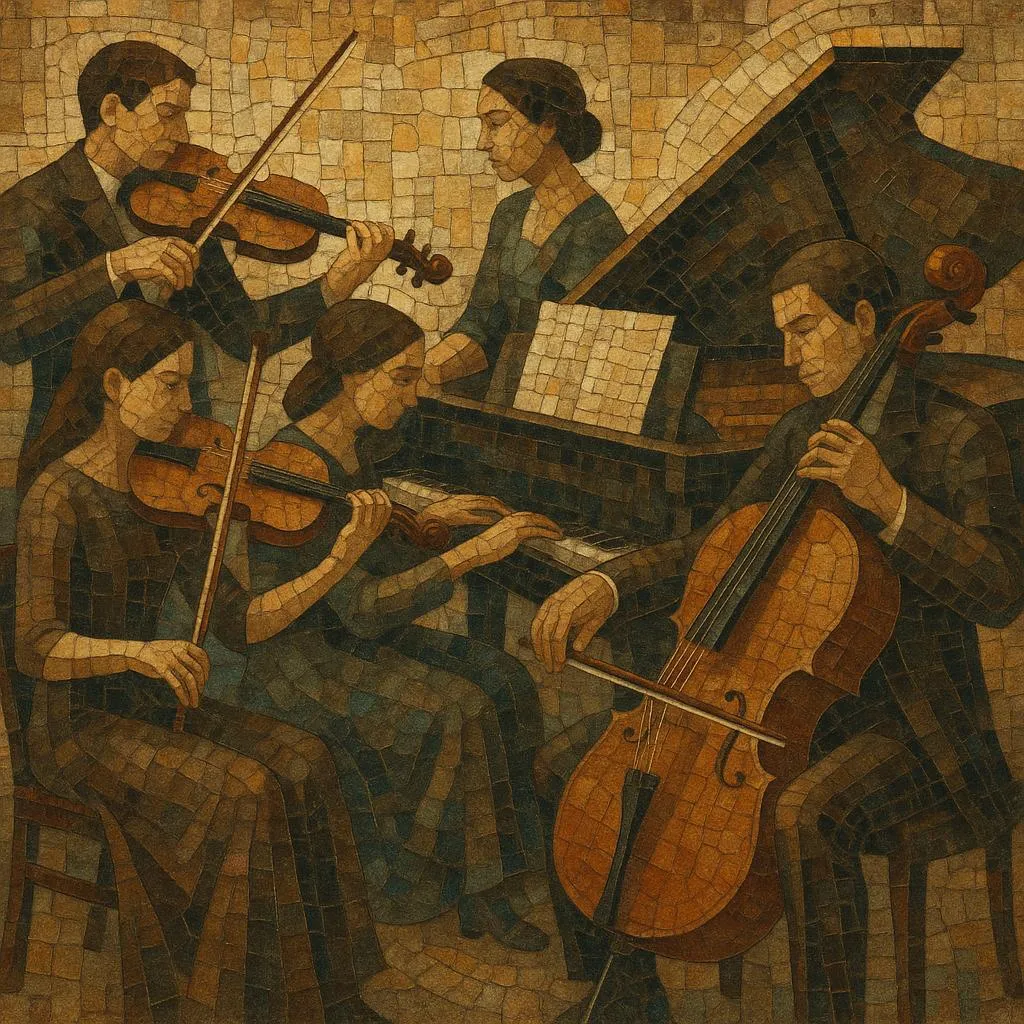
The classical piano quartet is a chamber music genre typically scored for a specific ensemble: one piano and a string trio consisting of a violin, a viola, and a cello.
Unlike the piano trio, the addition of the viola adds a rich middle register, allowing for denser textures and a more symphonic sound palette while maintaining the intimacy of chamber music. The genre demands a careful balance between the powerful, percussive nature of the piano and the sustained, lyrical qualities of the string instruments.
History
The piano quartet emerged in the mid-to-late 18th century. Early examples were often 'accompanied sonatas' where the strings played a subordinate role to the keyboard. However, Wolfgang Amadeus Mozart transformed the genre in 1785 with his Quartet in G minor (K. 478), treating all four instruments as equal partners. This shifted the genre from domestic entertainment to serious concert music.
During the 19th century, the genre flourished as composers sought more expressive and expansive forms. Robert Schumann's Op. 47 (1842) became a model for integrating the piano with strings in a song-like, romantic style. Johannes Brahms later contributed three massive works that pushed the technical and emotional boundaries of the ensemble, introducing symphonic density and Hungarian folk influences.
In France, Gabriel Fauré composed two highly regarded quartets that emphasized color, fluidity, and modal harmonies, distinct from the Germanic tradition. The genre continued to be a vehicle for profound expression into the late 19th and early 20th centuries with contributions from composers like Dvořák and Mahler.
The standard lineup is Piano, Violin, Viola, and Cello. The primary challenge is balancing the piano's volume with the strings. To achieve this, avoid writing thick chords in the piano's middle register when strings are playing low or mid-range melodies. Use the piano's extreme registers (deep bass octaves or sparkling high treble) to leave sonic space for the strings.
Treat the ensemble as a conversation among equals. The strings can play in unison to counter the piano's weight, or engage in contrapuntal dialogue. The piano can function as a rhythmic engine, a melodic soloist, or a harmonic bed. Alternating between 'piano vs. strings' and 'tutti' textures creates necessary contrast.
Follow the traditional four-movement structure:
-
•
Allegro: A fast opening movement in Sonata form.
•Slow Movement: An Adagio or Andante focusing on lyricism and expression.
•Scherzo or Minuet: A rhythmic, dance-like movement (often in 3/4 time).
•Finale: A fast, energetic conclusion, often a Rondo or Sonata-Rondo.