Your digging level
Description
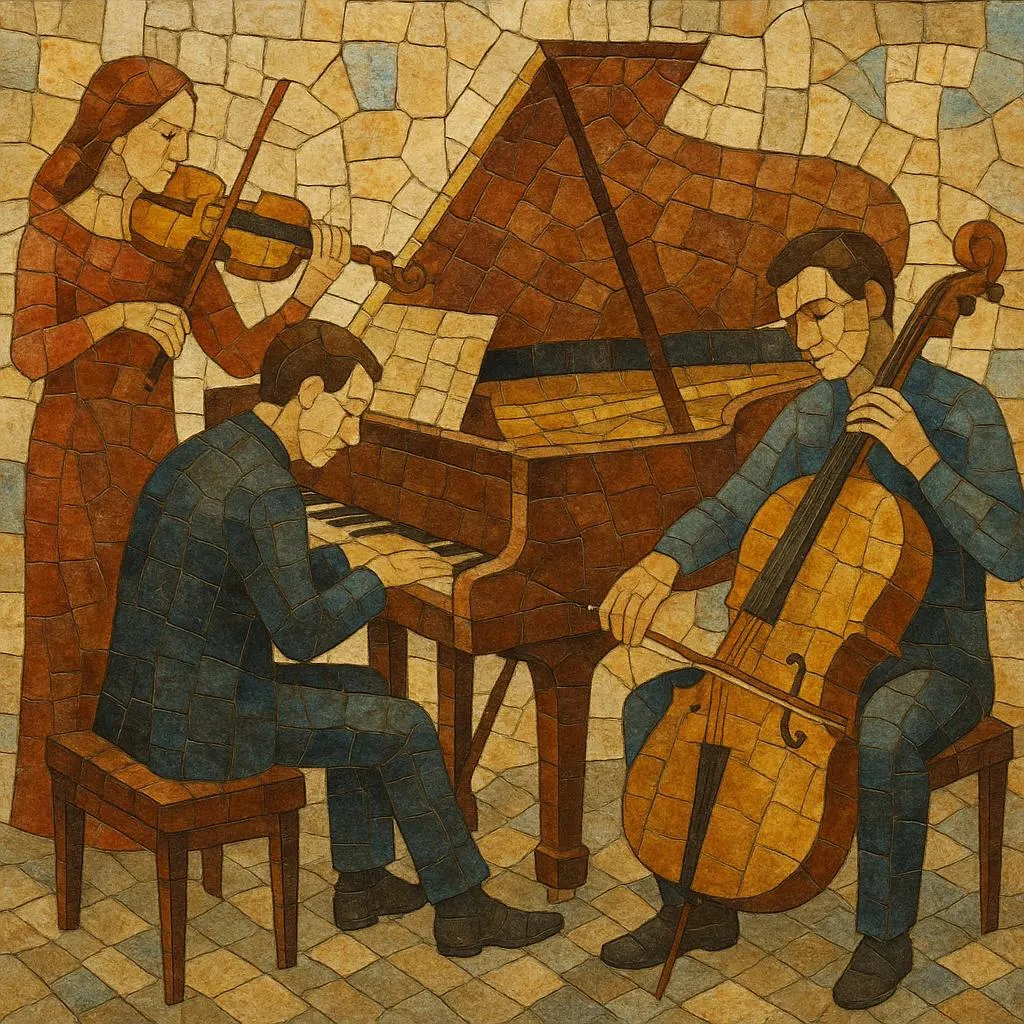
The classical piano trio is a chamber-music genre written for three performers: piano, violin, and cello.
It typically balances lyrical string writing with a harmonically and rhythmically active piano part, moving beyond “keyboard with accompaniment” into true conversational chamber texture.
The core repertoire is rooted in European art music and is most closely associated with the Classical and Romantic eras, though composers continue to write piano trios in modern and contemporary idioms.
Standard works are usually multi-movement (often 3–4 movements) and use forms such as sonata form, theme and variations, scherzo/minuet, and rondo, while later works may use cyclic form, extended techniques, or post-tonal harmony.
History
Early piano trios grew out of domestic keyboard traditions in which the piano carried the principal material and the strings doubled or lightly colored the texture.
Over the later 18th century, composers—especially in the Viennese sphere—developed the trio into a balanced chamber genre, granting the violin and cello more independent lines and giving the ensemble a conversational, motivically driven style.
In the 19th century the piano trio expanded in expressive range, harmonic color, and virtuosity.
The piano part often became more orchestral (wide registers, denser textures), while strings gained singing themes, dramatic counterpoint, and heightened dialogue.
Large-scale structures, cyclical thematic recall, and national stylistic fingerprints became more common.
Composers pushed the piano trio toward sharper rhythmic profiles, new harmonic languages (modal, extended tonality, atonality), and more transparent or highly contrasted textures.
The trio became a flexible medium for experimentation while still preserving classical chamber principles: clarity of line, motivic development, and ensemble interplay.
Today the piano trio remains a central chamber format, spanning neo-classical, post-minimal, spectral, and eclectic approaches.
Performers also commission new works and program older repertoire alongside modern pieces, keeping the genre active both in concert halls and recordings.
Avoid treating strings as constant doublings of the right hand; instead:
•Use imitation/counterpoint (motives passed between all three).
•Create call-and-response phrasing between piano and strings.
•Employ register separation (cello as tenor, violin as soprano, piano bridging or opposing).
•Use piano reduction moments (thin textures) so string lines speak with clarity.