

Your digging level
Description
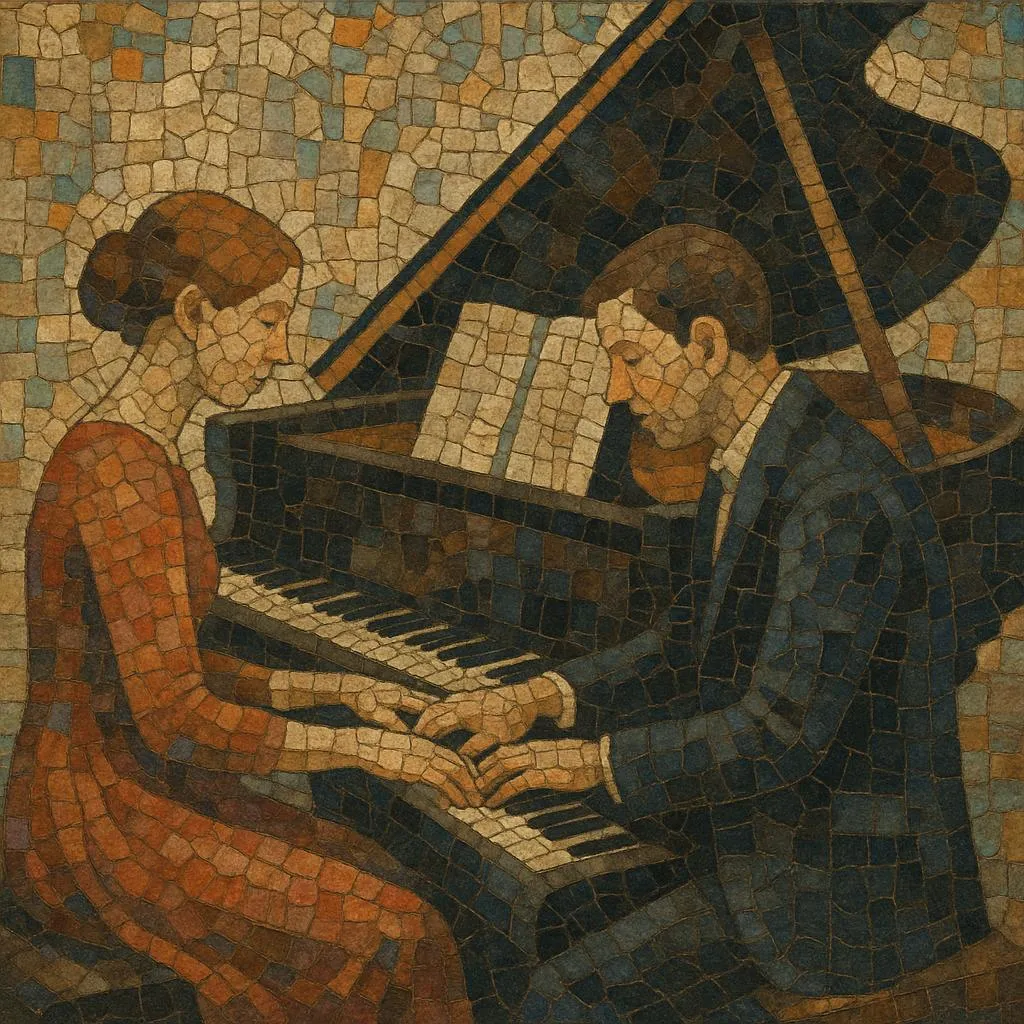
Classical piano duo refers to repertoire and performance for two pianists, either at one instrument (piano four hands: primo and secondo sharing a single keyboard) or at two instruments (two‑piano literature).
The genre grew out of late‑18th‑century domestic music-making and salon culture, then blossomed in the 19th century when composers treated the medium as both an intimate chamber vehicle and a symphonic surrogate. Its sound world ranges from delicate, interlocking textures to orchestral power and color achieved through doubled keyboards.
Core repertoire spans Mozart and Schubert’s four‑hand fantasies and sonatas; Romantic dances and transcriptions by Brahms, Dvořák, and others; and 20th‑century originals by Ravel, Debussy, Stravinsky, Rachmaninoff, Poulenc, Lutosławski, Shostakovich, Reich, and Ligeti. Today, piano duos commission new works, revive historic transcriptions, and bring orchestral canvases to the recital stage.
History
Piano four hands emerged in the 1770s within Austrian and German domestic music-making. Mozart’s multi-movement sonatas for four hands set an early benchmark, exploiting antiphony, crossed hands, and conversational counterpoint. The medium offered social intimacy and a practical way to experience large forms at home.
With the rise of the modern piano and middle-class salons, four-hand publications exploded. Schubert’s Fantasia in F minor (D.940) epitomized the genre’s lyric breadth and symphonic scope. Composers like Brahms and Dvořák supplied dances and character pieces that were both pedagogical and artistically substantial. Two‑piano repertoire also gained ground, enabling greater power, register separation, and orchestral color.
Throughout the 19th century, piano-duo transcriptions of symphonies, operas, and ballets circulated widely, functioning as portable orchestras and spreading new music before recordings existed. This tradition continued into the 20th century, with duos presenting Stravinsky and other moderns in piano reductions and original two‑piano formats.
Ravel and Debussy revitalized four‑hand color; Rachmaninoff, Poulenc, and Lutosławski wrote virtuoso two‑piano showpieces; and Stravinsky, Ligeti, and Reich extended rhythmic and timbral frontiers. In the later 20th and 21st centuries, dedicated duos—often familial or long-term partnerships—commissioned new works, explored historically informed practices on period instruments, and integrated multimedia or cross-genre collaborations, securing the piano duo as a core chamber genre.



