Your digging level
Description
Latin folk is a broad umbrella for singer‑songwriter and ensemble music that draws on traditional folk forms from across Latin America while presenting them in contemporary, often acoustically driven arrangements.
It emphasizes storytelling, social and poetic lyricism, and the timbres of regional instruments such as the guitar, charango, quena, zampoña, cuatro, and bombo legüero. Rhythmic cells are borrowed from pan‑regional traditions (chacarera, cueca, zamba, huayno, joropo, son, and others), yet songs are commonly shaped in accessible verse‑chorus structures.
While its roots are centuries old, the modern genre coalesced during the mid‑20th‑century folk revival and the Nueva Canción movements, which linked ancestral sounds with contemporary concerns such as identity, justice, and cultural memory.
History
Latin folk emerges from the confluence of Indigenous, Afro‑Latin, and Iberian folk traditions that took shape from the colonial era onward. These streams produced regionally distinct song forms (e.g., huayno in the Andes, cueca and zamba in the Southern Cone, son in Cuba, joropo in Venezuela, and bambuco in Colombia), each with characteristic rhythms, instruments, and poetic structures.
In the 1950s–1960s, a conscious revival of traditional repertoire and instruments swept through several countries. In Chile, Violeta Parra documented and popularized rural song, catalyzing a scene that soon nurtured artists and ensembles who modernized folk idioms for urban audiences. Parallel movements unfolded in Argentina’s folklore boom and in Peru, Bolivia, Mexico, and Cuba, where collectors, performers, and broadcasters elevated local traditions.
By the 1960s–1970s, Nueva Canción in Chile, Argentina, and Uruguay fused folk forms with contemporary social commentary. Groups such as Inti‑Illimani and Quilapayún, and voices like Víctor Jara and Mercedes Sosa, combined charango, quena, bombo legüero, and polyphonic vocals with songs addressing justice, dignity, and cultural roots. This wave codified the modern idea of "Latin folk" as a pan‑regional, artist‑led style that was both traditional and forward‑looking.
From the late 20th century onward, Latin folk diversified—interfacing with pop, rock, and indie scenes while maintaining acoustic cores and regional rhythms. Contemporary artists reinterpreted standards, collaborated across borders, and integrated new production aesthetics, bringing Latin folk to international festivals, film soundtracks, and crossover charts without losing its connection to place, memory, and community.
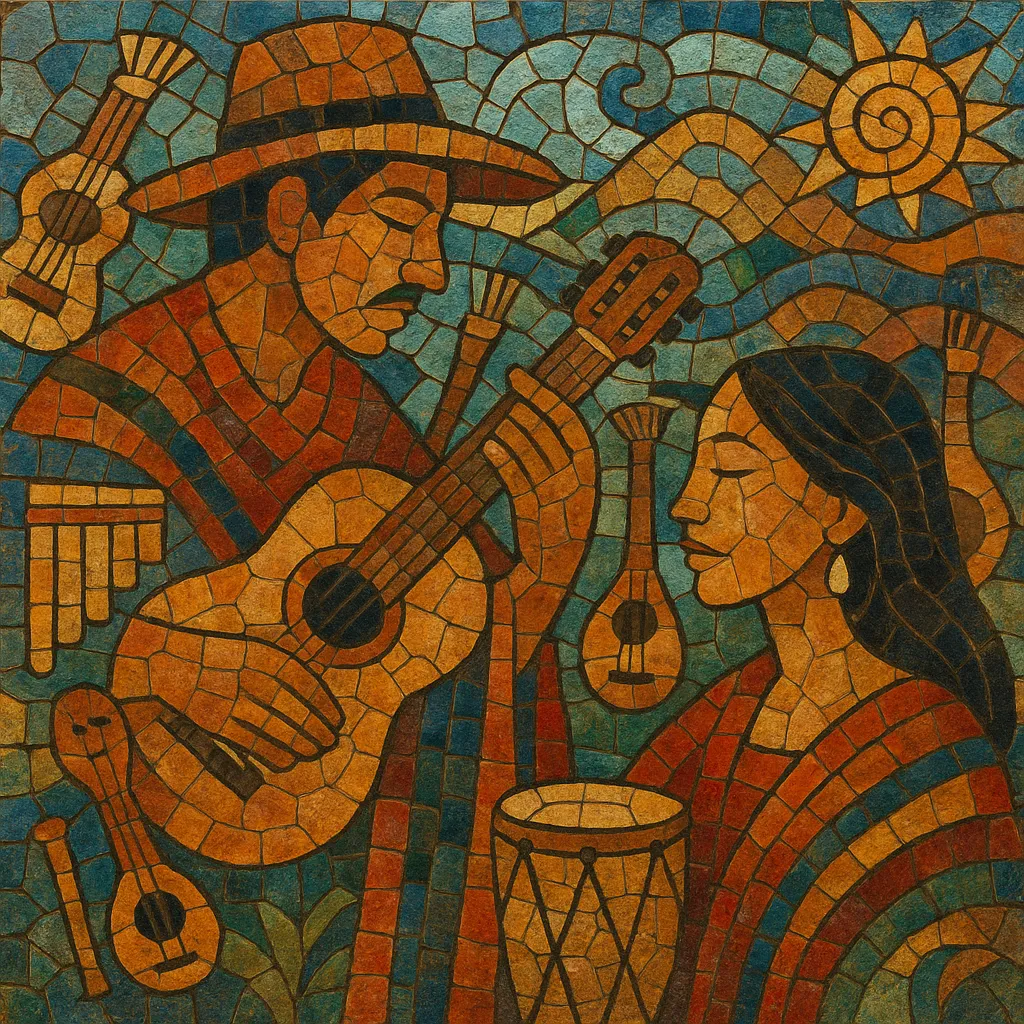
Start with an acoustic core: nylon‑string guitar and voice. Add regional colors with charango (Andean lute), quena and zampoña (panpipes), cuatro (Venezuela/Puerto Rico), tiple (Andean regions), bombo legüero and cajón, hand percussion (maracas, güiro), and occasional harp or bandola.
Borrow rhythm cells from traditional forms: chacarera (hemiola interplay of 6/8 over 3/4), zamba (lilting 6/8), cueca (dance‑call patterns), huayno (upbeat 2/4 with anticipations), joropo (driving harp‑cuatro‑maracas syncopation), and son (clave‑based phrasing). Keep grooves organic—use strummed patterns, arpeggios, and light percussion that serve the lyric.
Favor diatonic harmonies with modal inflections (Dorian/Aeolian touches) and cadence variations drawn from folk guitar vocabulary (I–V–I, I–IV–V, and I–bVII–IV in modal contexts). Melodies should be singable, often pentatonic or narrow‑range for strophic verses, with ornamentation (grace notes, appoggiaturas) reflecting local styles.
Write narrative, image‑rich lyrics about land, memory, love, daily life, and social conscience. Use strophic forms with refrains, décimas or coplas where appropriate, and call‑and‑response in dance‑derived pieces. Spanish is common, but incorporate Indigenous languages or regional lexicon for authenticity.
Prioritize intimate, front‑of‑mix vocals; double with light harmonies. Mic acoustic instruments closely to capture wood and breath. Avoid heavy processing; subtle room reverb and stereo imaging help preserve warmth. Modern hybrids can add understated bass, strings, or indie/ambient textures without masking the folk heartbeat.

Top albums