Your digging level
Description
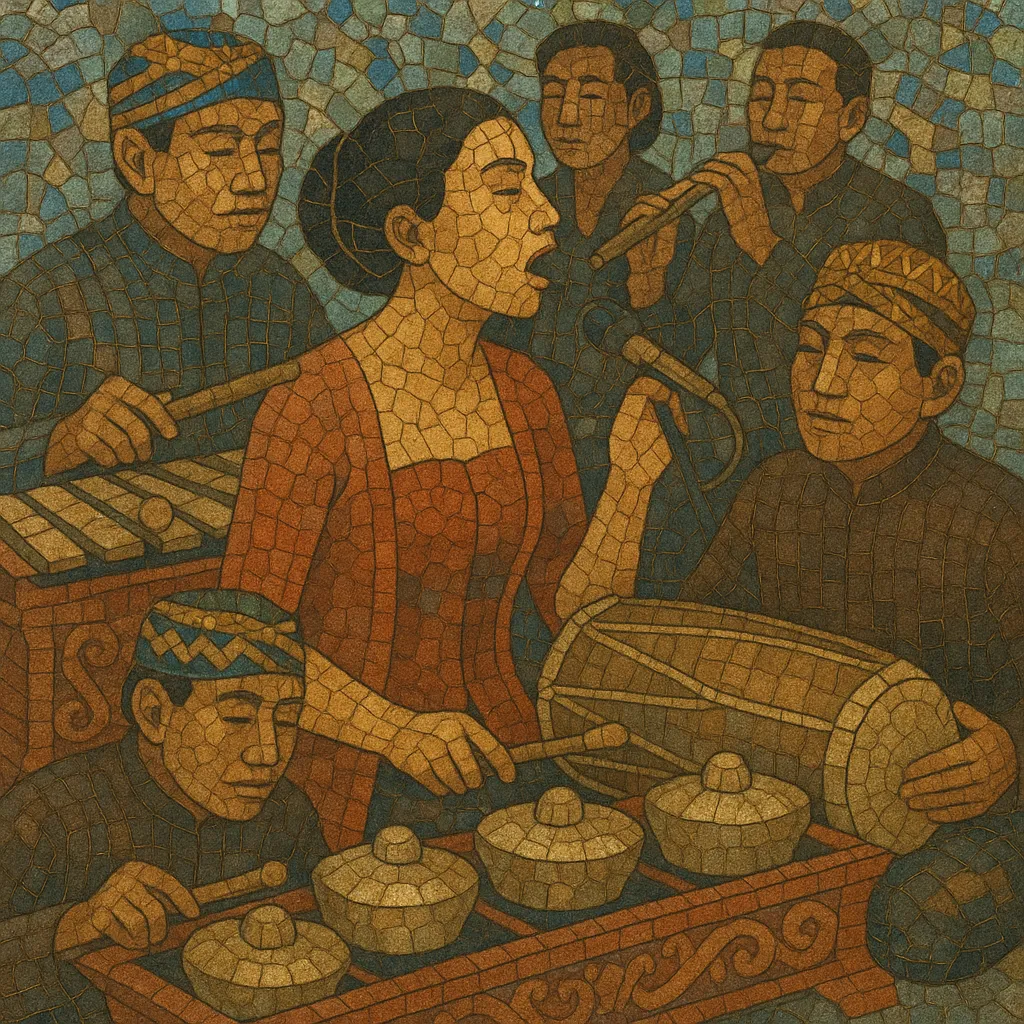
Javanese gamelan is a refined court-centered musical tradition from Central Java, Indonesia, performed by an ensemble of bronze gongs, metallophones, drums, and soft-sounding string and wind instruments.
It is distinguished by its two tuning systems—sléndro (five-note) and pèlog (seven-note)—and by modal frameworks called pathet. Music unfolds in cyclical, colotomic structures articulated by gongs, with a core melody (balungan) elaborated by an interlocking web of instruments and guided in tempo and character by the drummer (kendhang) and the leader (pengendhang).
Aesthetic values emphasize alus (refinement), balance, and flexibility of density through irama levels. The repertoire encompasses court dances, wayang (shadow theater), liturgical palace ceremonies, and concert forms, featuring male chorus (gerong) and a solo female singer (pesindhen) who float above the instrumental texture.
History
Gamelan practice on Java has deep roots in indigenous Austronesian gong-chime traditions, enriched over centuries by Hindu-Buddhist court culture. Archaeological and textual evidence points to ensemble gong practices by the 8th–9th centuries CE, associated with temple ritual and royal ceremony.
The modern Javanese gamelan idiom was codified in the royal courts of Yogyakarta and Surakarta after the mid-18th century. Here, metallophone families, large hanging gongs (gong ageng), and drums (kendhang) were standardized, and concepts of pathet (modal affect) and irama (tempo-density relations) were formalized. Cipher notation (kepatihan) emerged in the 19th century as a pedagogical aid for preserving and teaching the extensive repertoire (gendhing).
During the late colonial period, court and village ensembles flourished in parallel, serving wayang kulit (shadow theater), dance, and civic ritual. Early recordings and radio broadcasts helped disseminate styles beyond palace walls. National cultural institutions established in Surakarta and Yogyakarta professionalized training and documentation.
From the mid-20th century, Javanese masters collaborated with scholars and composers worldwide, fostering ensembles at universities and cultural centers. New composition (gamelan kontemporer) expanded timbres and form while honoring colotomic cycles and pathet logic. Today, Javanese gamelan thrives in courts, conservatories, and global communities, influencing minimalist and ambient aesthetics and continuing to accompany wayang, dance, and concert performance.

Top albums
%20Orchestra%20-%20Kl%C3%AAn%C3%AAngan%20Session%20of%20Solonese%20Gam%C3%AAlan%20I%2C%20Cover%20art.webp)