Your digging level
Description
Southeast Asian post-rock is a regional strain of instrumental, cinematic rock that blends the slow-burn dynamics and textural layering of post-rock with rhythmic cycles, timbres, and modal colors drawn from Southeast Asia.
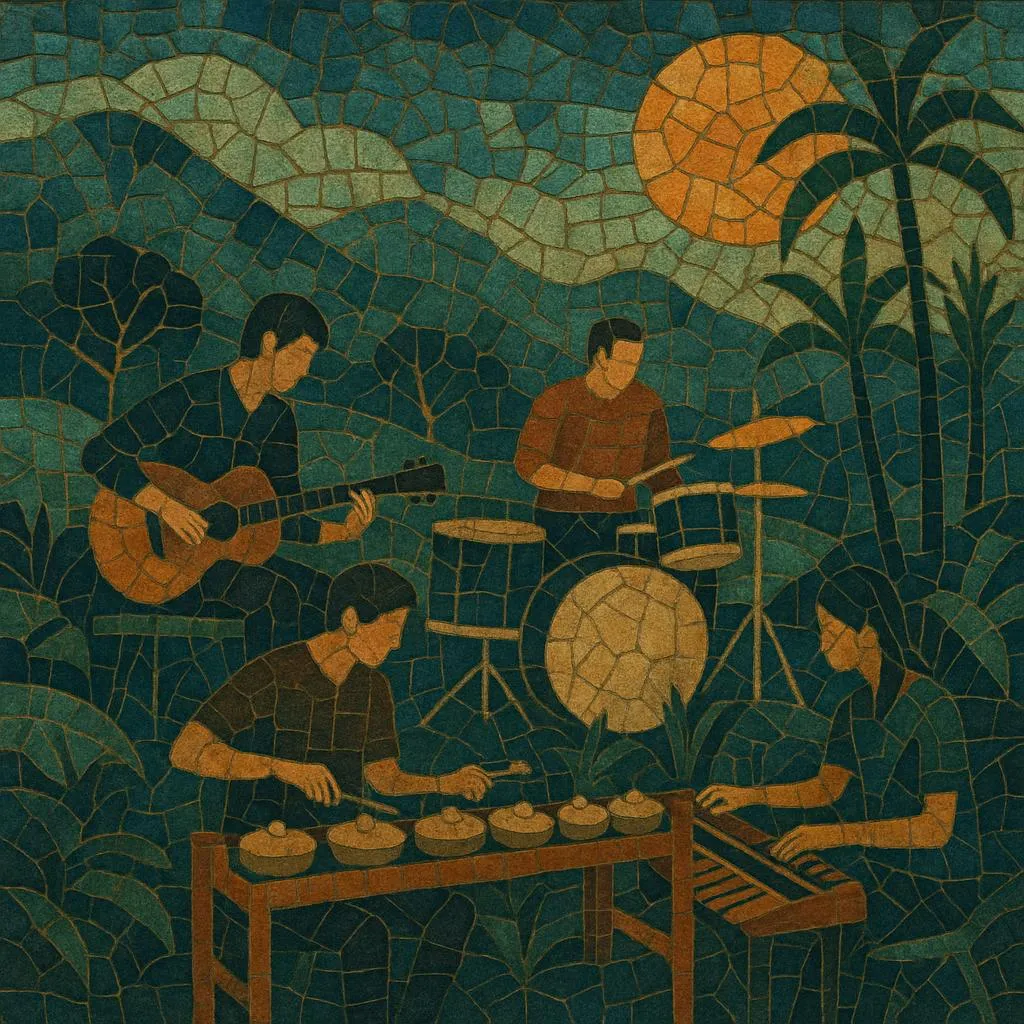
Bands typically build long-form crescendos with interlocking guitar ostinati, roomy drums, and expansive reverbs, while weaving in local instruments (e.g., gamelan metallophones, kulintang, angklung) or evoking them through prepared guitar techniques and bell-like delay lines. Field recordings (monsoon rain, street markets, temple ambience) and modal inflections from pelog/slendro, pentatonic, or folk scales give the music a sense of place without abandoning the idiom’s global vocabulary.
The result is a spacious, emotionally resonant sound—at once familiar to fans of classic post-rock and distinctly Southeast Asian in groove, color, and atmosphere.
History
Post-rock’s global spread in the late 1990s found early adopters in Malaysia, Singapore, Thailand, Indonesia, and the Philippines. Local DIY circles, university gigs, and nascent indie festivals provided the first stages, while web forums, MySpace, and blog culture connected musicians across borders. Early Malaysian and Singaporean outfits, along with Thai and Indonesian collectives, adapted the crescendo-driven template to local rhythms and a warmer, more humid sound palette.
Through the 2010s, regional festivals and showcases (e.g., city arts festivals, indie weekenders, and government-supported music platforms) helped codify a scene. Independent labels and promoters fostered tours between Kuala Lumpur, Singapore, Bangkok, Jakarta, Manila, and Ho Chi Minh City, encouraging a shared aesthetic: long-form instrumentals, modal color from pelog/slendro and pentatonic scales, and subtle use of indigenous instruments or their timbral analogues. Recording quality rose, and post-rock began to intermingle with math rock, ambient, and shoegaze—often on the same bills.
Rather than overt fusion, many bands localize through feel: cyclical ostinati that echo gamelan interlocking, gong-like swells via ebows and volume pedals, and percussive patterns hinting at kulintang or kendang heuristics. Field recordings and location-based composition further situate the music in Southeast Asian urban and natural soundscapes.
Streaming-era discovery broadened the audience, while cross-genre collaboration (with electronic producers, modern classical ensembles, and visual artists) expanded the idiom. Country-specific micro-scenes (Thai post-rock, Indonesian experimental/post-rock hybrids, Singapore’s polished instrumental rock) continue to feed a regionally coherent but stylistically diverse movement.