Your digging level
Description
An early music ensemble is a specialized vocal, instrumental, or mixed group devoted to the historically informed performance of Medieval, Renaissance, and Baroque repertoires (roughly before 1750).
These ensembles typically use period instruments (or accurate reconstructions), historical tunings and temperaments, and performance practices derived from primary sources and treatises. Their goal is not a museum-like re‑creation but a living, stylistically grounded interpretation that clarifies texture, rhythm, rhetoric, and the soundworlds of earlier eras.
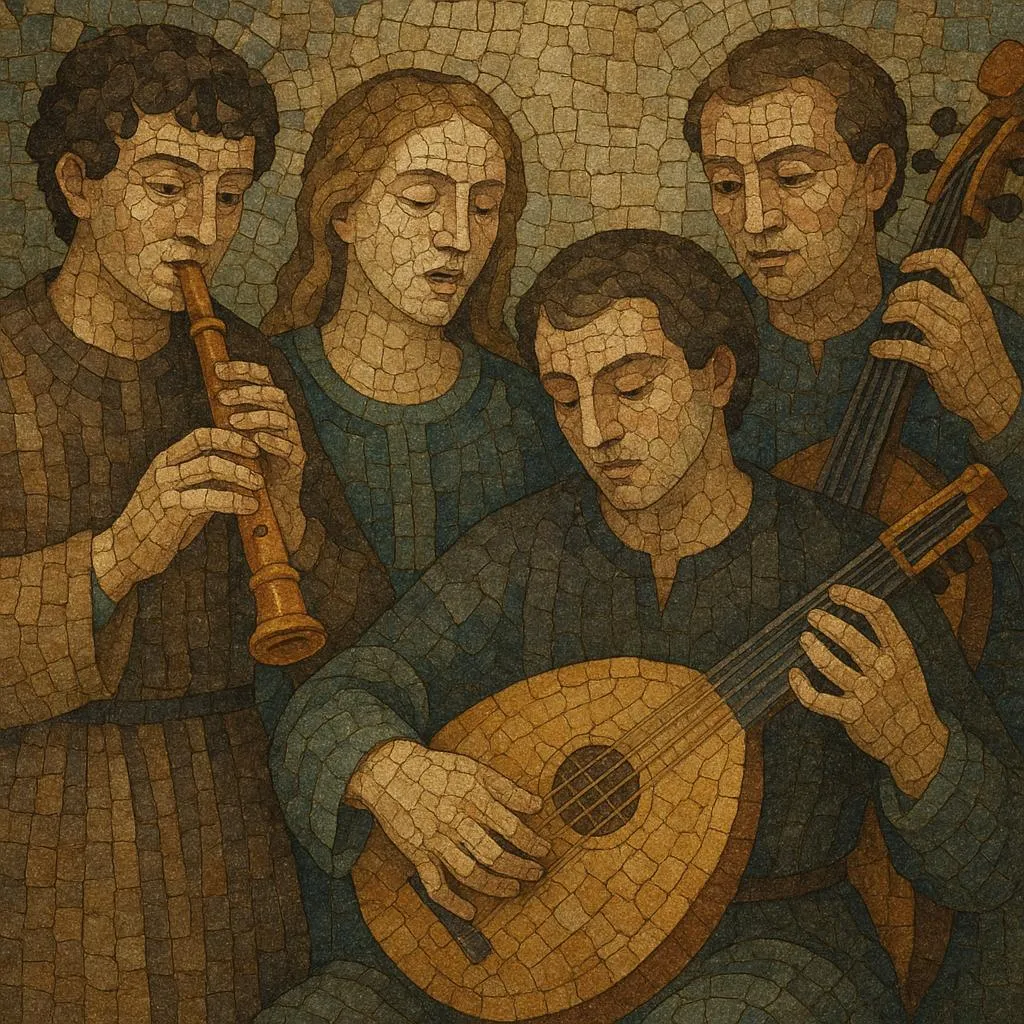
Line‑ups range from small consorts (e.g., viols, recorders, lutes) to chamber orchestras with continuo groups, and from one‑to‑a‑part vocal consorts to medium‑sized choirs for larger polyphonic or Baroque works.
History
Scholarly curiosity about pre‑Classical repertoires goes back to the 19th century, but modern ensemble‑based revival took shape in the early 20th century through figures like Arnold Dolmetsch in Britain, who promoted consort playing on viols and recorders and advocated building and using historical instruments.
After World War II, dedicated ensembles coalesced around historical methods. Pioneers such as Nikolaus Harnoncourt (Concentus Musicus Wien), Gustav Leonhardt, and Frans Brüggen (in the German‑speaking and Dutch spheres) and British counterparts like David Munrow and, soon after, Christopher Hogwood and Trevor Pinnock, established a repertoire and sound ideal grounded in sources. The adoption of period strings, gut frets, historical woodwinds, cornetts and sackbuts, lutes and theorbos, and chamber organs distinguished these groups from modern symphonic practice.
The movement broadened stylistically and geographically. Ensembles like The English Concert, The Academy of Ancient Music, The Tallis Scholars, The Hilliard Ensemble, Les Arts Florissants, Hespèrion XX/XXI, Musica Antiqua Köln, and Sequentia brought Medieval chant and song, Renaissance polyphony, and Baroque opera/oratorio to global audiences. Historically informed performance (HIP) principles began to influence mainstream orchestras and conservatories, reshaping articulation, vibrato, tempi, and phrasing even on modern instruments.
Today, early music ensembles range from one‑to‑a‑part vocal consorts to flexible Baroque orchestras. They explore newly edited sources, historically contingent tunings (A≈392/415/430/466), varied temperaments, and performance rhetorics drawn from period treatises (Praetorius, Quantz, C. P. E. Bach, Mersenne, among others). Repertoire extends from medieval liturgical dramas to Monteverdi and Handel operas, from Iberian polyphony to central European sacred works, and into collaborations that frame early repertoires for contemporary listeners while remaining source‑faithful.