Your digging level
Description
Turkic-Mongolic music is a broad family of Inner Asian musical traditions shaped by nomadic lifeways across the steppe, taiga, and desert zones from Mongolia and Siberia to Xinjiang and Central Asia. It emphasizes timbre, overtone color, and modal melody over dense harmony, often centering a drone or open fifths with anhemitonic pentatonic contour.
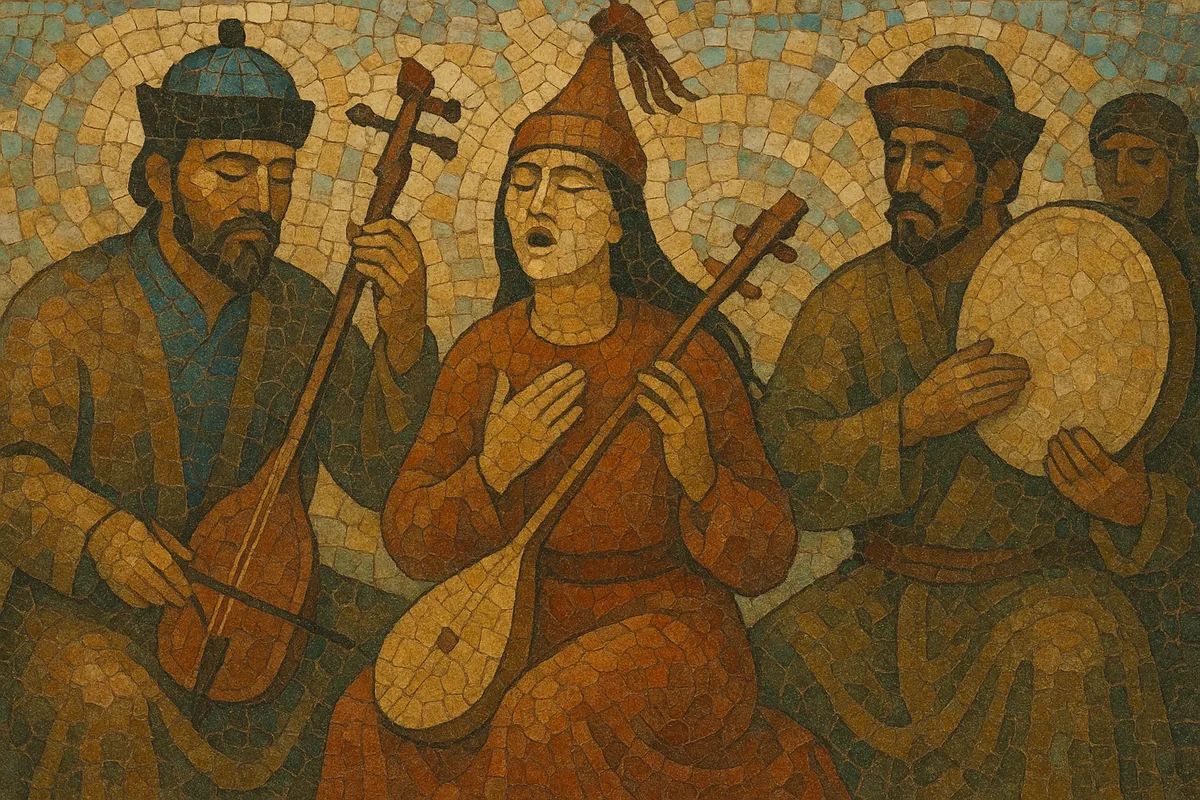
Characteristic practices include overtone (throat) singing, epic chant, long-song with free rhythm, and dance songs with “galloping” rhythms that mimic horse movement. Common instruments include horse-head fiddles (morin khuur), two-string lutes (igil, topshuur, dombra, komuz), frame and shaman drums, and jaw harps (khomus/temir komuz). Texts frequently recount genealogies, heroic epics, pastoral imagery, and spiritual cosmologies linked to Tengrism, Buddhism, and Islam.
Across Turkic- and Mongolic-speaking communities, local styles vary—Uyghur muqam cycles are long-form modal suites, Kazakh and Kyrgyz traditions foreground plucked lutes and instrumental toqs/kyuis, and Tuvan and Mongolian repertoires foreground throat singing and long-song aesthetics—yet all share a preference for modal melody, flexible rhythm, and timbre-focused expression.
History
The shared musical sensibilities of Turkic-Mongolic peoples arose over many centuries among pastoral nomads whose sonic practices were intertwined with animal husbandry, horsemanship, and shamanic ritual. Songs imitated the rhythms of riding and the voices of winds, water, and animals; epic recital served to transmit memory and law. Modal, pentatonic melodies over drones, open fifths, and flexible rhythm became common features across the region.
The Mongol Empire (13th century) intensified cultural exchange across Eurasia. In Mongolic areas, Tibetan Buddhism introduced chant aesthetics and ritual repertories, while in western Turkic regions, Islam and courtly arts fostered maqāmic systems and large-scale suites (e.g., Uyghur Muqam). Court patronage encouraged instrument making (morin khuur, igil, dombra, komuz) and professional epic bards.
Imperial and later Soviet policies alternately suppressed ritual practices and recast them into staged “folklore ensembles.” Throat singing, epic chant, and muqam persisted through master-disciple lineages and state troupes. Notation, radio, and recording standardized variants, even as local techniques and instruments survived in community practice.
After the 1990s, festivals, world-music circuits, and academic fieldwork fueled revivals. Tuvan and Mongolian throat-singing ensembles toured globally; Uyghur and Kazakh folk orchestras codified repertoires; and crossovers with rock, ambient, and new age brought steppe timbres to international audiences. Today, artists balance conservation of lineage styles with new fusions that retain core traits—modal melody, timbral focus, epic text, and pastoral rhythmic feel.