Your digging level
Description
Uyghur folk is the traditional music of the Uyghur people of the Tarim Basin and oases of Xinjiang (northwestern China), shaped for centuries by Silk Road exchange.
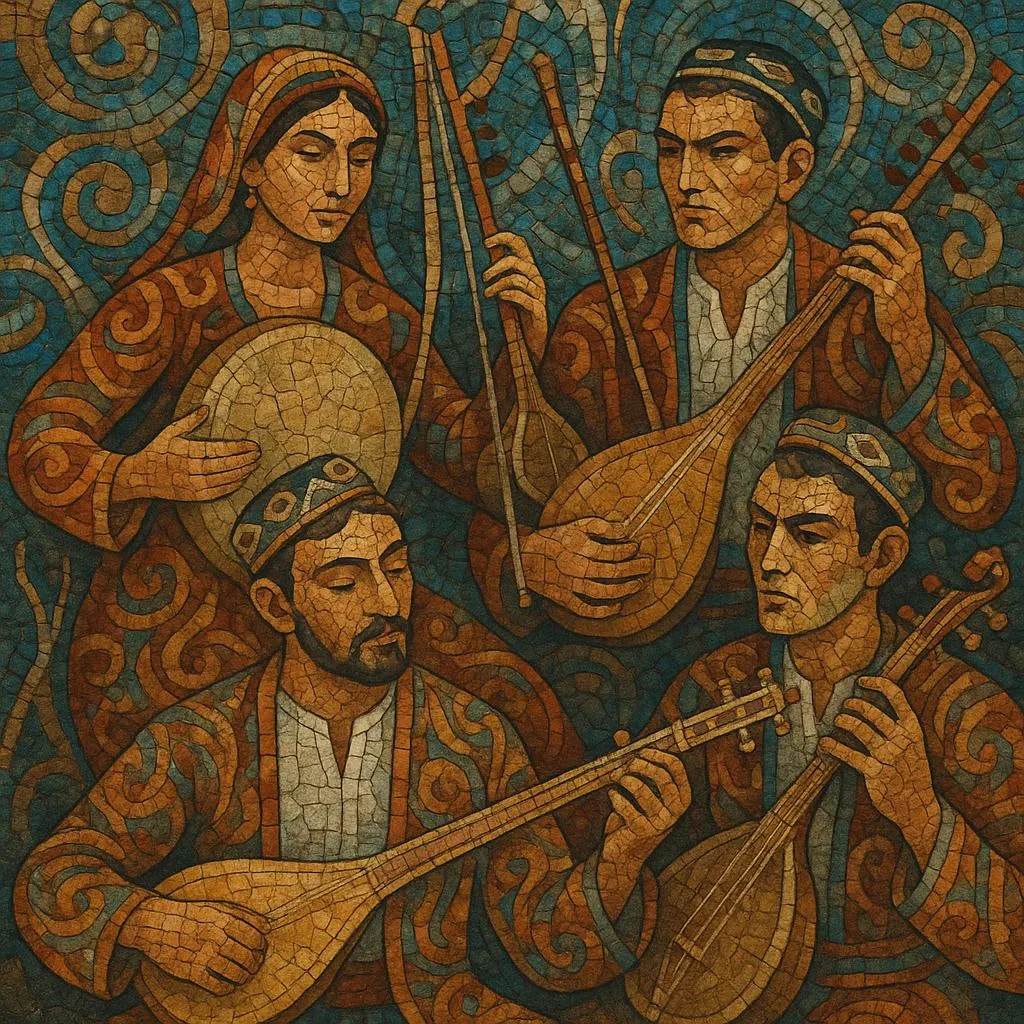
It is best known for rich modal melodies related to the broader maqam/dastgah family of the Islamic world, ornate vocal melismas, and energetic dance rhythms. Typical instruments include long‑necked lutes (rawap, dutar, tambur, satar), bowed ghijak, qanun/kalun, surnay shawm, naghra/kos drums, and the dap frame drum, with heterophonic textures created by voice and plucked strings moving in parallel.
Repertoire spans lyrical love songs, narrative epics (dastan), work and wedding pieces, and communal meshrep songs and dances such as sanam. Rhythmic cycles (usul) commonly use lively duple/compound meters (2/4, 6/8) alongside asymmetric patterns, while modes (muqam) employ microtonal inflection and characteristic cadential formulas.
History
Uyghur folk emerged from the oasis cultures of the Tarim Basin, where Turkic, Persian, and other Central Asian communities met Chinese, Mongol, and Middle Eastern travelers. Musical ideas—modes, instruments, and poetic forms—moved along trade routes, producing a cosmopolitan sound grounded in local language and dance.
By the 1500s, during the Yarkand Khanate, court musicians and tradition bearers shaped extensive modal cycles—what Uyghurs call muqam—into multi‑movement suites of songs, instrumentals, and dances. Oral histories credit Amannisa Khan with compiling and organizing the Twelve Muqam, emblematic of Uyghur musical identity. Parallel regional styles (e.g., Dolan, Ili, and Qumul/Hami muqam) developed with distinct rhythmic feels and timbres.
In the early–mid 20th century, master performers transmitted repertoires in apprenticeships; notable among them, Turdi Akhun, whose interpretations were documented in the 1950s by researchers and state ensembles. Institutional troupes formed in Xinjiang to stage muqam suites and folk dances, standardizing instrumentations (rawap, dutar, ghijak, dap, surnay/naghra) and concert formats.
In 2005, UNESCO proclaimed the "Muqam of Xinjiang Uyghur Autonomous Region" a Masterpiece of the Oral and Intangible Heritage of Humanity, highlighting the depth of Uyghur musical practice. Today, folk performance thrives in weddings, meshrep gatherings, and professional troupes, while solo singer‑instrumentalists adapt traditional modes and rhythms in new contexts. Diaspora artists and researchers have further documented and revitalized repertoires, balancing preservation with creative reinterpretation.