Your digging level
Description
Kurdish folk music is the orally transmitted musical tradition of the Kurdish people, spanning the mountainous regions of present‑day Iraq, Turkey, Iran, and Syria.
It encompasses epic bardic singing (dengbêj), lyrical songs (stran), dance tunes for line and circle dances (govend/halparke), lullabies, and laments, delivered in Kurdish language varieties such as Kurmanji, Sorani, Zazaki (Dimilî), and Hawrami (Gorani).
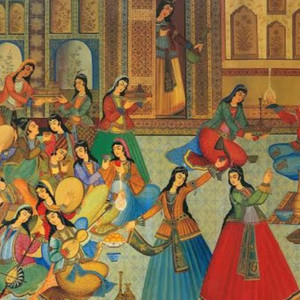
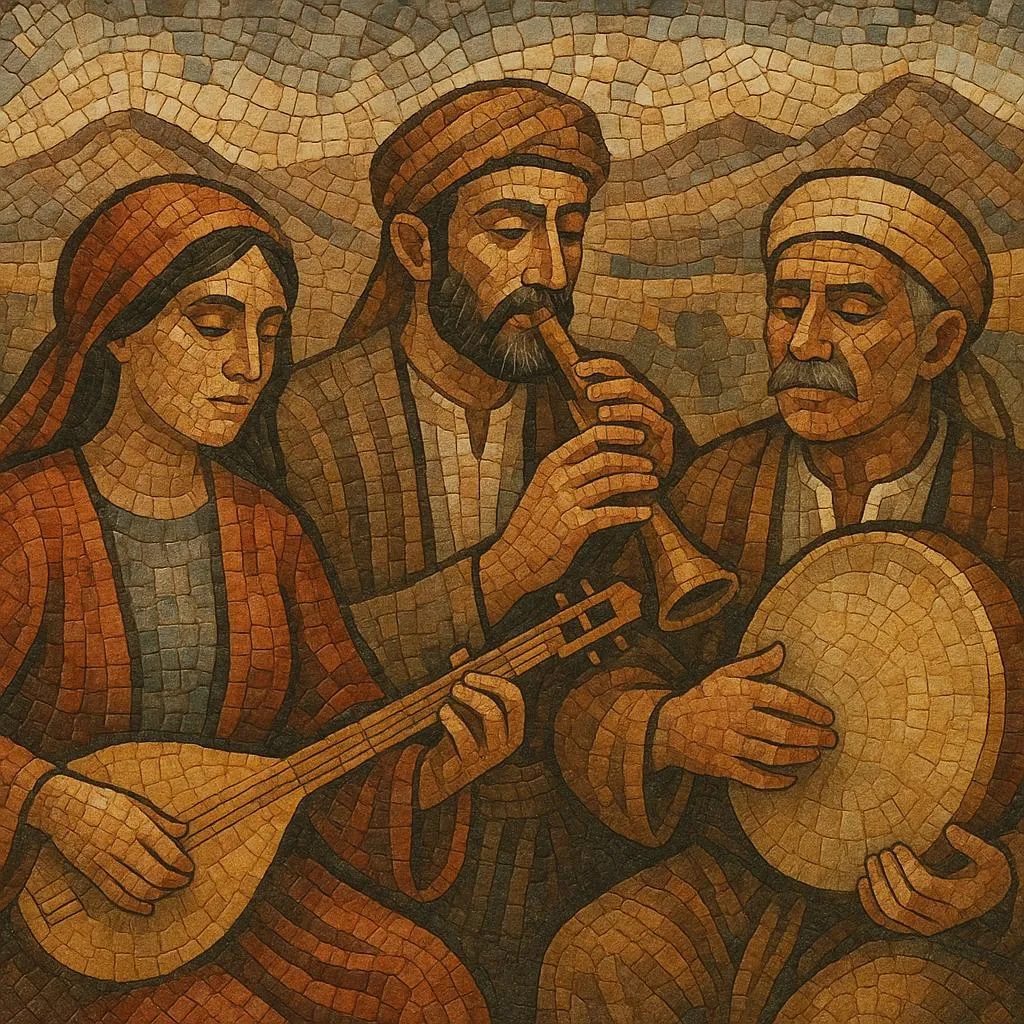
Typical instruments include the tembûr (tanbur), saz/bağlama, daf/def (frame drum), dohol (davul), zurna (zirne), kaval/ney (şimşal/bilûr), kamancheh, and occasionally qanun or violin. Melodically it draws on Middle Eastern modal systems (maqam/dastgāh), often using microtonal intervals; rhythmically it ranges from free‑meter narrative chant to lively asymmetric meters (e.g., 7/8, 9/8) for social dances.
Its lyrics reflect Kurdish history and everyday life—love, nature, migration and exile, social struggle, and communal memory—making the genre a living archive of Kurdish culture.
History
Kurdish folk music predates modern nation‑states and crystallized in rural, tribal, and urban settings across the Kurdish highlands. Its transmission has long been oral, with dengbêj bards preserving heroic epics, genealogies, and social histories through unaccompanied, highly ornamented singing.
By the 19th century, distinct performance practices were recognizable: narrative, largely non‑metric epic singing; lyrical songs (stran) with refrains; and energetic dance suites (govend/halparke) for weddings and community festivals. Instruments such as the tembûr/saz, daf, dohol, and zurna anchored outdoor festivities, while end‑blown flutes (kaval/ney/şimşal) and bowed instruments (kamancheh) supported more intimate settings. Melodic language reflects the regional maqam/dastgāh universe (e.g., Kurd/Phrygian‑type scales, Hijaz, Rast), with microtonal inflections and heterophonic textures.
In the early to mid‑20th century, Kurdish artists began to be recorded in Baghdad, Tehran, Istanbul, and later in Erbil and Sulaymaniyah. Despite periodic censorship or marginalization in several states, local radio, cassette culture, and diaspora networks (notably in Europe) helped maintain circulation. The dengbêj tradition adapted to staged contexts, while urban ensembles fused folk timbres with strings and, later, electronics.
From the late 20th century onward, migration and diaspora communities accelerated documentation, archiving, and stylistic renewal. Professional ensembles and conservatory‑trained musicians arranged folk repertory for concert halls, while popular artists blended Kurdish folk idioms with pop, rock, and global "world music" aesthetics. Today, Kurdish folk music thrives in both heritage‑focused and innovatively hybrid forms, serving as a cultural touchstone and a medium of identity and historical memory.