Your digging level
Description
Sorani pop is contemporary Kurdish popular music performed primarily in the Sorani dialect, the main literary and media variety of Kurdish in Iraqi Kurdistan and parts of western Iran. It blends modern pop production with Kurdish melodic contours, vocal ornamentation, and dance rhythms.
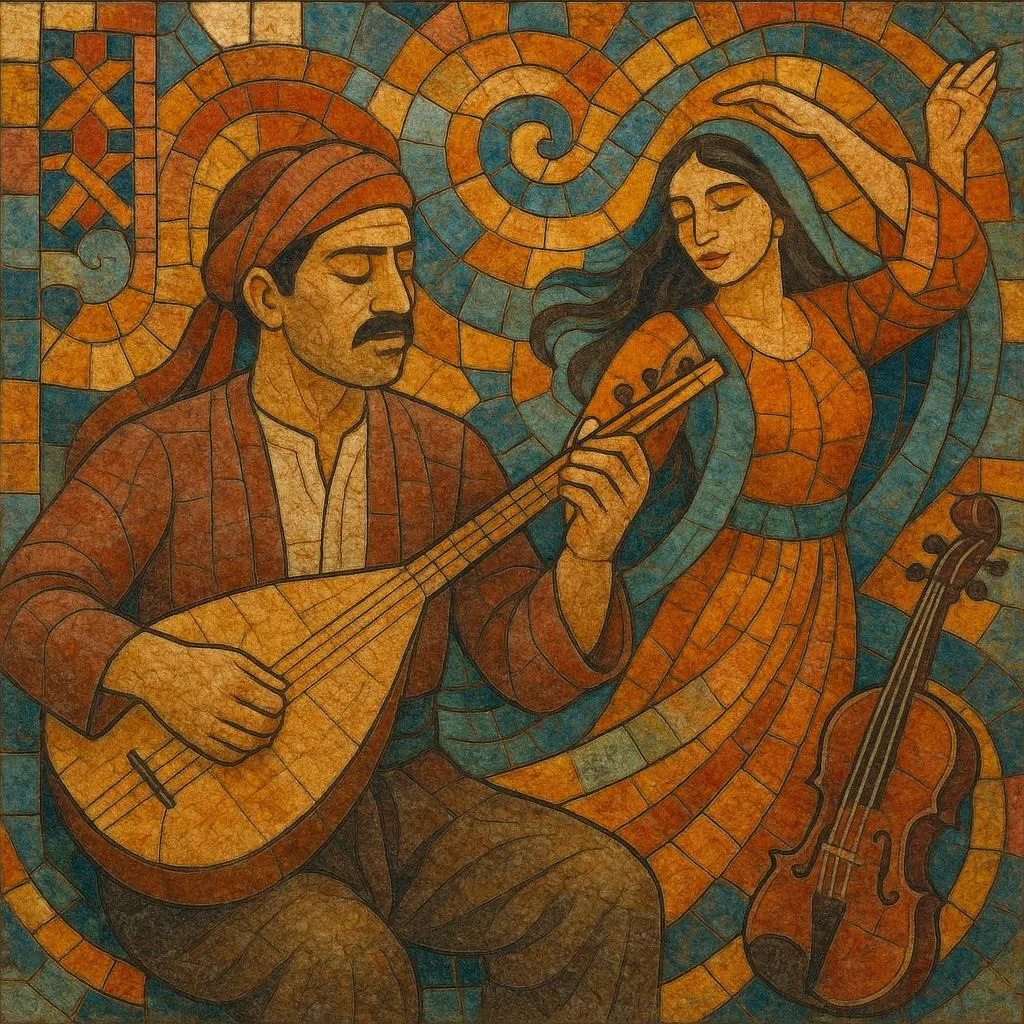
Typical Sorani pop arrangements juxtapose electronic beats, keyboards, and guitar/bass with regional timbres such as tembûr/saz (long‑necked lute), daf/frame drums, and occasionally zurna or ney. Melodies often draw on maqam-derived modes familiar across the Middle East (e.g., Hijaz, Kurdi/Phrygian, Rast), while lyrics—sung in Sorani—center on love, longing, celebration, and place-based identity.
As a media ecosystem, the style grew with post‑1991 Kurdish autonomy, satellite TV, and later diaspora studios in Europe, which helped standardize polished pop aesthetics while maintaining Kurdish linguistic and cultural signifiers.


History
Kurdish urban song and dance traditions in the Sorani‑speaking regions (today’s Iraqi Kurdistan and neighboring Iranian provinces) entered the modern era via radio orchestras, wedding bands, and cassette culture. While these repertories were not yet “pop” in the global sense, they established the melodic language, vocal style (melisma, glides, trills), and dance rhythms (4/4 party grooves, 6/8 line‑dance feels) that later pop artists would adapt.
Following 1991 and the development of de facto Kurdish autonomy in northern Iraq, a local media infrastructure—studios, labels, and especially satellite TV—enabled Sorani‑language music videos and star systems to flourish. Producers began fusing Kurdish folk motifs with Western pop song form, drum machines, and synthesizers, yielding a recognizably Kurdish but contemporary sound. Cross‑border influence from Persian and Turkish pop, and from Arabic pop emanating from Baghdad, Cairo, and Beirut, accelerated this stylistic convergence.
Kurdish communities in Europe (notably Sweden, Germany, the Netherlands, and the UK) provided additional studios, session players, and video production, lifting sonic polish and expanding distribution. Collaborations with non‑Kurdish arrangers and engineers introduced denser pop mixes (side‑chained synths, layered percussion, chorus hooks) while preserving Sorani lyrics and Kurdish modal color.
YouTube, TikTok, and regional streaming normalized single‑driven releases and hybrid substyles (EDM‑leaning club tracks, acoustic pop ballads, pop‑rap crossovers). Sorani pop now circulates across a transnational Kurdish public sphere, with artists toggling between festival stages, wedding circuits, and global platforms. The core identity—Sorani lyrics, Kurdish melodic fingerprints, and dance‑oriented grooves—remains intact even as production aesthetics continue to globalize.