Your digging level
Description
Armenian folk music is the traditional music of the Armenian people, traceable to antiquity and preserved through rich regional styles. It is unified by shared modal systems, vocal ornaments, and poetic song forms that give it a distinctive Armenian character despite local dialects and variants.
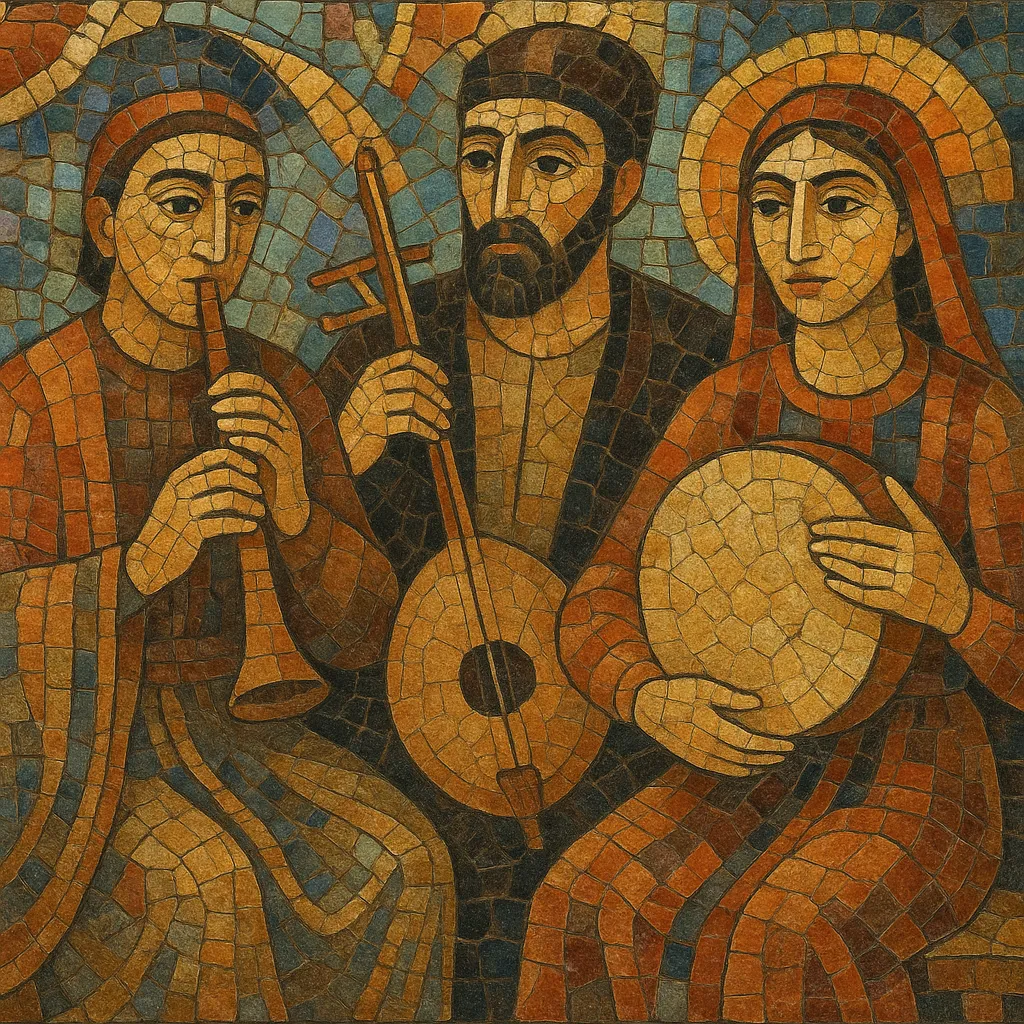
Typical instruments include the duduk (double‑reed apricot wood oboe), the kamancha/kemenche (spike fiddle), the oud (fretless lute), the zurna and dhol (outdoor shawm and drum pair), the shvi/blul (duct flutes), the kanun (plucked zither), and the tar. Vocal genres range from work songs (horovel) and laments to epic and love ballads associated with the ashugh (bardic) tradition, alongside lively line dances such as kochari, shalakho, and tamzara.
In sound and structure it is closely related to other Caucasian and West Asian traditions, sharing melodic types, asymmetric rhythms (e.g., 5/8, 7/8, 9/8), and ornamentation with Georgia, Azerbaijan, and eastern Anatolia, yet retaining unmistakable Armenian melodic turns and cadences.
History
Armenian folk music is attested since antiquity across the regions of historic Armenia. Oral transmission fostered strong local dialects of style, but common modal frameworks and vocal ornaments created a unified national sound. Rural song types—work songs (horovel), wedding and lullaby repertoire (oror), and epic/lyric narratives—formed the core.
From the medieval period onward, professional poet‑singers (ashughs) shaped the art ballad and love song (e.g., hayren) with refined poetry and modal improvisation. The 18th‑century master Sayat‑Nova symbolizes this tradition, synthesizing Armenian practice with broader Caucasian and Persianate aesthetics.
Under Ottoman and Russian imperial rule, repertoire circulated widely among villages and towns. In the late 19th and early 20th centuries, Komitas Vardapet pioneered ethnomusicological collection, transcription, and choral arrangement of peasant songs, stabilizing modes and melodic variants and establishing a scholarly canon that preserved ancient layers while enabling concert performance.
During the Soviet period, state ensembles (e.g., the Tatul Altunyan State Song and Dance Ensemble) standardized instrumentation and dance suites for the stage. Conservatory training for folk instrumentalists and arranged choral settings brought village idioms to professional theaters and radio, while rural styles continued in parallel.
Following the genocide and later migrations, diaspora Armenians cultivated party and wedding styles ("kef" music) in the Middle East, Europe, and the Americas, blending oud, violin, and clarinet with local popular idioms. Artists such as Richard Hagopian and Onnik Dinkjian helped globalize Armenian folk sound.
From the 1990s onward, revivalist ensembles (e.g., Shoghaken) emphasized historically informed playing and regional songs. Parallel currents fuse folk timbres (notably the duduk) with jazz, rock, and film music, while community dance repertoires (kochari, shalakho, tamzara) remain central to social life.

Top albums
%2C%20Cover%20art.webp)