Your digging level
Description
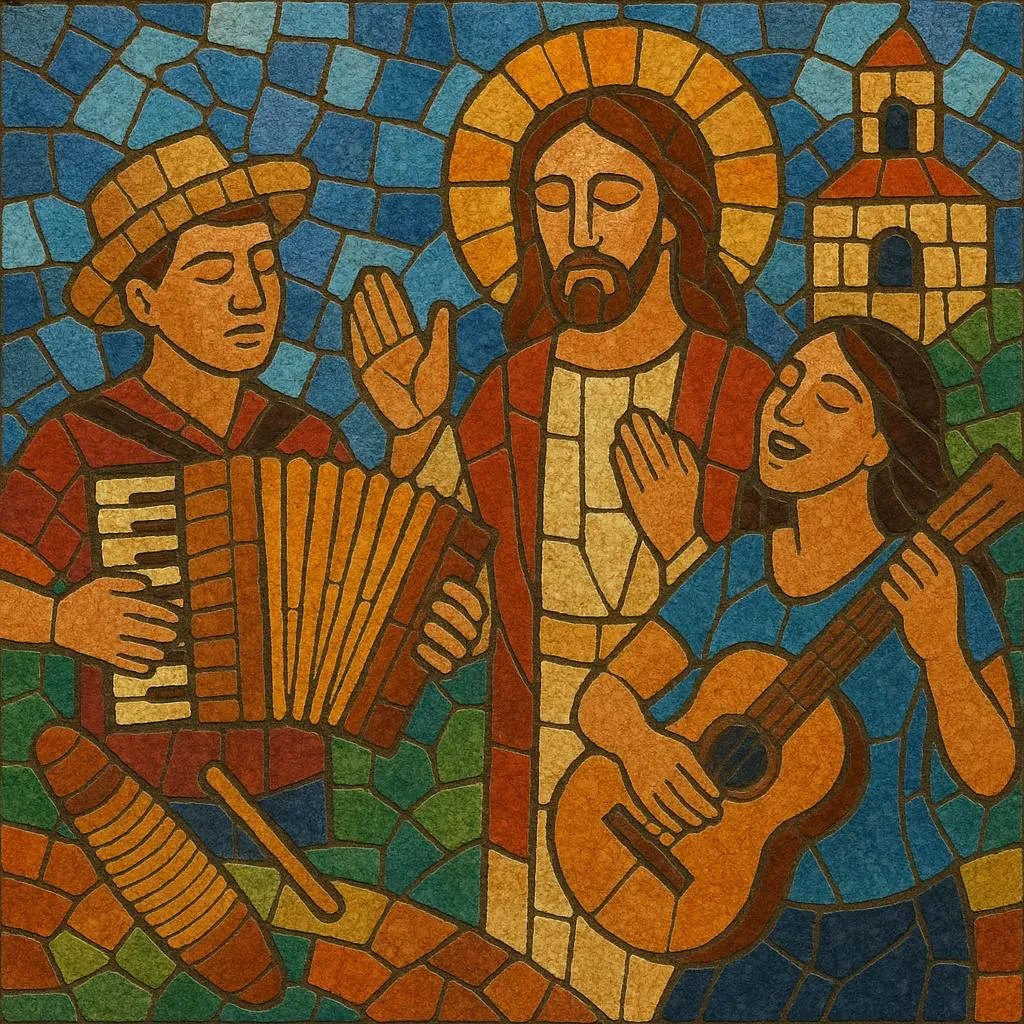
Cumbia cristiana (Christian cumbia) is a faith-centered adaptation of Latin American cumbia whose lyrics explicitly focus on Christian worship, praise, testimony, and evangelism. It keeps cumbia’s infectious two-step groove, percussion drive, and call-and-response hooks, but reorients the message toward devotion to God, Jesus, and community life in the church.
Arrangements range from acoustic/folk ensembles with accordion and guiro to modern, keyboard-led praise bands with drum kit, electric bass, rhythm guitars, and occasional brass. Frequently used in services, conferences, youth events, and evangelical outreach, it invites dancing as a communal, celebratory form of worship while remaining doctrinally centered and congregationally singable.
History
Christian cumbia emerged as Pentecostal and evangelical worship practices in Latin America embraced familiar local dance rhythms to reach broader congregations and youth. Musicians adapted the classic Colombian/Mexican cumbia groove to church contexts, pairing it with Christ-centered lyrics, altar-call refrains, and testimonies. Early adoption was particularly visible in Mexico and across Mexican and Central American diaspora churches in the United States, where praise leaders translated well-known worship choruses into cumbia feels for live services.
Through the 1990s and 2000s, large worship ministries and touring bands popularized “alabanza en cumbia” sets, medleys, and live arrangements. Studio recordings began to mirror church bands: drum kit and bass laying a steady tumbao, guiro and congas for drive, synth/accordion hooks, and simple major-key progressions to keep songs congregational. As Christian music festivals and conferences grew, cumbia sets became reliable high-energy moments in worship programs across Mexico, Guatemala, Colombia, Peru, Chile, and Argentina.
Streaming platforms and social media accelerated the sharing of cumbia-style worship medleys, backing tracks for small church bands, and remixes aimed at youth groups. Producers further blended Christian cumbia with pop, norteño/teclado aesthetics, and contemporary worship balladry. While lyrical themes remain explicitly devotional (praise, gratitude, repentance, testimony, and mission), the palette now stretches from vintage accordion-led grooves to glossy, keyboard-forward ‘praise band’ sonics.
Cumbia cristiana serves both as congregational music and as outreach: its familiar danceable beat lowers cultural barriers, enabling worship to feel local, festive, and communal. It also functions catechetically—embedding scripture-based ideas into catchy refrains that congregations memorize and sing in daily life.


![¿Cómo Tocar Cumbia En Bajo? [En La Iglesia] 🎸🎶🎤](https://i.ytimg.com/vi/BV_v7iwtoZU/hqdefault.jpg)