Your digging level

For this genre
0/8
🏆
Sign in, then listen to this genre to level up

Description

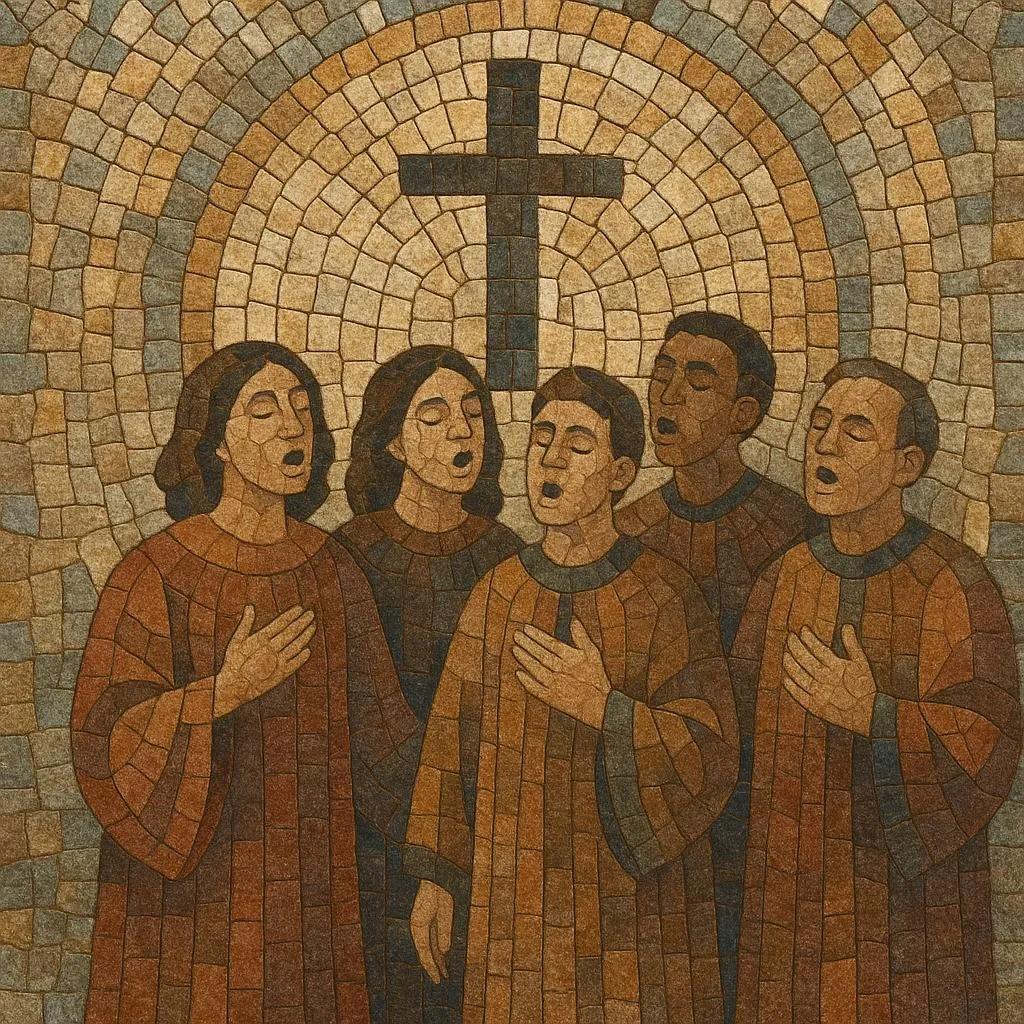
Christian a cappella is a vocal-only approach to Christian sacred and devotional music, performed without instruments. It spans congregational hymns, spirituals, Scripture-based choruses, and contemporary worship songs arranged for small ensembles, quartets, university groups, and choirs.

Stylistically it draws on centuries of church singing and choral practice, the close-harmony language of barbershop and doo‑wop, and the rhythmic drive and call‑and‑response of Black gospel quartets. Modern Christian a cappella may include vocal percussion, rich extended harmonies, and studio-layered textures, yet it remains centered on clear text delivery and congregationally intelligible melody.

The genre thrives in worship services, campus ministries, Christian colleges, and on the concert stage, where its text-forward delivery and portable format make it both spiritually expressive and musically flexible.


Sources: Spotify, Wikipedia, Discogs, Rate Your Music, MusicBrainz, and other online sources

History

Early roots

Christian a cappella stands on very old foundations: plainchant and other forms of unaccompanied sacred song shaped Christian worship from Late Antiquity through the Middle Ages. Over centuries, polyphonic choral writing and congregational hymnody (including shape‑note/Sacred Harp traditions) normalized unaccompanied, text‑driven singing in churches and community gatherings.

Quartet and community traditions (1900s–1960s)

In the early 20th century, barbershop harmony and Black gospel quartet music popularized close four‑part textures, call‑and‑response, and blend as primary expressive tools—often without instruments. These idioms fed directly into church ensembles and campus groups, creating a toolkit for sacred singing that prioritized clarity of the message and memorable harmony.

Contemporary formation (1980s–1990s)

The 1980s saw a distinct market and identity for Christian a cappella emerge in the United States. Independent labels, college ensembles, and touring quartets began recording Scripture songs, hymns, and contemporary worship choruses in fully vocal arrangements. Studio techniques (multi‑tracking, reverb spatialization, tight tuning) expanded the palette while preserving the acoustic ethos of voice‑only performance.

Expansion and diversification (2000s–present)

By the 2000s, Christian a cappella had diversified across university choirs, campus groups, and church collectives, with repertoire ranging from traditional hymnody to modern worship hits rendered with beatboxing, body percussion, and dense jazz‑inflected voicings. Digital distribution and social platforms amplified the reach of small ministries and collegiate groups, while festivals and competitions helped standardize arranging practices (e.g., SATB/TTBB voicings, vocal percussion patterns, and congregationally singable refrains). Today the genre remains global, with a strong presence in North America and growing communities in Europe, Africa, and Oceania.

How to make a track in this genre

Voices and roles
•   Choose a core texture (SATB, SSAA, or TTBB). For quartet idioms, think lead, tenor, baritone, and bass roles, with the lead carrying the tune. •   Consider adding a vocal percussionist for contemporary worship material; otherwise, use body percussion or handclaps to mark groove.
Harmony and voicings
•   Start with four-part hymn-style voicing for strophic verses; enrich refrains with added 6ths/9ths or gospel extensions (e.g., IVmaj9 → V13 → Imaj9). •   Use barbershop techniques (circle-of-fifths movement, secondary dominants, tags) to craft memorable cadences, and end verses with a plagal “Amen” cadence for a classic church feel. •   In ballads, employ clustered upper voices (e.g., major 2nds/9ths) for a warm, luminous pad beneath a solo.
Rhythm and groove
•   For upbeat praise choruses, set a 4/4 backbeat using mouth hi‑hat and kick/snare syllables (e.g., “ts t‑ts | pf k”). Keep the bass line rhythmically locked to the kick pattern. •   For spirituals or quartet styles, favor call‑and‑response and antiphonal entries. Handclaps on beats 2 & 4 or a light shuffle can add propulsion without percussion.
Melody, text, and theology
•   Prioritize intelligible lyric setting: align stressed syllables with strong beats and avoid over-decorating key doctrinal lines. •   When paraphrasing Scripture, maintain natural speech contours; use melisma sparingly for emphasis (e.g., on names or doxologies). •   Keep congregational refrains within a singable range (roughly A3–E4 for mixed congregation) even if inner harmonies extend higher.
Arranging hymns vs. contemporary worship
•   Hymns: respect the original harmonic rhythm; vary verses with modulations, counter-melodies, or texture (solo verse → full choir → unison climax → a cappella tag). •   Contemporary worship: build dynamics across cycles (pad → add bass → add vp → full stack harmony), and consider breakdowns to re‑center the lyric.
Ensemble craft and production
•   Blend and tuning are paramount: match vowel shapes and consonant releases, and use staggered breathing to sustain pads. •   In live settings, close miking (headset or handheld) helps clarity; in recordings, layered doubles and light reverb can simulate sacred space without blurring text.

Top tracks

Locked
Share your favorite track to unlock other users’ top tracks
Influenced by
Has influenced
Challenges
Digger Battle
Let's see who can find the best track in this genre

Download our mobile app

Get the Melodigging app and start digging for new genres on the go
© 2026 Melodigging
Melodding was created as a tribute to Every Noise at Once, which inspired us to help curious minds keep digging into music's ever-evolving genres.
Buy me a coffee for Melodigging