Your digging level

For this genre
0/8
🏆
Sign in, then listen to this genre to level up

Description

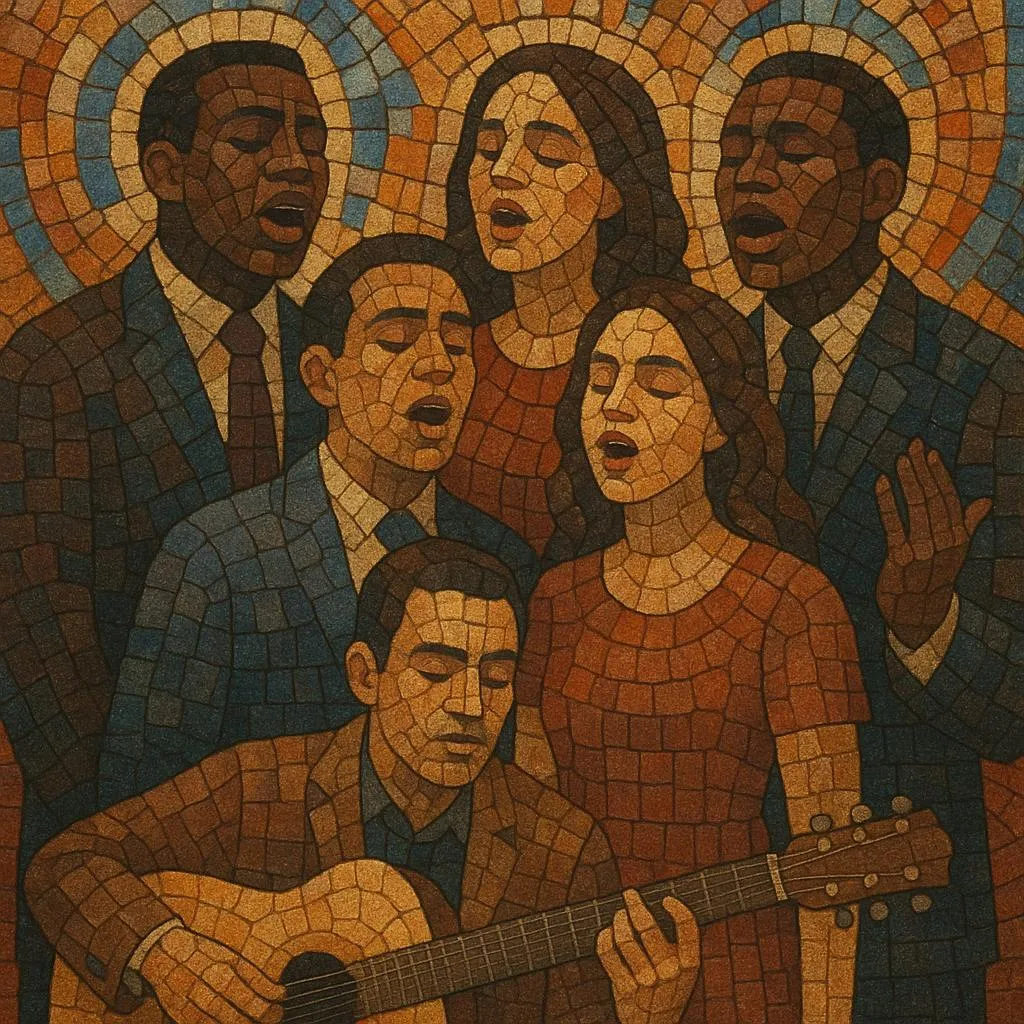
Quarteto gospel is the Portuguese‑language tradition of four‑part gospel vocal groups, most prominently rooted in Brazil’s evangelical and Adventist communities.

The style adapts the American Southern Gospel quartet format (lead/tenor/baritone/bass) to Portuguese (and sometimes Spanish) repertoire, blending close‑harmony arranging with hymnody and modern worship choruses. Performances are typically a cappella or supported by sparse piano, acoustic guitar, or light rhythm section. Hallmarks include tight blend and intonation, step‑up modulations for climactic verses, call‑and‑response tags, and devotional, Scripture‑inflected lyrics.

Since the 1960s the quartet has become a recognizable strand of Brazilian gospel, sustained by church circuits, radio/TV ministries, and extensive touring across Brazil and the Lusophone/LatAm diaspora.


Sources: Spotify, Wikipedia, Discogs, Rate Your Music, MusicBrainz, and other online sources

History

Origins (1960s)

Quarteto gospel emerged in Brazil in the 1960s as Protestant churches expanded and local musicians adapted the American Southern Gospel quartet model to Portuguese hymnody. Early groups established the template of TTBB (or SATB) close harmony, devotional repertoire, and outreach through church services and evangelistic events.

Consolidation and Media Ministry (1970s–1990s)

Through the 1970s–1990s, denominational media (radio/TV) and recording ministries helped professionalize the format. Touring quartets became fixtures at camp meetings, congresses, and regional festivals, while studio recordings standardized arrangements: piano‑led accompaniments, careful voice‑leading, and polished Portuguese diction.

Diversification and Regional Spread (1990s–2000s)

Quartets diversified their repertoire by arranging traditional hymns alongside contemporary worship songs, incorporating modulations, gospel “tags,” and occasional pop or bossa‑tinged harmonies. Spanish‑language sister quartets in Latin America encouraged cross‑border repertoire sharing and bilingual releases.

Digital Era (2010s–present)

Streaming platforms and social media broadened the audience beyond denominational circuits. Production values rose (multi‑mic vocal capture, tighter editing), and some groups added live bands or orchestral backings for special projects. Yet the core identity—four voices in tight harmony proclaiming Christian faith—remains central.

How to make a track in this genre

Core Voicing and Roles
•   Use four distinct parts: Tenor (top harmony), Lead (often the melody), Baritone (inner glue), and Bass (foundation and approach tones). •   Aim for close‑harmony spacing, keeping inner voices within a 10th and avoiding unnecessary voice crossing.
Harmony and Progressions
•   Start with hymn‑like progressions (I–IV–V with secondary dominants) and employ plagal cadences (IV–I) for classic “Amen” endings. •   Add gospel color: 6ths/9ths, 4–3 and 9–8 suspensions, tritone substitutions sparingly, and a turnaround (I–vi–ii–V) before final refrains. •   Use one or two step‑up modulations (often +1 semitone) to lift the final chorus.
Melody, Text, and Language
•   Set biblically inspired Portuguese lyrics (clear diction, natural prosody). Verses can paraphrase Scripture; refrains emphasize hope, grace, and testimony. •   Favor singable, diatonic melodies with occasional blue notes or pentatonic inflections for warmth.
Rhythm and Feel
•   Common meters: 4/4 and 6/8 at moderate tempos. Ballads highlight blend; mid‑tempos suit testimony songs; gentle swing feels can underline joyous texts. •   Use rests for breath unity; align consonants to maintain ensemble clarity.
Arrangement Craft
•   Give the Lead prominence in verses; expand to full four‑part homophony in choruses. Employ brief call‑and‑response or echo lines (tenor lead‑ins, bass walk‑ups). •   Endings often feature a “tag” (repeated closing phrase) with sustained tonic and stacked extensions.
Instrumentation and Recording
•   A cappella is traditional; piano or acoustic guitar can provide light support. Keep arrangements uncluttered to foreground the vocal blend. •   In studio: individual close mics, low‑ratio compression, de‑essing on upper parts, and subtle reverb to simulate sanctuary space.
Performance Practice
•   Prioritize blend (matched vowels, controlled vibrato), unified phrasing, and dynamic swells into cadences. •   Program sets that interleave classic hymns with contemporary worship to connect generations while preserving quartet identity.

Top tracks

Locked
Share your favorite track to unlock other users’ top tracks
Influenced by
Has influenced
Challenges
Digger Battle
Let's see who can find the best track in this genre

Download our mobile app

Get the Melodigging app and start digging for new genres on the go
© 2026 Melodigging
Melodding was created as a tribute to Every Noise at Once, which inspired us to help curious minds keep digging into music's ever-evolving genres.
Buy me a coffee for Melodigging