Your digging level
Description
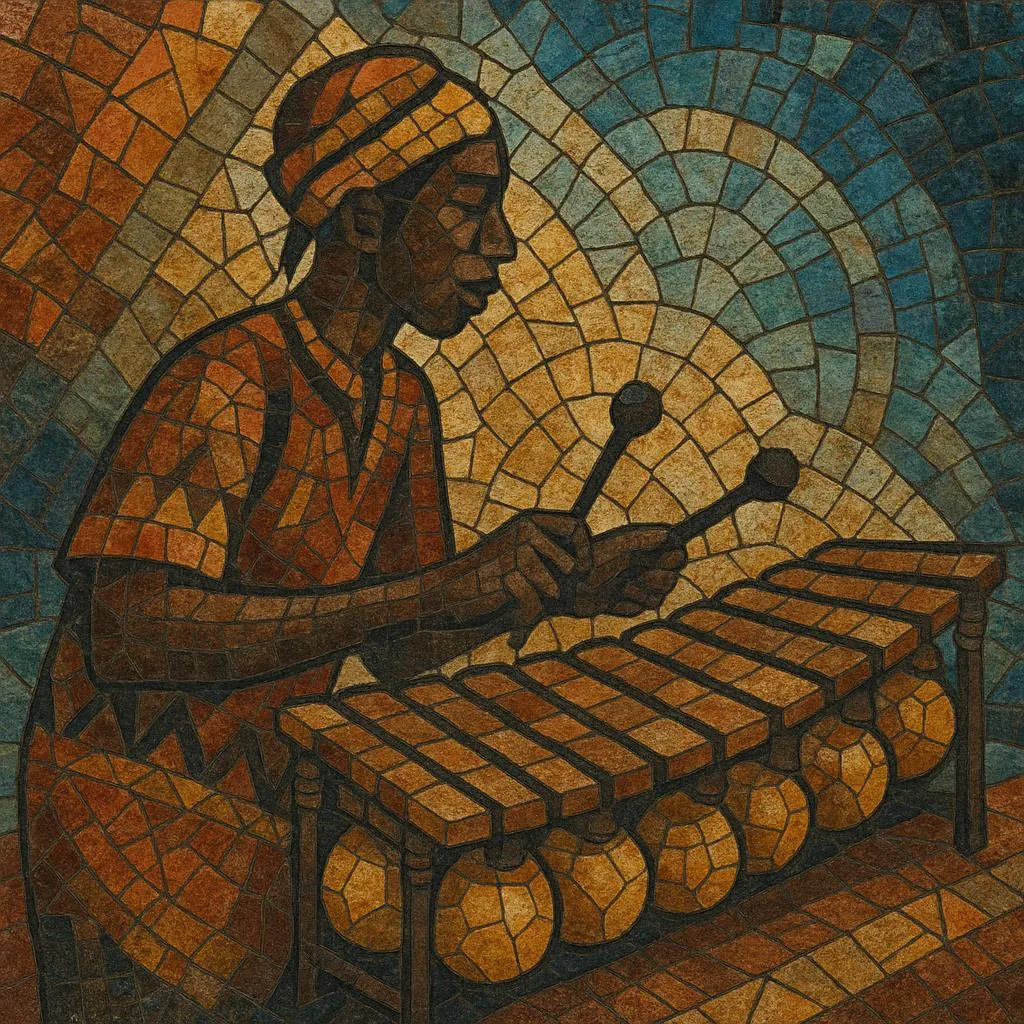
Balafon is a traditional West African xylophone-centered genre whose core sound comes from wooden keys mounted over gourd resonators fitted with buzzing membranes. The instrument’s bright, percussive tone and shimmering buzz create dense, interlocking patterns that are central to the music’s feel.
Rooted in Mandé court and griot (jeli) traditions across today’s Guinea, Mali, Burkina Faso, and Côte d’Ivoire, balafon music features polyrhythmic ostinatos, call-and-response, and pentatonic or hexatonic tunings. Pieces are performed for praise-singing, ceremonies, festivals, and dance, often in ensembles with drums (dunun/djembe), voice, and other lutes or harps. Modern performers also adapt balafon to jazz and global fusion settings, preserving its cyclical grooves while expanding its harmonic palette.
History
Balafon performance is documented in oral histories of the Mandé world, notably the Sosso Bala associated with the era of Sundiata Keita and the Mali Empire (13th century). Custodianship of repertoire and instrument-making was (and remains) linked to hereditary griot lineages who used the balafon to accompany praise poetry, genealogies, and royal ceremonies.
Over time, distinct balafon traditions flourished among Mandinka, Senufo, Bobo, Lobi, and other groups across present-day Guinea, Mali, Burkina Faso, and Côte d’Ivoire. Tunings vary by region (often pentatonic or hexatonic), and ensembles commonly feature multiple balafons in complementary registers that interlock, supported by drum choirs and voice. The music accompanied rites of passage, agricultural cycles, and communal dancing.
Colonial-era ethnographers first recorded balafon ensembles in the early 20th century. After independence, national ballets and touring groups (e.g., Guinean and Burkinabé ensembles) showcased balafon on international stages. Master players began recording as soloists and collaborating with jazz and world-music artists, bringing the instrument’s layered ostinati and polyrhythms to wider audiences.
Since the late 20th century, virtuosi have expanded the instrument’s range (chromatic or extended-key balafons), integrated it into ethno-jazz and global fusion, and explored cross-genre projects. The “Balafon tradition of the Senufo communities of Mali, Burkina Faso and Côte d’Ivoire” is recognized by UNESCO, underscoring the practice’s living heritage. Today, traditional ceremonial functions coexist with concert performance and studio innovation, including amplification and electronic processing.