Your digging level

For this genre
0/8
🏆
Sign in, then listen to this genre to level up

Description

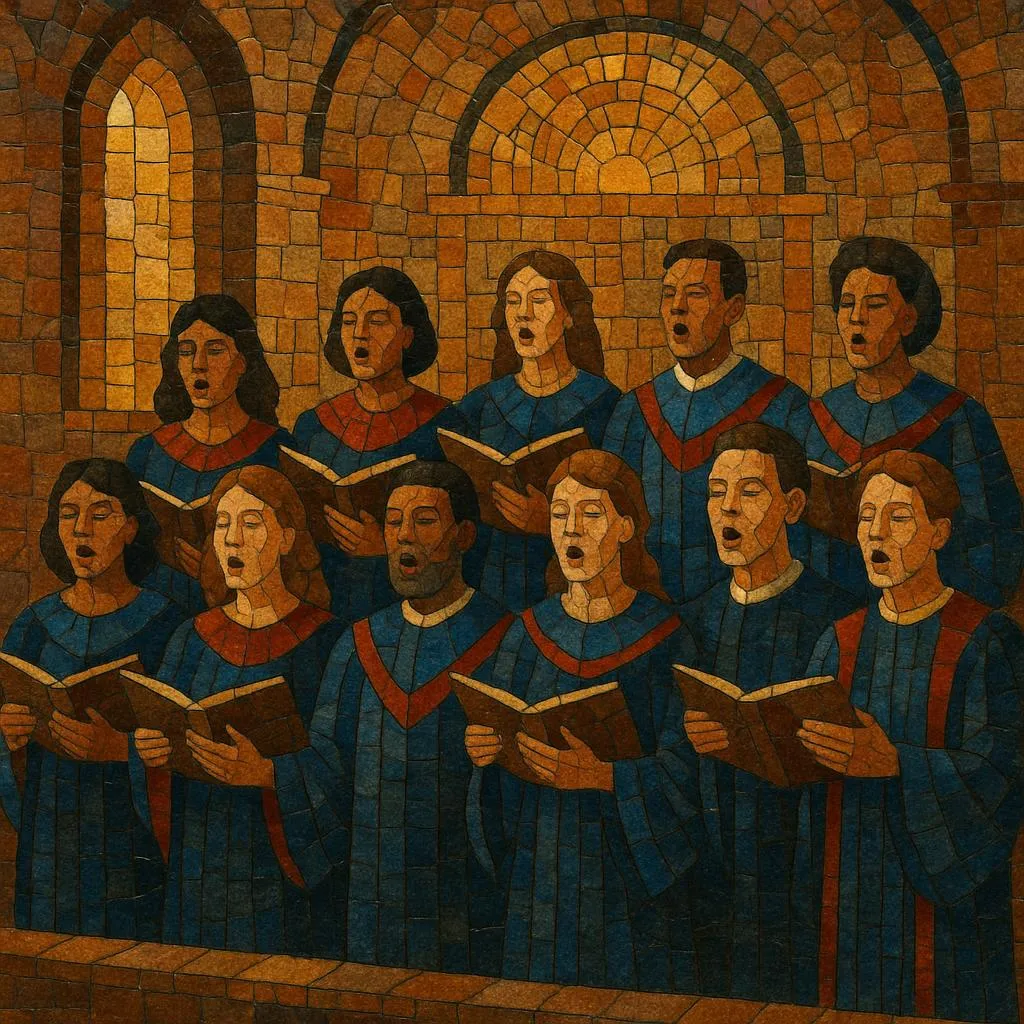
American choir refers to the choral tradition centered in the United States, spanning church, collegiate, community, and professional ensembles. It blends European sacred and concert choral practices with distinctly American sources—shape-note hymnody, spirituals, gospel, Broadway, and contemporary classical writing.

A typical American choral sound emphasizes clarity of text, flexible tone (from warm vibrato to straight tone as repertoire demands), crisp rhythm, and a culture of stylistic breadth. Repertoire ranges from Renaissance motets to newly commissioned works by living American composers, as well as artful arrangements of spirituals and folk songs that foreground call-and-response, syncopation, and expressive text shaping.


Sources: Spotify, Wikipedia, Discogs, RYM, MB, user feedback and other online sources

History

Origins (18th–19th centuries)

American choral practice begins with colonial psalmody and singing schools, then expands through shape-note/Sacred Harp traditions in the early 1800s and robust church choirs in Protestant and Episcopal contexts. These roots fuse European choral counterpoint and hymnody with local congregational singing and frontier pedagogies.

The A Cappella Movement (early 1900s)

In the 1900s–1910s, the American a cappella choir movement—led by figures such as Peter C. Lutkin (Northwestern) and F. Melius Christiansen (St. Olaf)—standardized SATB ensemble balance, vowel unification, and memorized performance. Collegiate touring choirs popularized an American choral identity nationwide.

Mid-century Professionalization (1940s–1970s)

Postwar America saw a boom in symphonic and independent choirs, elevated by conductors like Robert Shaw, who insisted on textual precision, disciplined tuning, and stylistic authenticity from Bach to contemporary works. Community and church choirs expanded in size and quality, and publishers began cultivating distinctive American choral catalogs.

Pluralism and New Music (1980s–present)

American choirs embraced stylistic pluralism: gospel/spiritual arrangements, minimalist and post-tonal works, extended vocal techniques, and multimedia projects. Composers such as Randall Thompson, Samuel Barber, Morten Lauridsen, Eric Whitacre, Moses Hogan, Stephen Paulus, Alice Parker (with Robert Shaw), and a subsequent generation of prizewinning composers helped make the U.S. a global center for commissioned choral music.

Today

A dense ecosystem of church, school, collegiate, community, and professional ensembles commissions hundreds of works annually. American choirs are recognized for stylistic range, premiering new music, and refined interpretations of spirituals, hymnody, and global repertoire—often with an emphasis on social themes, poet-driven texts, and collaborative performance practice.

How to make a track in this genre

Ensemble & Voicing
•   Write for SATB as a baseline; common divisi include SSAATTBB for luminosity and cluster harmony. •   Ranges (typical): Soprano (C4–A5), Alto (G3–E5), Tenor (C3–A4), Bass (E2–E4). Keep tessitura comfortable and stagger climaxes across sections.
Sound & Diction
•   Prioritize unified vowels and clear consonants; American English benefits from neutralized diphthongs on sustained pitches. •   Vary tone: straight tone for early music or transparent textures; warmer vibrato for Romantic and gospel-influenced writing.
Harmony & Texture
•   Mix diatonic lyricism with color-tones (add2/add9, 7ths, 9ths), quartal/quintal sonorities, and gentle cluster stacks (e.g., seconds) for shimmer. •   Use parallel planing and slowly shifting cluster chords for an American “choral ambient” sheen; cadence with open-voiced triads or added seconds. •   Alternate homophony for textual clarity with brief polyphony or canonic imitation for momentum.
Rhythm & Groove
•   For spirituals/gospel-inspired pieces, employ syncopation, off-beat accents, and hand-clap/body-percussion cues (optional) while keeping notated pulse clear. •   For concert works, leverage mixed meters and additive rhythms but anchor with clear conducting patterns and sectional cues.
Text Setting
•   Choose American poets, sacred texts, or folk sources. Align natural speech stress with musical accent; allow melismas only where text can sustain them. •   Use refrains or call-and-response to reference spirituals and hymn traditions.
Form & Orchestration
•   A cappella is standard; when using instruments, favor organ, piano, strings, or light percussion. Keep registral space for the choir (avoid thick midrange masking). •   Architect forms around textual arcs: verse–refrain, ternary (A–B–A’), or through-composed with dynamic pillars.
Practical Tips
•   Write ample breaths and plan staggered breathing in long sustains. •   Mark consonant releases (e.g., “t” on beat) to align text. •   Provide rehearsal pianovocal reductions with cue clefs; include IPA and diction notes if using nonstandard pronunciation.

Top tracks

Locked
Share your favorite track to unlock other users’ top tracks

Upcoming concerts

in this genre
Influenced by
Has influenced

Download our mobile app

Get the Melodigging app and start digging for new genres on the go
© 2026 Melodigging
Melodding was created as a tribute to Every Noise at Once, which inspired us to help curious minds keep digging into music's ever-evolving genres.
Buy me a coffee for Melodigging