Your digging level

For this genre
0/8
🏆
Sign in, then listen to this genre to level up

Description

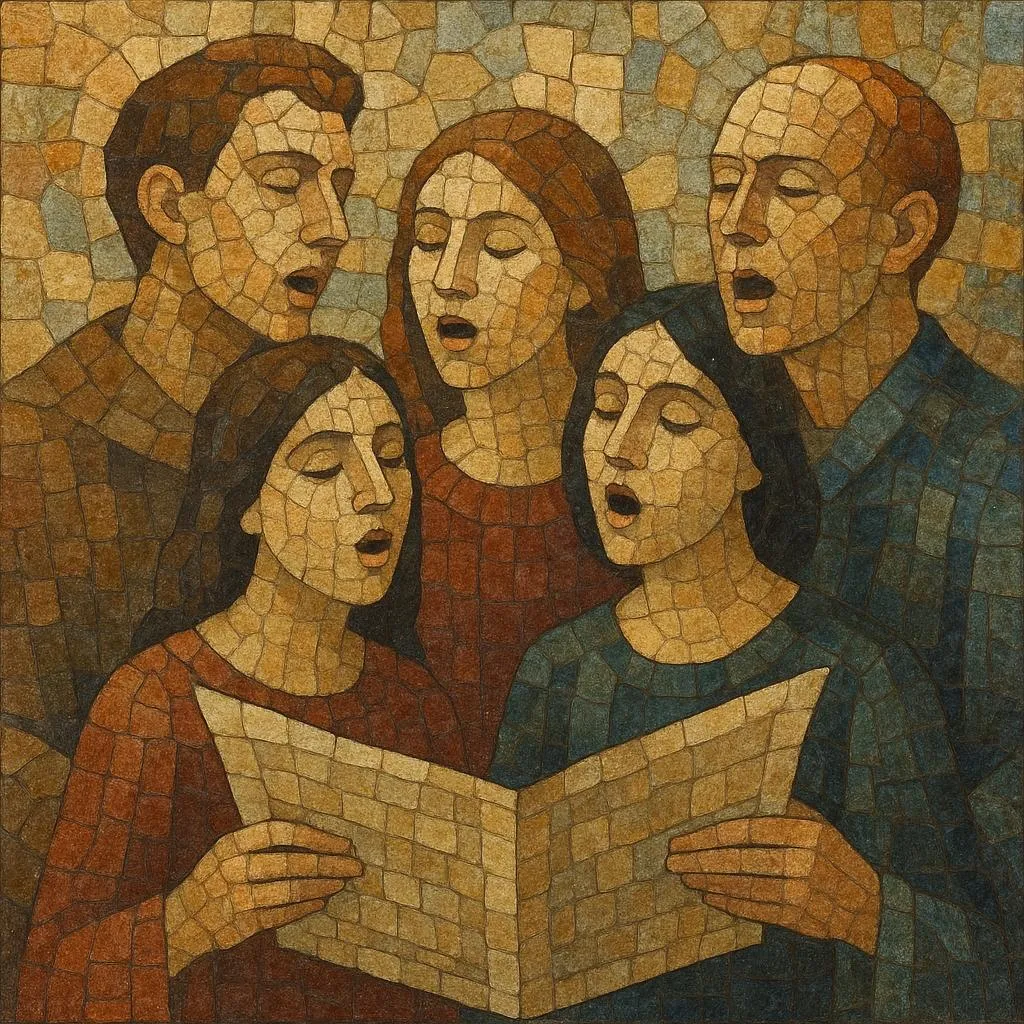
Vocal ensemble refers to small-to-medium groups of singers (typically 3–16 voices) performing polyphonic or homophonic music with one or few singers per part. Unlike large choirs, vocal ensembles emphasize chamber-scale blend, clarity of individual lines, and intimate text delivery.

The repertoire spans medieval conductus and motets, Renaissance madrigals and masses, Baroque part-songs, Romantic partsongs, and contemporary a cappella works. Ensembles often sing a cappella, but may be accompanied by continuo or instruments. Precision of tuning, diction, and balance among soprano/alto/tenor/bass (SATB) parts is central to the idiom.


Sources: Spotify, Wikipedia, Discogs, Rate Your Music, MusicBrainz, and other online sources

History

Medieval beginnings (12th–13th centuries)

The vocal ensemble tradition coalesced in medieval Europe as singers began performing multi-voice organum and conductus. At Notre Dame in Paris, composers such as Léonin and Pérotin codified rhythmic coordination among a few voices, laying a technical foundation for part-singing in small groups.

Renaissance flourishing (15th–16th centuries)

With the rise of imitative polyphony, small ensembles became the natural vehicle for motets, masses, and madrigals by composers across Italy, France, England, and the Low Countries. One-to-a-part or few-to-a-part singing enabled transparent counterpoint and expressive text declamation, defining the classic chamber-choral sound.

Baroque to Romantic (17th–19th centuries)

Baroque ensembles navigated stile concertato textures (sometimes with continuo or instruments). In the 18th and 19th centuries, domestic music-making fostered partsongs and secular part-writing for compact forces, sustaining the chamber-vocal tradition alongside larger choirs.

Modern revival and expansion (20th–21st centuries)

The early-music movement revived historically informed performance of medieval and Renaissance repertories, while contemporary composers wrote new a cappella and mixed-instrumental works tailored to agile, small ensembles. Today, professional groups blend scholarship and artistry, expanding the repertoire and refining ensemble techniques for both sacred and secular contexts.

How to make a track in this genre

Forces and voicing
•   Write for SATB (or SSATB/SSAATTBB) with one singer per part or small multiples. •   Exploit timbral contrast (e.g., divisi, solo/tutti) while maintaining blend and balanced dynamics.
Texture, counterpoint, and harmony
•   Use clear, singable lines with stepwise motion and careful leaps; ensure independence and voice-leading integrity. •   For Renaissance-style works, favor modal counterpoint, prepared/avoided dissonances, and points of imitation. •   For modern idioms, integrate extended tertian or quartal harmonies, clusters used judiciously, and carefully voiced dissonances to preserve tunability.
Rhythm and text underlay
•   Align accentuation with natural speech stresses; keep syllabic underlay clear to aid diction and ensemble unity. •   Employ imitation, homophonic cadences, and antiphonal exchanges to articulate form and aid ensemble cohesion.
Language and articulation
•   Latin, Italian, English, French, and German texts are common; ensure vowel unification and consonant synchronization. •   Mark breath plans, staggered breathing in sustained passages, and precise consonant releases.
Practical rehearsal considerations
•   Write cues for entrances, clear cadential goals, and manageable ranges (S: up to A/B, A: up to E/F, T: up to E/F, B: down to D/C depending on ensemble). •   Keep tessitura comfortable to facilitate blend; avoid overlong unison exposures unless for color.
Optional accompaniment
•   A cappella is standard, but continuo, lute, organ, or small consorts can support pitch and color; ensure accompaniment doesn’t mask text.

Top tracks

Locked
Share your favorite track to unlock other users’ top tracks
Influenced by
Has influenced
Challenges
Digger Battle
Let's see who can find the best track in this genre

Download our mobile app

Get the Melodigging app and start digging for new genres on the go
© 2026 Melodigging
Melodding was created as a tribute to Every Noise at Once, which inspired us to help curious minds keep digging into music's ever-evolving genres.
Buy me a coffee for Melodigging