

Genres
Artists
Albums
Make Music
Sign in
Sign in
Artists
Classical
Artists
Classical
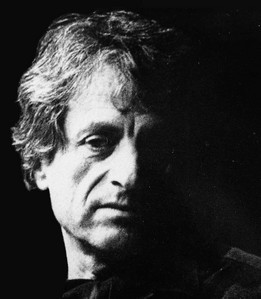
Iannis Xenakis
1986–2022
·
24 albums
Listen
2
/5
Genres
New Isolationism
New isolationism is a contemporary strain of isolationist ambient and post-industrial minimalism that emerged in the 2010s, particularly around Scandinavian experimental labels and studios. It foregrounds intimate, close-mic’d sound, negative space, and a quiet-but-present noise floor; its pieces feel both internal and architectural, like rooms built from reverb tails, tape hiss, and soft electronics. Sonically, the style blends glacial drones, fragile chamber timbres (strings, organ, piano), lo‑fi electronics, and field recordings into stark, slow-evolving tableaux. Melodic information is sparse—often only a few tones or gestures—while rhythm is either absent or reduced to distant pulses, heartbeats, or mechanical cycles. Vocals, when they appear, are murmured, diaristic, or abstracted by pitch and time manipulation. Aesthetically, new isolationism is post‑internet and diaristic: it captures solitude, memory, and dislocation with a palette that feels personal yet estranged, drawing as much from contemporary gallery sound practice as from classic dark ambient.
Discover
Listen
Modern Classical
Modern classical is a contemporary strand of instrumental music that applies classical composition techniques to intimate, cinematic settings. It typically foregrounds piano and strings, is sparsely orchestrated, and embraces ambience, repetition, and timbral detail. Rather than the academic modernism of the early 20th century, modern classical as used today refers to accessible, mood-driven works that sit between classical, ambient, and film music. Felt pianos, close‑miked string quartets, tape hiss, drones, soft electronics, and minimal harmonic movement are common, producing a contemplative, emotionally direct sound that translates well to headphones, streaming playlists, and screen media.
Discover
Listen
New Complexity
New Complexity is a movement in contemporary classical composition characterized by extremely detailed notation, dense polyphonic textures, and intricate rhythmic layers. Composers in this school aim to encode a wealth of micro-level information—articulations, dynamics, timbral inflections, and nuanced temporal relationships—directly into the score. The music typically features nested tuplets, rapidly shifting meters, microtonal pitch structures, and extensive use of extended techniques. While often perceived as virtuosic and formidable, its goal is not complexity for its own sake but the precise realization of highly differentiated sound worlds and continuously transforming textures.
Discover
Listen
Stochastic Music
Stochastic music is a 20th‑century avant‑garde approach in which musical parameters are governed by probability theory and random processes rather than fixed, note‑by‑note determination. Instead of traditional melody and harmony, composers shape "sound masses" by controlling statistical features like density, event rate, pitch distributions, durations, and dynamics. Typical tools include Gaussian, Poisson, and Markov processes, which create evolving textures, swarms, and clouds of sound—often realized in both orchestral and electroacoustic settings. The term is most closely associated with Iannis Xenakis, who formalized the method and demonstrated it in landmark works and writings, but it has deeply influenced computer music, experimental electronic practices, and later microsound/granular approaches.
Discover
Listen
Experimental
Experimental music is an umbrella term for practices that prioritize exploration, process, and discovery over adherence to established genre norms. It embraces new sound sources, nonstandard tuning systems, indeterminacy and chance operations, graphic and open-form scores, extended techniques, and technology-led sound design (tape, electronics, computers, and live processing). Rather than a single style, it is a methodology and ethos: testing hypotheses about sound, structure, and performance, often blurring boundaries between composition, improvisation, sound art, and performance art. Listeners can expect unfamiliar timbres, unusual forms, and an emphasis on how music is made as much as the resulting sound.
Discover
Listen
Acousmatic
Acousmatic music is a form of electroacoustic composition created specifically for loudspeakers, where the audience hears sounds without seeing their sources. The genre privileges timbre, morphology, and spatial movement over traditional melody and harmony, and it is often experienced in darkened auditoria to sharpen attention to pure listening. Composers typically work with recorded or synthesized sounds—ranging from environmental recordings and instrumental fragments to purely electronic textures—then edit, transform, and organize them into a fixed medium. Performance focuses on diffusion: the live projection of a fixed track across a multichannel loudspeaker array to sculpt space and perspective in real time.
Discover
Listen
Electroacoustic
Electroacoustic music is a broad art-music tradition that integrates recorded acoustic sound and electronically generated or processed sound into coherent musical works. It privileges timbre, gesture, texture, and spatialization over conventional melody-and-harmony song forms, often employing tape manipulation, synthesis, live electronics, and computer-based signal processing. Works are frequently composed for fixed media (stereo or multichannel loudspeakers) and may also involve live performers who are transformed in real time. Concert presentation typically emphasizes spatial diffusion and immersive listening, and the repertoire spans concert works, radio pieces, installations, and soundscape compositions.
Discover
Listen
Tape Music
Tape music is a form of early electronic and electroacoustic composition that uses recorded sounds on magnetic tape as the primary material. Composers assemble, cut, splice, loop, reverse, and vary the speed of tape to sculpt timbre, rhythm, and form, often transforming everyday noises into abstract musical structures. Emerging from post–World War II studio experimentation, it blurred the line between composition and sound design. Works are typically fixed-media pieces intended for loudspeaker playback rather than traditional performance, privileging timbral exploration, spatial projection, and montage over conventional harmony and meter.
Discover
Listen
Avant-Garde
Avant-garde music is an umbrella term for boundary-pushing practices that challenge prevailing norms of harmony, rhythm, timbre, form, and performance. It privileges experimentation, conceptual rigor, and a willingness to reframe what counts as music at all. Historically tied to early 20th‑century artistic modernism, avant-garde music introduced atonality, the emancipation of noise, and new forms of notation and process. It embraces indeterminacy, extended techniques, electronics, spatialization, and multimedia performance, treating sound as material to be sculpted, questioned, and reinvented.
Discover
Listen
Electronic
Electronic is a broad umbrella genre defined by the primary use of electronically generated or electronically processed sound. It encompasses music made with synthesizers, drum machines, samplers, computers, and studio/tape techniques, as well as electroacoustic manipulation of recorded or synthetic sources. The genre ranges from academic and experimental traditions to popular and dance-oriented forms. While its sonic palette is rooted in electricity and circuitry, its aesthetics span minimal and textural explorations, structured song forms, and beat-driven club permutations. Electronic emphasizes sound design, timbre, and studio-as-instrument practices as much as melody and harmony.
Discover
Listen
Orchestral
Orchestral music refers to compositions written for an orchestra—a large ensemble typically built around a string section (violins, violas, cellos, double basses), complemented by woodwinds, brass, percussion, and often harp, keyboard, or other auxiliary instruments. A conductor coordinates the ensemble, shaping balance, phrasing, and expression. The style emphasizes coloristic timbre combinations, dynamic range from the softest pianissimo to explosive tuttis, and textures that can shift seamlessly between transparent chamber-like writing and monumental masses of sound. Orchestral writing underpins concert genres such as symphonies, overtures, and tone poems, as well as opera, ballet, and modern film and game scores. While orchestral writing evolved across centuries, its core craft centers on melody, counterpoint, harmony, register, and orchestration—the art of assigning musical ideas to instruments to achieve clarity, contrast, and narrative impact.
Discover
Listen
Ballet
Ballet (as a musical genre) refers to orchestral music written to accompany choreographed dance on stage. It prioritizes clear tempi, strongly articulated rhythms, and memorable leitmotifs to support narrative, character, and movement. While rooted in court entertainment, ballet music evolved into a sophisticated, self-sufficient concert art: many ballets yield popular orchestral suites that are performed independently. Typical numbers include adagios, variations, codas, divertissements, character dances, and large ensemble scenes that mirror the dramatic arc of the choreography. Stylistically, ballet spans Baroque courtly idioms, Classical clarity, Romantic lyricism, and 20th‑century modernism and neoclassicism. It is predominantly instrumental (full orchestra), but can occasionally include choral or vocal parts when dramaturgy requires it.
Discover
Listen
Chamber Music
Chamber music is a tradition of composed music for small ensembles—typically one player per part—intended for intimate spaces such as courts, salons, and private rooms rather than large public halls. Its aesthetic emphasizes clarity of texture, conversational interplay among parts, and balance without a conductor. Hallmark formations include the string quartet, piano trio, wind quintet, string quintet, and various mixed ensembles. Multi‑movement cycles (often in sonata form) and finely wrought counterpoint are common, ranging from Baroque trio sonatas to Classical string quartets and modern works with expanded timbres and techniques. Because of its scale and transparency, chamber music has long been a proving ground for compositional craft and ensemble musicianship, shaping the core of Western art music from the Baroque through the present.
Discover
Listen
Classical
Classical music is the notated art-music tradition of Europe and its global descendants, characterized by durable forms, carefully codified harmony and counterpoint, and a literate score-based practice. The term “classical” can refer broadly to the entire Western art-music lineage from the Medieval era to today, not just the Classical period (c. 1750s–1820s). It privileges long-form structures (such as symphonies, sonatas, concertos, masses, and operas), functional or modal harmony, thematic development, and timbral nuance across ensembles ranging from solo instruments to full orchestras and choirs. Across centuries, the style evolved from chant and modal polyphony to tonal harmony, and later to post-tonal idioms, while maintaining a shared emphasis on written notation, performance practice, and craft.
Discover
Listen
Show all 14 genres
Albums
2022
1
/5
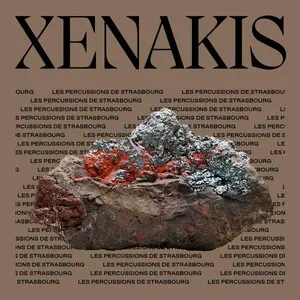
Pléiades; Persephassa
Iannis Xenakis Ιάννης Ξενάκης / Les Percussions de Strasbourg
Stochastic Music
2022
1
/5
Electro-Acoustic Music
Iannis Xenakis Ιάννης Ξενάκης / Groupe de Recherches Musicales de la RTF
Tape Music
Stochastic Music
Acousmatic
2018
2
/5
Persepolis
Iannis Xenakis Ιάννης Ξενάκης
Stochastic Music
Tape Music
Acousmatic
2017
1
/5
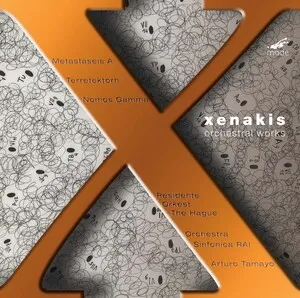
Orchestral Works
Iannis Xenakis Ιάννης Ξενάκης
Stochastic Music
Classical
2015
1
/5
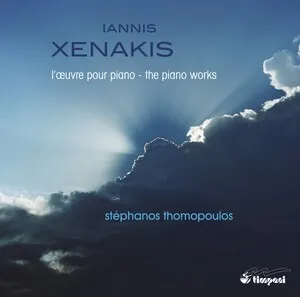
L'œuvre pour piano
Iannis Xenakis Ιάννης Ξενάκης / Stéphanos Thomopoulos
Stochastic Music
2015
1
/5
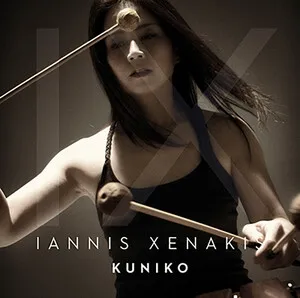
IX
Iannis Xenakis Ιάννης Ξενάκης / KUNIKO
Stochastic Music
Classical
2013
1
/5
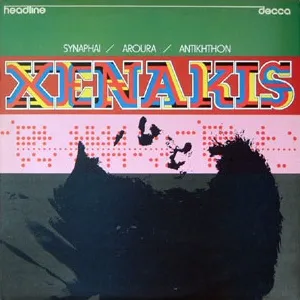
Synaphai; Aroura; Antikhthon
Iannis Xenakis Ιάννης Ξενάκης
Stochastic Music
2010
1
/5
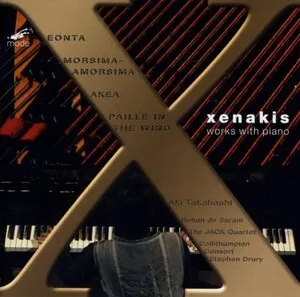
Works With Piano
Iannis Xenakis Ιάννης Ξενάκης
Stochastic Music
2009
1
/5
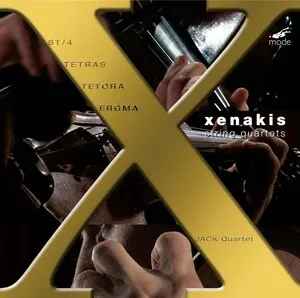
Complete String Quartets: ST/4; Tetras; Tetora; Ergma
Iannis Xenakis Ιάννης Ξενάκης / JACK Quartet
Stochastic Music
Classical
2008
1
/5
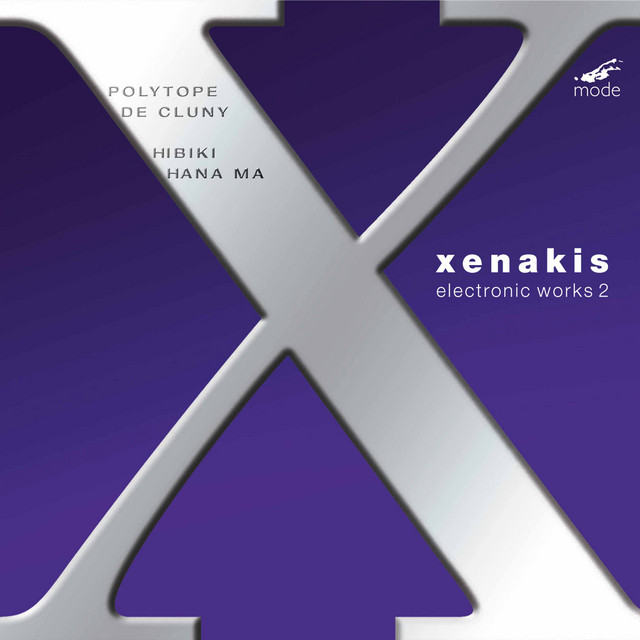
Xenakis: Electronic Works, Vol. 2
Iannis Xenakis
Acousmatic
Classical
Electroacoustic
2008
1
/5
Xenakis: Electronic Works, Vol. 2
Iannis Xenakis
Acousmatic
Classical
Electroacoustic
2008
1
/5
Kraanerg
Iannis Xenakis Ιάννης Ξενάκης / Callithumpian Consort / Stephen Drury
Stochastic Music
Electroacoustic
Ballet
2008
1
/5
Orchestral Works Vol. 5: Metastaseis; Pithoprakta; ST/48; Achorripsis; Syrmos; Hiketides
Iannis Xenakis Ιάννης Ξενάκης / Orchestre philharmonique du Luxembourg / Arturo…
Stochastic Music
Classical
Orchestral
2007
1
/5
Orchestral Works - Vol. III: Synaphaï; Horos; Eridanos; Kyania
Iannis Xenakis Ιάννης Ξενάκης
Stochastic Music
Classical
Orchestral
2007
1
/5
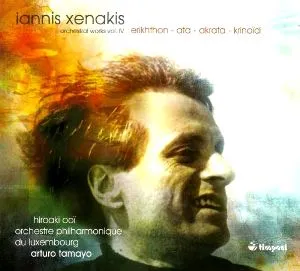
Orchestral Works Vol. IV: Erikhthon; Ata; Akrata; Krinoïdi
Iannis Xenakis Ιάννης Ξενάκης
Stochastic Music
2006
1
/5
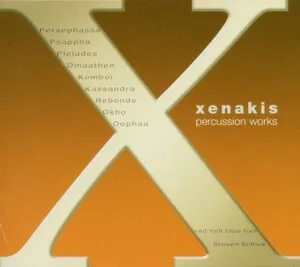
Percussion Works
Iannis Xenakis Ιάννης Ξενάκης / red fish blue fish / Steven Schick
Stochastic Music
Classical
2005
1
/5
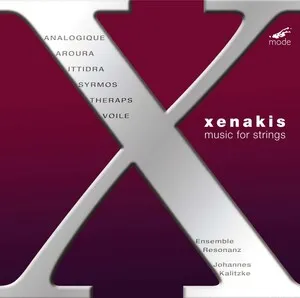
Music for Strings
Iannis Xenakis Ιάννης Ξενάκης / Ensemble Resonanz / Johannes Kalitzke
Stochastic Music
Classical
2000
1
/5
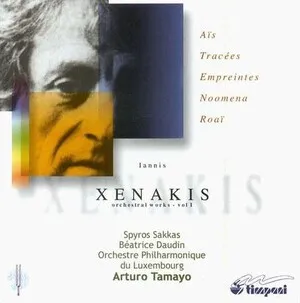
Orchestral Works - Vol. I: Aïs; Tracées; Empreintes; Noomena; Roaï
Iannis Xenakis Ιάννης Ξενάκης
Stochastic Music
Classical
Modern Classical
2000
1
/5
Iannis Xenakis 1: Chamber Music 1955-1990
Iannis Xenakis Ιάννης Ξενάκης / Arditti Quartet / Claude Helffer
Stochastic Music
Chamber Music
Modern Classical
1999
1
/5
Works for Piano
Iannis Xenakis Ιάννης Ξενάκης
Stochastic Music
Classical
1994
1
/5
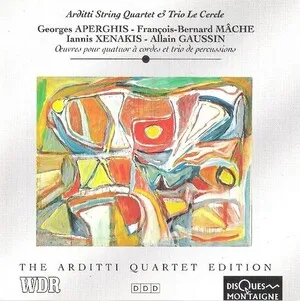
Œuvres pour quatuor à cordes et trio de percussions
Georges Aperghis / Arditti Quartet / Trio Le Cercle
New Complexity
Classical
1990
1
/5
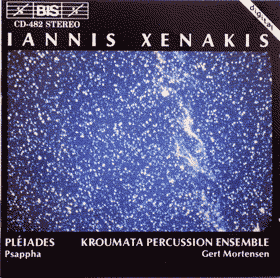
Pléiades; Psappha
Iannis Xenakis Ιάννης Ξενάκης / Kroumata / Gert Mortensen
Stochastic Music
1990
1
/5
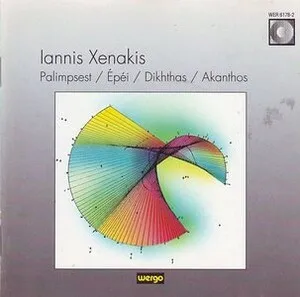
Palimpsest; Épéi; Dikhthas; Akanthos
Iannis Xenakis Ιάννης Ξενάκης
Stochastic Music
Classical
1986
1
/5
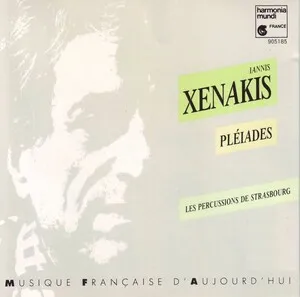
Pléïades
Iannis Xenakis Ιάννης Ξενάκης / Les Percussions de Strasbourg
Stochastic Music
Similar artists
2
/5
Karlheinz Stockhausen
Integral Serialism
Serialism
Darmstadt School
1
/5
Various Artists
Afro-Funk
Alternative Rock
Ambient
2
/5
Raymond Scott
Acousmatic
Electronic
Children's Music
1
/5
Arditti Quartet
Chamber Music
Classical
String Quartet
1
/5
Arturo Tamayo
Orchestral
Classical
Stochastic Music
2
/5
WDR Sinfonieorchester Köln
Classical
Avant-Garde
Darmstadt School
1
/5
Robert Ashley
Spoken Word
Acousmatic
Experimental
1
/5
Éliane Radigue
Drone
Experimental
Ambient
1
/5
Luigi Nono
Darmstadt School
Classical
Acousmatic
1
/5
Stephen Drury
Avant-Garde
Minimalism
Ballet
Download our mobile app
Get the Melodigging app and start digging for new genres on the go
Download on the App Store
Get it on Google Play
© 2026 Melodigging
Give feedback
Legal
Melodding was created as a tribute to
Every Noise at Once
, which inspired us to help curious minds keep digging into music's ever-evolving genres.