Genres
Artists
Albums
Make Music
Sign in
Sign in
Artists
Integral Serialism
Artists
Integral Serialism
Karlheinz Stockhausen
1960–2023
·
33 albums
Listen
2
/5
Genres
New Isolationism
New isolationism is a contemporary strain of isolationist ambient and post-industrial minimalism that emerged in the 2010s, particularly around Scandinavian experimental labels and studios. It foregrounds intimate, close-mic’d sound, negative space, and a quiet-but-present noise floor; its pieces feel both internal and architectural, like rooms built from reverb tails, tape hiss, and soft electronics. Sonically, the style blends glacial drones, fragile chamber timbres (strings, organ, piano), lo‑fi electronics, and field recordings into stark, slow-evolving tableaux. Melodic information is sparse—often only a few tones or gestures—while rhythm is either absent or reduced to distant pulses, heartbeats, or mechanical cycles. Vocals, when they appear, are murmured, diaristic, or abstracted by pitch and time manipulation. Aesthetically, new isolationism is post‑internet and diaristic: it captures solitude, memory, and dislocation with a palette that feels personal yet estranged, drawing as much from contemporary gallery sound practice as from classic dark ambient.
Discover
Listen
Modern Classical
Modern classical is a contemporary strand of instrumental music that applies classical composition techniques to intimate, cinematic settings. It typically foregrounds piano and strings, is sparsely orchestrated, and embraces ambience, repetition, and timbral detail. Rather than the academic modernism of the early 20th century, modern classical as used today refers to accessible, mood-driven works that sit between classical, ambient, and film music. Felt pianos, close‑miked string quartets, tape hiss, drones, soft electronics, and minimal harmonic movement are common, producing a contemplative, emotionally direct sound that translates well to headphones, streaming playlists, and screen media.
Discover
Listen
Krautrock
Krautrock is an experimental form of rock that emerged in late-1960s West Germany, characterized by hypnotic repetition, long-form structures, and a forward-looking embrace of electronics and studio experimentation. It typically features a steady, driving 4/4 “motorik” beat, circular bass ostinatos, sparse harmonic movement, and textural layering that draws from minimalism, free improvisation, and avant-garde composition. Rather than virtuosic solos, the emphasis is on collective groove, trance-inducing momentum, and timbral exploration. The sound ranges from raw, percussive jams to spacious, cosmic electronics, often eschewing conventional Anglo-American blues forms in favor of a distinctly European modernist aesthetic.
Discover
Listen
Minimalism
Minimalism is a style of Western art music that emerged in the United States during the 1960s, characterized by the use of very limited musical materials, steady pulse, and extensive repetition. Composers often build pieces from short cells or motifs that are repeated and slowly transformed through additive or subtractive processes, phase shifting, and gradual changes in harmony, texture, or register. Harmony is typically consonant (often modal or diatonic), though just intonation and extended drones are also common. The result is music that foregrounds process, clarity, audibility of structure, and a hypnotic sense of stasis and flow. Typical ensembles include keyboards, mallet percussion, strings, winds, voices, and electronics or tape. Minimalism influenced a wide array of later styles, from ambient and new age to post-minimalism and minimal techno.
Discover
Listen
Process Music
Process music is a movement in which a composition is generated by a clearly defined procedure or rule-set. Sometimes this procedure is made audible—so the listener can follow the gradual changes as they unfold—and sometimes the process remains hidden behind the surface of the sound. Typical processes include phasing (two identical patterns drifting out of sync), additive or subtractive procedures (expanding or contracting a pattern by fixed steps), iterative feedback (repeating an operation so the output becomes the next input), permutations, stochastic or probabilistic rules, or instruction-based performance systems. The aesthetic ranges from hypnotic and pulse-driven to fragile and static, but the core idea remains: the music arises from the process.
Discover
Listen
Integral Serialism
Integral serialism (also called total serialism) is a post–World War II compositional approach that extends the serial ordering principle beyond pitch to other musical parameters such as duration, dynamics, timbre, articulation, and register. Instead of relying on tonal harmony or freely atonal gestures, the composer constructs one or more ordered sets (series) for each parameter and subjects them to systematic transformations (inversion, retrograde, transposition, permutation) and cross-mappings. The result is highly controlled, pointillistic textures and tightly organized forms whose coherence derives from parametric organization rather than tonal function. Its sound world often features fragmented gestures, rapid contrasts of dynamics and articulation, and intricate rhythmic structures. While perceived as austere or rigorous, it enabled composers to craft micro-detailed musical behaviors and helped forge the postwar European avant-garde’s language.
Discover
Listen
Darmstadt School
The Darmstadt School refers to the post–World War II circle of composers who gathered around the Internationale Ferienkurse für Neue Musik (International Summer Courses for New Music) in Darmstadt, West Germany. Characterized by rigorous serial and post-serial techniques, extreme control of musical parameters (pitch, rhythm, dynamics, timbre), and a rejection of tonal and romantic idioms, the style prized structural clarity, pointillist textures, and an ascetic, laboratory-like approach to sound. While aesthetically diverse, its core ethos was a modernist drive toward formal innovation, often engaging electronic media and advanced notation, and deeply influenced by the Second Viennese School—especially Webern’s concise, atomized writing.
Discover
Listen
Indeterminacy
Indeterminacy is a strand of post‑war experimental music in which some aspects of a composition are left to chance or to the free choice of the performer, ensuring that no two realizations are exactly the same. The approach encompasses chance procedures used during composition (e.g., tossing coins or consulting the I Ching), open or mobile forms in which sections may be reordered, graphic or text‑based notation that prompts interpretation rather than strict reading, and time‑bracket techniques that specify durations but not exact synchrony. Closely associated with the New York School (John Cage, Earle Brown, Morton Feldman, Christian Wolff), indeterminacy challenged traditional authorship, fixed works, and score‑bound precision by shifting agency to processes and performers. While often conflated with “aleatoric” music, indeterminacy typically denotes unpredictability at the level of performance/realization (open form, variable notation), whereas chance composition may use randomness to create a fixed score. In practice, many works combine both.
Discover
Listen
Experimental
Experimental music is an umbrella term for practices that prioritize exploration, process, and discovery over adherence to established genre norms. It embraces new sound sources, nonstandard tuning systems, indeterminacy and chance operations, graphic and open-form scores, extended techniques, and technology-led sound design (tape, electronics, computers, and live processing). Rather than a single style, it is a methodology and ethos: testing hypotheses about sound, structure, and performance, often blurring boundaries between composition, improvisation, sound art, and performance art. Listeners can expect unfamiliar timbres, unusual forms, and an emphasis on how music is made as much as the resulting sound.
Discover
Listen
Stochastic Music
Stochastic music is a 20th‑century avant‑garde approach in which musical parameters are governed by probability theory and random processes rather than fixed, note‑by‑note determination. Instead of traditional melody and harmony, composers shape "sound masses" by controlling statistical features like density, event rate, pitch distributions, durations, and dynamics. Typical tools include Gaussian, Poisson, and Markov processes, which create evolving textures, swarms, and clouds of sound—often realized in both orchestral and electroacoustic settings. The term is most closely associated with Iannis Xenakis, who formalized the method and demonstrated it in landmark works and writings, but it has deeply influenced computer music, experimental electronic practices, and later microsound/granular approaches.
Discover
Listen
Acousmatic
Acousmatic music is a form of electroacoustic composition created specifically for loudspeakers, where the audience hears sounds without seeing their sources. The genre privileges timbre, morphology, and spatial movement over traditional melody and harmony, and it is often experienced in darkened auditoria to sharpen attention to pure listening. Composers typically work with recorded or synthesized sounds—ranging from environmental recordings and instrumental fragments to purely electronic textures—then edit, transform, and organize them into a fixed medium. Performance focuses on diffusion: the live projection of a fixed track across a multichannel loudspeaker array to sculpt space and perspective in real time.
Discover
Listen
Electroacoustic
Electroacoustic music is a broad art-music tradition that integrates recorded acoustic sound and electronically generated or processed sound into coherent musical works. It privileges timbre, gesture, texture, and spatialization over conventional melody-and-harmony song forms, often employing tape manipulation, synthesis, live electronics, and computer-based signal processing. Works are frequently composed for fixed media (stereo or multichannel loudspeakers) and may also involve live performers who are transformed in real time. Concert presentation typically emphasizes spatial diffusion and immersive listening, and the repertoire spans concert works, radio pieces, installations, and soundscape compositions.
Discover
Listen
Musique Concrète
Musique concrète is an electroacoustic approach to composition that uses recorded real‑world sounds (objets sonores) as primary material rather than traditional instruments or notation. Composers edit, splice, loop, reverse, time‑stretch, filter, and otherwise transform these recordings to create works designed for loudspeakers. Emerging in late‑1940s France, it introduced acousmatic listening—focusing on the sound itself, detached from its source—along with a morphology‑based vocabulary of gesture, texture, and timbre. Historically realized on tape and now on digital audio workstations, musique concrète privileges montage and transformation over conventional harmony and meter, inviting listeners into a rich, tactile world of sonic phenomena.
Discover
Listen
Serialism
Serialism is a compositional method in which musical parameters are organized into ordered series that govern a work’s structure. Most famously, twelve‑tone serialism uses an ordered row of the 12 pitch classes, deploying transformations such as prime, inversion, retrograde, and retrograde inversion to avoid traditional tonal hierarchy. While Schoenberg’s twelve‑tone technique focuses on pitch, post‑war composers expanded the idea to "total" or "integral" serialism, applying series to rhythm, dynamics, articulation, timbre, and register. The results often emphasize clarity of event over tonal center, pointillistic textures, and rigorous formal control. Aesthetic outcomes range from Berg’s expressive lyricism to Webern’s ultra‑condensed, crystalline writing, and later to the highly systematized post‑war European avant‑garde. Serialism remains a cornerstone of 20th‑century modernist practice, whether embraced, extended, or reacted against by subsequent movements.
Discover
Listen
Avant-Garde
Avant-garde music is an umbrella term for boundary-pushing practices that challenge prevailing norms of harmony, rhythm, timbre, form, and performance. It privileges experimentation, conceptual rigor, and a willingness to reframe what counts as music at all. Historically tied to early 20th‑century artistic modernism, avant-garde music introduced atonality, the emancipation of noise, and new forms of notation and process. It embraces indeterminacy, extended techniques, electronics, spatialization, and multimedia performance, treating sound as material to be sculpted, questioned, and reinvented.
Discover
Listen
Electronic
Electronic is a broad umbrella genre defined by the primary use of electronically generated or electronically processed sound. It encompasses music made with synthesizers, drum machines, samplers, computers, and studio/tape techniques, as well as electroacoustic manipulation of recorded or synthetic sources. The genre ranges from academic and experimental traditions to popular and dance-oriented forms. While its sonic palette is rooted in electricity and circuitry, its aesthetics span minimal and textural explorations, structured song forms, and beat-driven club permutations. Electronic emphasizes sound design, timbre, and studio-as-instrument practices as much as melody and harmony.
Discover
Listen
Étude
An étude is a short solo instrumental piece, most commonly for piano, designed to develop a specific technical skill while also standing as a musically satisfying work. Emerging in the early 19th century from pedagogical "studies," the concert étude transformed drill-like patterns (arpeggios, octaves, double notes, leaps, rapid scales, polyrhythms) into expressive miniatures suitable for the stage. Typical études are through-composed or ternary in shape, last a few minutes, and center on a single technical focus that is woven into the musical fabric. Although most associated with the piano, the étude tradition extends to violin, winds, brass, and other instruments, where sets of studies target instrument-specific techniques. Over time the genre has ranged from classical tonality (Czerny, Chopin) to late-Romantic and modern harmonic languages (Rachmaninoff, Scriabin, Debussy) and into avant-garde textures and extended techniques (Ligeti).
Discover
Listen
Cantata
A cantata is a multi-movement vocal composition with instrumental accompaniment, typically written for one or more soloists, choir, and a continuo or small orchestra. It may be sacred (for liturgical use) or secular (for courtly or domestic performance). Emerging in early 17th-century Italy, the cantata adopts the expressive recitative–aria contrast of opera on a smaller scale. Baroque church cantatas—especially in the German Lutheran tradition—often weave congregational chorales, contrapuntal choruses, and solo arias into a coherent cycle tied to the liturgical calendar. Stylistically, cantatas use tonal Baroque harmony, basso continuo, and movement types such as recitativo secco/accompagnato, da capo arias, choruses, and sinfonias. The genre later broadened into concert and scenic cantatas in the 19th and 20th centuries.
Discover
Listen
Classical
Classical music is the notated art-music tradition of Europe and its global descendants, characterized by durable forms, carefully codified harmony and counterpoint, and a literate score-based practice. The term “classical” can refer broadly to the entire Western art-music lineage from the Medieval era to today, not just the Classical period (c. 1750s–1820s). It privileges long-form structures (such as symphonies, sonatas, concertos, masses, and operas), functional or modal harmony, thematic development, and timbral nuance across ensembles ranging from solo instruments to full orchestras and choirs. Across centuries, the style evolved from chant and modal polyphony to tonal harmony, and later to post-tonal idioms, while maintaining a shared emphasis on written notation, performance practice, and craft.
Discover
Listen
Show all 19 genres
Albums
2023
1
/5
Ogura Plays Stockhausen
Karlheinz Stockhausen / Miharu Ogura 小倉美春
Integral Serialism
2021
1
/5
Momente
Karlheinz Stockhausen
Cantata
2018
1
/5
Gaze Through the Stars (Tierkreis, Intuitive Music)
Karlheinz Stockhausen
Integral Serialism
2018
1
/5
Gesang der Jünlinge
Karlheinz Stockhausen
Serialism
Acousmatic
2015
1
/5
Kontakte
Karlheinz Stockhausen
Serialism
2014
1
/5
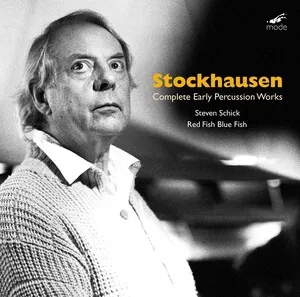
Complete Early Percussion Works
Karlheinz Stockhausen / red fish blue fish / Steven Schick
Darmstadt School
2013
2
/5
A Young Person's Guide to the Avant-Garde
Karlheinz Stockhausen
Serialism
2001
1
/5
Gruppen; Punkte
Karlheinz Stockhausen / WDR Sinfonieorchester / Péter Eötvös
Serialism
2000
1
/5
Piano Music of the Darmstadt School Vol. 1
Olivier Messiaen / Steffen Schleiermacher
Darmstadt School
Integral Serialism
Classical
1993
1
/5
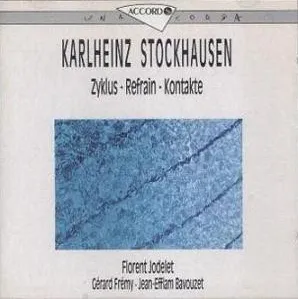
Zyklus; Refrain; Kontakte
Karlheinz Stockhausen
Integral Serialism
1988
1
/5
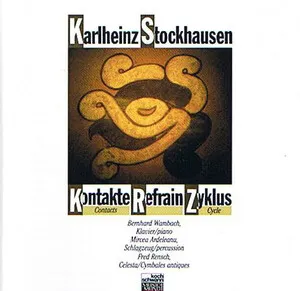
Kontakte; Refrain; Zyklus
Karlheinz Stockhausen
Integral Serialism
1988
1
/5
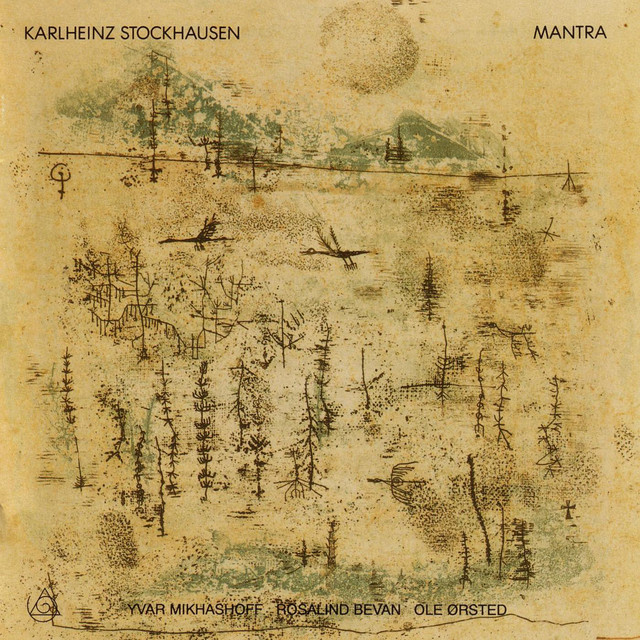
Mantra
Karlheinz Stockhausen
Serialism
Acousmatic
Classical
1970
1
/5
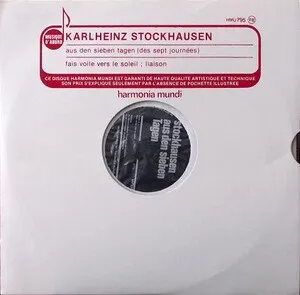
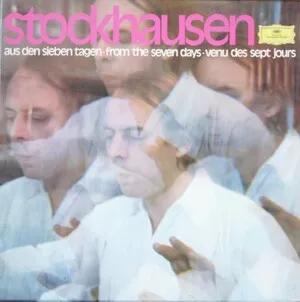
Aus den sieben Tagen
Karlheinz Stockhausen
Indeterminacy
1962
1
/5
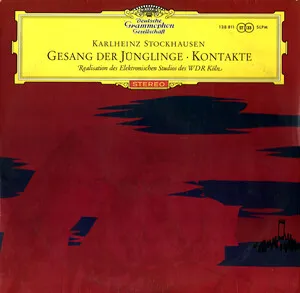
Gesang der Jünglinge; Kontakte
Karlheinz Stockhausen / Studio für elektronische Musik des Westdeutschen Rundfu…
Integral Serialism
Darmstadt School
Acousmatic
1960
1
/5
Studie I; Studie II; Gesang der Jünglinge
Karlheinz Stockhausen / Studio für elektronische Musik des Westdeutschen Rundfu…
Integral Serialism
Étude
Acousmatic
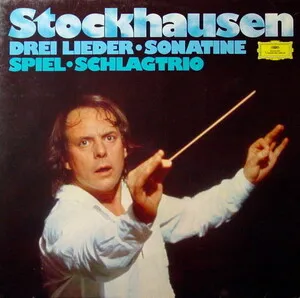
Drei Lieder; Sonatine; Spiel; Schlagtrio
Karlheinz Stockhausen
Darmstadt School
Kontakte für elektronische Klänge, Klavier und Schlagzeug
Karlheinz Stockhausen
Darmstadt School
Aus den sieben Tagen
Karlheinz Stockhausen
Darmstadt School
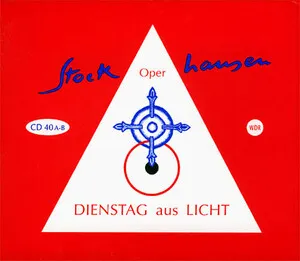
Dienstag aus Licht
Karlheinz Stockhausen
Serialism
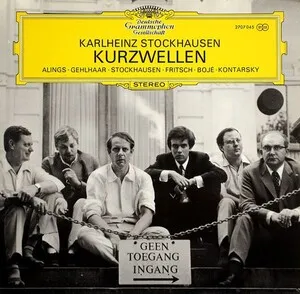
Kurzwellen
Karlheinz Stockhausen
Serialism
Kontakte für elektronische Klänge, Klavier und Schlagzeug
Karlheinz Stockhausen
Serialism
»Gruppen« für 3 Orchester; »Carré« für 4 Orchester und 4 Chöre
Karlheinz Stockhausen
Serialism
Oktophonie
Karlheinz Stockhausen
Electroacoustic
Oktophonie
Karlheinz Stockhausen
Acousmatic
Prozession
Karlheinz Stockhausen
Process Music
Kurzwellen
Karlheinz Stockhausen
Process Music
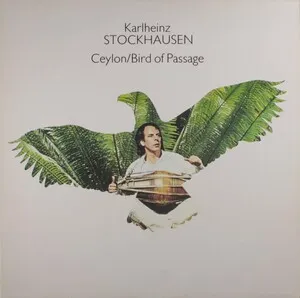
Ceylon; Bird of Passage
Karlheinz Stockhausen
Indeterminacy
Aus den sieben Tagen
Karlheinz Stockhausen
Indeterminacy
Prozession
Karlheinz Stockhausen
Stochastic Music
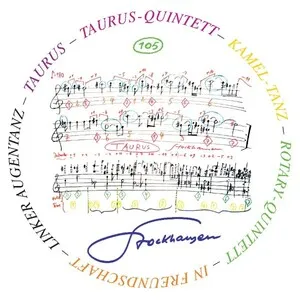
In Freundschaft; Linker Augentanz; Taurus; Taurus-Quintett; Kamel-Tanz; Rotary-Quintett
Karlheinz Stockhausen
Integral Serialism
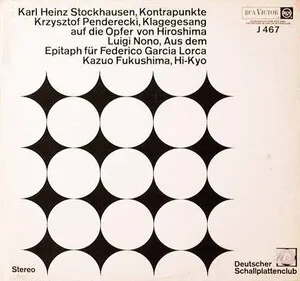
Kontrapunkte / Klagegesang auf die Opfer von Hiroshima / Aus dem Epitaph für Federico Garcia Lorca / Hi-kyò
Karlheinz Stockhausen
Integral Serialism
Kontakte für elektronische Klänge, Klavier und Schlagzeug
Karlheinz Stockhausen
Integral Serialism
»Gruppen« für 3 Orchester; »Carré« für 4 Orchester und 4 Chöre
Karlheinz Stockhausen
Integral Serialism
Similar artists
2
/5
WDR Sinfonieorchester Köln
Classical
Avant-Garde
Darmstadt School
3
/5
Pierre Boulez
Classical
Serialism
Second Viennese School
1
/5
Luigi Nono
Darmstadt School
Classical
Acousmatic
1
/5
Arditti Quartet
Chamber Music
Classical
String Quartet
1
/5
Bruno Maderna
Darmstadt School
Avant-Garde
Classical
1
/5
Various Artists
Afro-Funk
Alternative Rock
Ambient
2
/5
Luciano Berio
Serialism
Avant-Garde
Darmstadt School
2
/5
Olivier Messiaen
Classical
Mélodie
Chamber Music
2
/5
Robert Craft
Classical
Neoclassicism
Ballet
2
/5
Ensemble Intercontemporain
Avant-Garde
Chamber Music
Classical
Download our mobile app
Get the Melodigging app and start digging for new genres on the go
Download on the App Store
Get it on Google Play
© 2026 Melodigging
Give feedback
Legal
Melodding was created as a tribute to
Every Noise at Once
, which inspired us to help curious minds keep digging into music's ever-evolving genres.