Genres
Artists
Albums
Make Music
Sign in
Sign in
Artists
Gamelan
Artists
Gamelan
Gamelan Semara Pegulingan
1991
·
1 album
Listen
1
/5
Genres
Traditional Music
Traditional music is an umbrella term used in the mid–20th century by folklorists and ethnomusicologists to denote community-rooted, orally transmitted repertoires tied to social ritual, work, celebration, and storytelling. Unlike commercial pop or art-music traditions, traditional music is typically learned by ear, varies regionally, and evolves slowly through communal participation. It often features modal melodies, cyclic rhythms, heterophony or unison singing, and indigenous instruments whose timbres are integral to local identity. Lyrics tend to preserve language, history, and collective memory. While the musical practices themselves can be ancient, the phrase “traditional music” emerged to replace earlier, narrower or colonial framings like “folk” or “ethnic” music, foregrounding continuity, locality, and living practice rather than exoticism.
Discover
Listen
Gamelan Semar Pegulingan
Gamelan Semar Pegulingan is a refined Balinese court gamelan style known for its sweet, flowing melodies, delicate textures, and moderate tempos. The name “semar pegulingan” is often glossed as music for the royal sleeping quarters, reflecting its intimate, elegant function in palace life. The ensemble typically uses a seven-tone pelog (saih pitu) tuning system, from which five-tone modes (patutan) are selected for specific pieces. The sound is led by the trompong (kettle-gong melody leader) and supported by suling (bamboo flutes), metallophones of varying registers, drums, small timekeeping gongs, and the large colotomic gongs that articulate formal cycles. It is largely instrumental and often accompanies graceful court dances such as legong.
Discover
Listen
Balinese Gamelan
Balinese gamelan is the vibrant, bronze-percussion ensemble tradition of Bali, Indonesia, known for brilliant timbres, explosive dynamics, and agile interlocking rhythms. It is performed by community-based ensembles (sekaa), often to accompany temple rituals, dance-drama, and shadow puppetry, but it also thrives as a concert art. Its sound-world centers on metallophones (gangsa), kettle-gongs (reyong/trompong), large hanging gongs (gong ageng, kempur), hand drums (kendang), and cymbals (ceng-ceng), with bamboo flutes (suling) and occasional fiddle (rebab). Paired tuning (ombak) creates a deliberate “shimmer” through slightly detuned instrument pairs, while interlocking parts (kotekan) generate dazzling, motoric textures. Modal practice draws on five- and seven-tone collections with named modes (e.g., selisir, tembung), articulated through cyclical gong structures (gongan).
Discover
Listen
Balinese Music
Balinese music refers to the rich ensemble and vocal traditions of the island of Bali, Indonesia, best known for its vibrant bronze gamelan orchestras, tightly interlocking rhythms, and brilliant dynamic contrasts. It encompasses many ensemble types—such as gong kebyar, gender wayang, angklung, jegog, and beleganjur—each tied to specific social functions including temple ceremonies, dance-drama, processions, and modern stage performance. Balinese tuning systems (sléndro- and pélog-derived local modes) are uniquely realized through paired instruments tuned slightly apart to create a characteristic acoustic “shimmer” (ombak). The music’s hallmark techniques include rapid interlocking figuration (kotekan), bold sectional contrasts (kebyar “explosions”), and drum-led cues (angsel) that synchronize music and dance. While deeply rooted in ritual and community life, Balinese music has also become a global influence, informing modern composition and cross-cultural collaborations.
Discover
Listen
Gamelan
Gamelan is a traditional Indonesian ensemble music, centered on tuned metal percussion (metallophones and gongs), drums, and soft-sounding melodic instruments. It is most closely associated with the islands of Java and Bali, where distinct courtly and village traditions evolved. Its sound is defined by cyclical structures marked by gongs (colotomic cycles), interlocking figurations, and modal systems (laras) called sléndro and pélog. Textures are “stratified,” with a core melody (balungan) surrounded by elaborating parts. The result ranges from serene, floating atmospheres to dazzling, kinetic brilliance, depending on region and context. Beyond ceremony and theater (wayang), gamelan has influenced global composers and experimentalists, while continuing to thrive in Indonesia as a living, communal art.
Discover
Listen
Albums
1991
1
/5
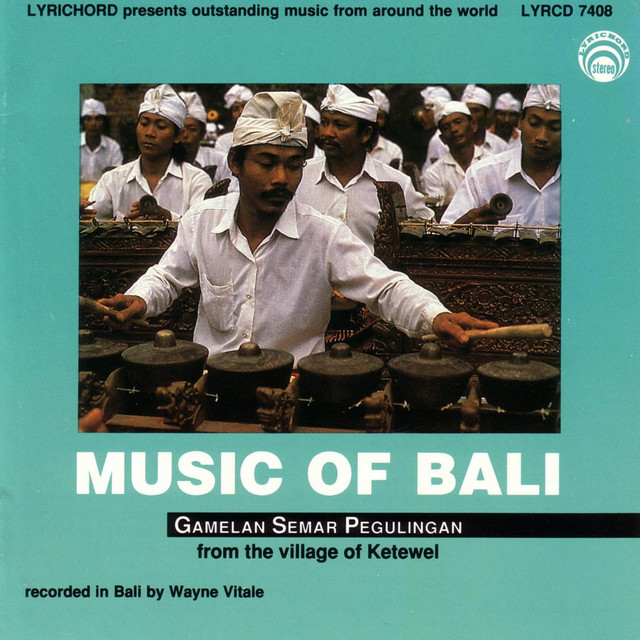
Music of Bali: Gamelan Semar Pegulingan From the Village of Ketewel
Sekehe Legong Bidadari Indra Parwati
Gamelan Semar Pegulingan
Balinese Music
Balinese Gamelan
Similar artists
1
/5
Gong kebyar
Traditional Music
Balinese Gamelan
Balinese Music
1
/5
Terompong beruk
Traditional Music
Balinese Gamelan
Balinese Music
1
/5
Gong Kebyar De Sebatu
Traditional Music
Balinese Gamelan
Balinese Music
1
/5
Tirta Sari
Gamelan Gong Kebyar
Balinese Gamelan
Balinese Music
1
/5
Werdi Sentana
Traditional Music
Balinese Gamelan
Balinese Music
1
/5
Sekar Jaya Gamelan
Traditional Music
Balinese Gamelan
Balinese Music
Gamelan Semar Pegulingan Saih Pitu
Balinese Gamelan
Balinese Music
Gamelan
1
/5
Sanggar Ceraken of Bali
Avant-Garde
Minimalism
Traditional Music
1
/5
Swara Cipta Priyanti
Traditional Music
Balinese Gamelan
Balinese Music
4
/5
Traditional
Gregorian Chant
Spanish Classical Music
Medieval Classical Music
Download our mobile app
Get the Melodigging app and start digging for new genres on the go
Download on the App Store
Get it on Google Play
© 2026 Melodigging
Give feedback
Legal
Melodding was created as a tribute to
Every Noise at Once
, which inspired us to help curious minds keep digging into music's ever-evolving genres.