Your digging level

For this genre
0/8
🏆
Sign in, then listen to this genre to level up

Description

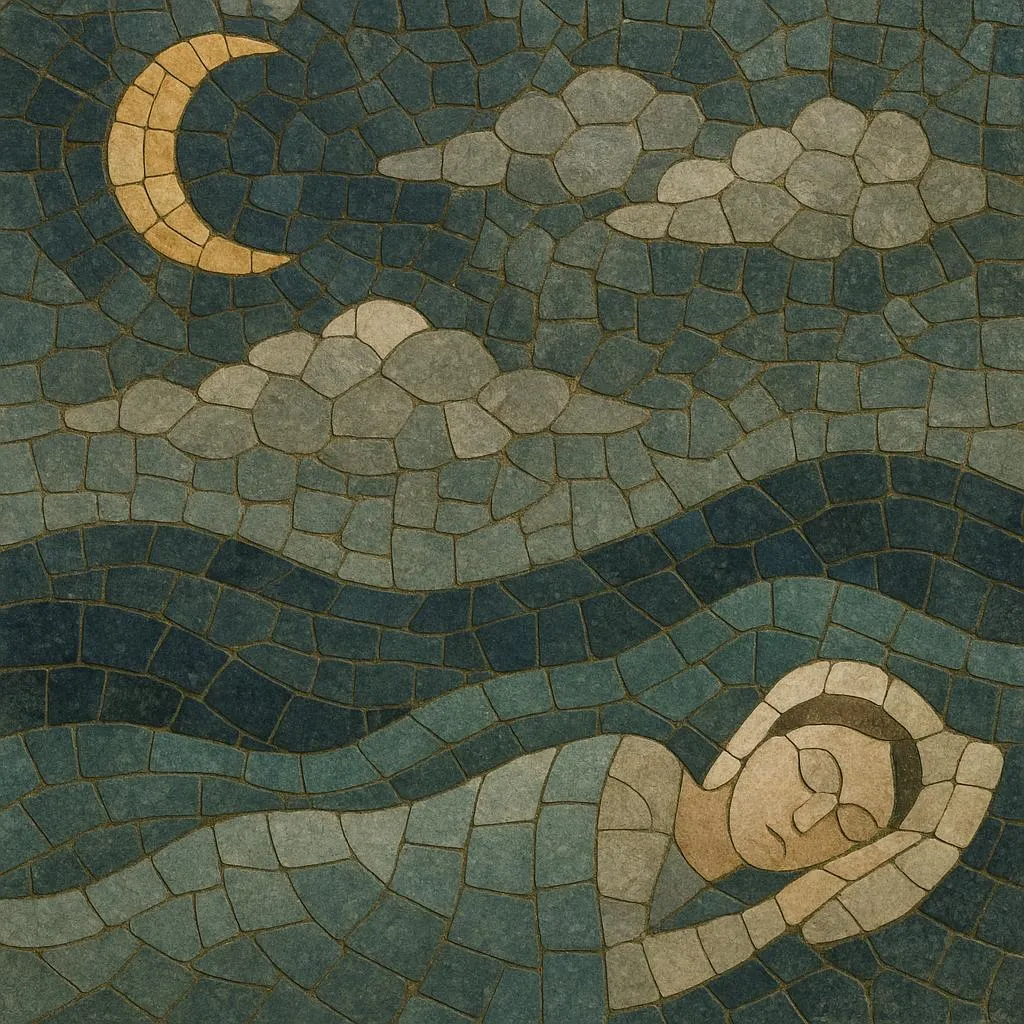
Sleep is a functional music category designed to support falling asleep and sustaining restful, uninterrupted sleep. It favors extremely low stimulation: slow or absent pulse, very soft dynamics, long envelopes, and timbres that avoid sharp transients.

Stylistically, it borrows from ambient and new-age traditions (drones, gentle pads, soft piano), environmental and field recordings (rain, waves, wind), and unobtrusive tonal fragments. Production emphasizes smooth spectral balance, minimal movement, and gradual change so the listener can disengage without sudden arousal.

In the streaming era, “sleep” became a distinct, curated space: long-form tracks and continuous mixes, colored-noise beds, and sparse neoclassical motifs, optimized for bedtime routines, night-long playback, and bedroom acoustics.

Sources: Spotify, Wikipedia, Discogs, RYM, MB, user feedback and other online sources

History

Origins (1970s–2000s)
•   Sleep music inherits its aesthetic from ambient and new-age lineages. Brian Eno’s ambient concept ("as ignorable as it is interesting") and earlier furniture-music ideals (via Satie) set the precedent for low-stimulation listening. •   Through the 1980s–2000s, new-age and drone artists, environmental recordings, and meditation albums normalized unobtrusive, slowly evolving textures suitable for relaxation and bedtime.
Streaming Era and the Functional Turn (2010s)
•   The 2010s saw sleep consolidated as a named category on streaming platforms and wellness apps. Curated playlists, very long tracks, and loopable sound beds emerged to minimize interruptions and reduce sleep-onset latency. •   Parallel micro-scenes flourished: colored-noise channels, minimalist piano lullabies, long-form drones, and weightless/zero-beat atmospheres. Production became purpose-built (soft attacks, low dynamic contrast, sub-60 BPM or beatless pacing).
Present Day (2020s–)
•   Sleep sits alongside "study," "focus," and "meditation" as part of an everyday functional listening ecosystem. It spans artisanal ambient composers, neoclassical writers, and anonymous production teams optimized for consistent nightly playback. •   While some creators experiment with binaural beats or solfeggio tunings, the core of the genre remains psychoacoustically modest: smooth spectra, gentle midrange focus, and minimal novelty—supporting predictable, soothing nighttime soundscapes.

How to make a track in this genre

Sound Palette and Instrumentation
•   Favor sustained sources: synth pads, bowed/softened strings, mellow electric pianos, delicate acoustic piano (felted or heavily damped), and gentle granular textures. •   Blend in environmental layers (rain, ocean, distant wind, room tone) at low level to provide a consistent auditory “blanket.” Avoid bright, percussive transients and hard attacks.
Harmony, Melody, and Tempo
•   Use consonant, slowly changing harmony (e.g., I–IV, modal drones, or static tonal centers). Extended chords (add9, sus, sixths) work well when voiced softly and low in density. •   Keep melody fragmentary and narrow in range; avoid hooks that demand attention. Consider beatless structures or a pulse under ~60 BPM with long note values.
Rhythm and Structure
•   Prefer no drums; if used, employ very soft, filtered, and sparse hits with long attacks. Design pieces as long arcs (10–60+ minutes) with imperceptible transitions and looping-safe endings. •   Introduce change through timbral evolution, stereo width shifts, or slow filter sweeps rather than harmonic or rhythmic events.
Mixing and Mastering
•   Aim for gentle dynamics (low crest factor) without heavy pumping. Use slow compressors and soft limiters; target a conservative loudness (e.g., roughly −20 to −24 LUFS integrated) and avoid sudden peaks that could wake listeners. •   Tame highs (2–8 kHz) and manage low end (<40 Hz) to reduce harshness and room rumble. Broad, natural reverbs help blend sources; keep panning movement subtle.
Optional Psychoacoustic Elements
•   Binaural beats or isochronic tones can be added very quietly if desired, but keep claims modest—listener comfort and consistency matter more than special effects. •   Colored noise (pink/brown) can mask environmental disturbances; shape it to sit behind musical content without hiss.
Delivery Tips
•   Provide gapless sequencing and crossfades. Offer alternate versions (with/without environmental layers). Test at very low playback volumes on small speakers to ensure nothing startles the listener.

Top tracks

Locked
Share your favorite track to unlock other users’ top tracks

Upcoming concerts

in this genre
Influenced by
Has influenced

Download our mobile app

Get the Melodigging app and start digging for new genres on the go
© 2026 Melodigging
Melodding was created as a tribute to Every Noise at Once, which inspired us to help curious minds keep digging into music's ever-evolving genres.
Buy me a coffee for Melodigging