Your digging level

For this genre
0/8
🏆
Sign in, then listen to this genre to level up

Description

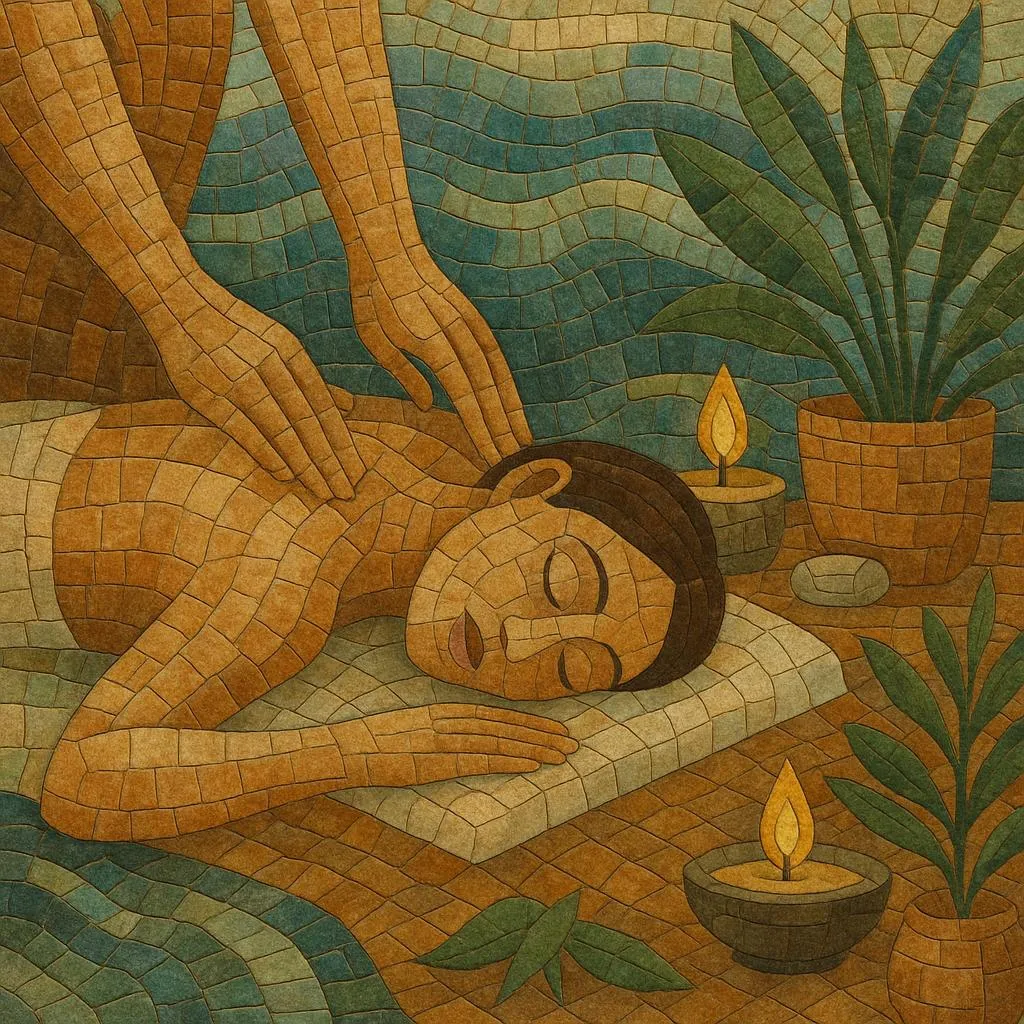
Massage music is a functional, soothing form of ambient/new-age-oriented instrumental music designed to support massage therapy, spa treatments, and wellness practices. It emphasizes calm, uninterrupted flow, soft timbres, and minimal musical surprises so that touch and breath remain the primary focus.

Typical characteristics include slow or beatless pacing, warm drones, gentle piano or acoustic guitar figures, airy pads, wind chimes or bowls, and subtle nature recordings (water, birds, wind). Harmony tends to be consonant and slow-moving, with extended chords or modal palettes that avoid tension. Dynamics remain low and stable, transitions are gradual, and mixes are curated to feel intimate, velvety, and non-intrusive.


Sources: Spotify, Wikipedia, Discogs, Rate Your Music, MusicBrainz, and other online sources

History

Origins and Context

Massage music emerged in the 1990s as wellness culture and professional massage therapy grew, especially in North America and Europe. It drew on the aesthetics of 1970s–80s New Age and Ambient—genres that had already explored long, consonant textures and meditative pacing—and adapted them for explicitly therapeutic, body-centered environments.

Commercialization and Spa Culture

By the late 1990s and 2000s, day spas and holistic health centers standardized music as part of the client experience, prompting labels and producers to create purpose-built albums and long playlists. These recordings emphasized even volume, long fades, and uninterrupted flow that could span a full treatment session. Nature recordings and soft world-influenced timbres (e.g., bamboo flutes, hand percussion used sparingly) became common.

Streaming Era and Functional Design

With the rise of streaming in the 2010s, massage music became a highly curated functional category. Long-form tracks, seamless crossfades, and 60–90-minute sets (to match treatment lengths) proliferated. Production approaches prioritized low fatigue, broadband warmth, reduced transient content, and gentle spatialization. The genre also cross-pollinated with yoga and mindfulness repertoires, and informed newer functional substyles aimed at sleep, focus, and stress reduction.

Aesthetics and Practice

Musically, massage music codified a language of patient harmony, tactile timbre, and near-frictionless transitions. The guiding principle is facilitative design: music that supports nervous system down-regulation, regular breathing, and steady manual technique without drawing attention to itself.

How to make a track in this genre

Core Aesthetic
•   Aim for music that never competes with touch: minimal surprises, consistent dynamics, and smooth continuity. •   Keep the average loudness modest and avoid sharp transients or bright peaks that could startle a client.
Instrumentation and Sound Design
•   Foundation: warm synth pads, bowed or sustained strings, soft piano arpeggios, gentle acoustic guitar, airy flutes, singing bowls, and light chimes. •   Textures: subtle nature recordings (water streams, distant birds, ocean), filtered to avoid harshness. Use wide, soft reverbs and slow modulation for motion without distraction.
Tempo, Rhythm, and Form
•   Tempo: 50–70 BPM if using pulse; many tracks can be beatless or rely on slow, soft pulses instead of drums. •   Rhythm: avoid heavy groove; use gentle swells, long sustains, and sparse, predictable patterns. •   Structure: long phrases (8–16 bars or more), very gradual transitions, no hard stops. Design suites of 15–30 minutes or continuous albums to cover full session lengths.
Harmony and Melody
•   Harmony: consonant, slow-moving; favor suspended chords, add9/add11 sonorities, and modal centers (Dorian, Lydian, Aeolian) with minimal functional tension. •   Melody: sparse and breath-like; avoid high-register brightness. Let motifs reappear subtly to foster coherence without demanding attention.
Mixing and Mastering
•   EQ: roll off harsh highs; smooth low-mid resonance without muddiness. Maintain a warm, enveloping midrange. •   Dynamics: gentle compression for stability; wide headroom to prevent fatigue. •   Spatial: long reverbs with soft pre-delay, moderate stereo width, and consistent ambiance across tracks.
Session-Aware Sequencing
•   Match typical massage durations (60–90 minutes) with continuous flow; provide a few imperceptible markers (e.g., slight timbral shifts) at practical intervals for the therapist. •   Test in a quiet room at low playback levels to ensure details remain soothing and unobtrusive.

Top tracks

Locked
Share your favorite track to unlock other users’ top tracks
Influenced by
Challenges
Digger Battle
Let's see who can find the best track in this genre

Download our mobile app

Get the Melodigging app and start digging for new genres on the go
© 2026 Melodigging
Melodding was created as a tribute to Every Noise at Once, which inspired us to help curious minds keep digging into music's ever-evolving genres.
Buy me a coffee for Melodigging