Your digging level

For this genre
0/8
🏆
Sign in, then listen to this genre to level up

Description

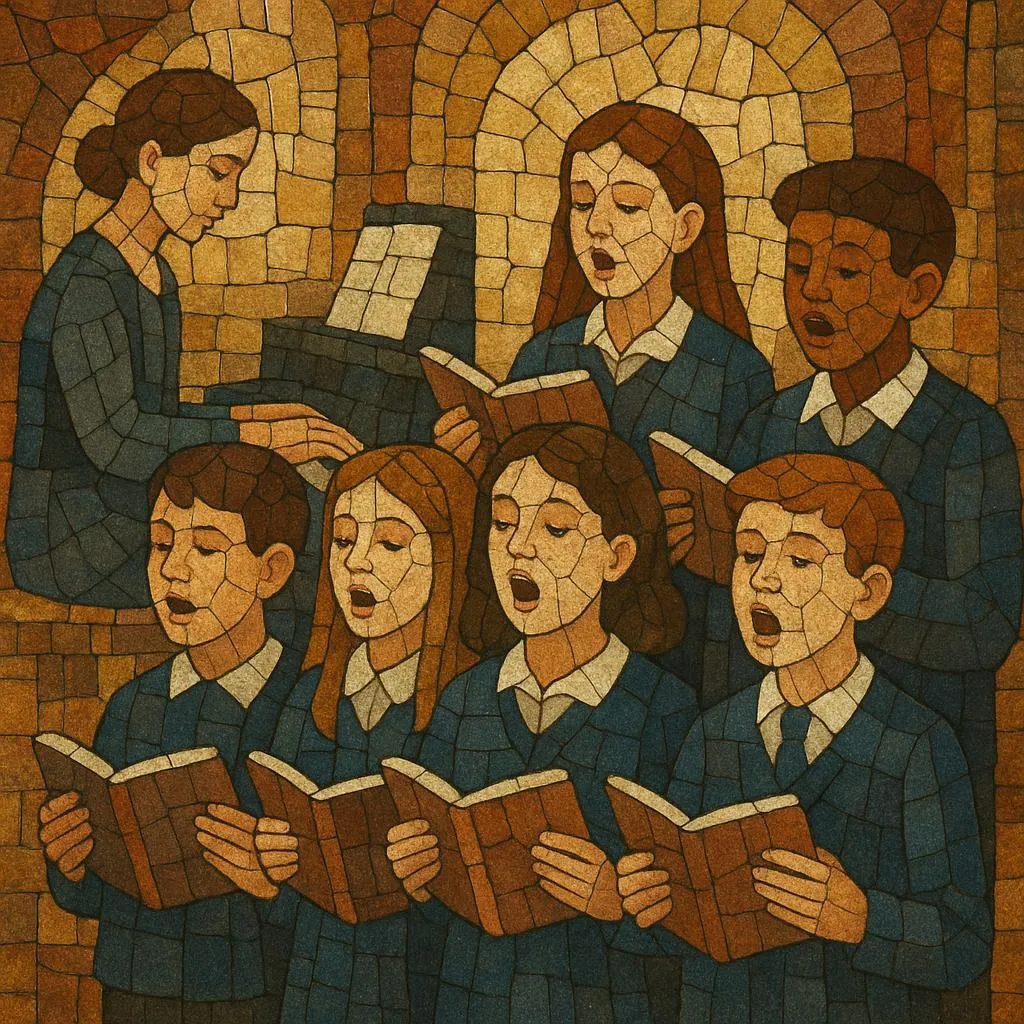
School choir is a choral tradition in which ensembles of school‑age singers rehearse and perform within an educational setting, typically as part of the curriculum or a co‑curricular activity. Depending on age, school choirs range from unison or two‑part treble groups to mixed SATB choirs at the secondary level.

Repertoire is intentionally broad and pedagogical: arrangements of folk songs, seasonal music and hymns, classical miniatures, canons, musical‑theatre and pop adaptations, and increasingly jazz or gospel‑influenced works. Ensembles often sing a cappella as well as with piano, guitar, or school orchestra/band, emphasizing literacy (solfège/tonic‑sol‑fa), blend, diction, and healthy vocal production for changing voices.

Beyond concerts and festivals, school choirs anchor school culture—singing at assemblies, ceremonies, competitions, and community events—while providing foundational training for future collegiate a cappella, community, church, and professional choral singing.


Sources: Spotify, Wikipedia, Discogs, RYM, MB, user feedback and other online sources

History

Origins in Choir Schools (late Middle Ages–Renaissance)

Choir schools attached to cathedrals and collegiate chapels in Britain and across Europe educated young choristers to sing daily services. This institutional model—schooling combined with systematic vocal training—established the template for school‑age choral instruction. Historic ensembles such as English cathedral choirs and the Vienna Boys’ Choir (founded 1498) exemplify these roots.

19th–early 20th Century: Mass Education and Music Pedagogy

With the rise of public education and the spread of classroom singing (e.g., tonic‑sol‑fa and sight‑reading curricula), group singing migrated from cathedral schools into ordinary classrooms. By the early 1900s, dedicated school choirs and festival systems emerged (notably in the UK and later North America), creating standard repertoire, adjudication, and teacher‑training networks.

Mid–late 20th Century: Diversification of Repertoire

Post‑war school choirs widened beyond European sacred/classical miniatures to include folk arrangements, spirituals, gospel and jazz‑influenced works, musical‑theatre medleys, and pop arrangements. Secondary‑level mixed choirs and chamber groups became common, while some programs developed show‑choir and jazz‑choir strands blending choreography and microphones with traditional ensemble skills.

21st Century: Globalization, Media, and Inclusion

Digital platforms, school festivals, and viral performances (e.g., internet‑famous elementary choirs) raised the profile of school ensembles and encouraged culturally diverse programming, student songwriting, and collaborations with bands or orchestras. Virtual choirs during the COVID‑19 era accelerated music‑technology adoption. Today, school choirs serve both artistry and access, centering healthy vocal technique, inclusive repertoire, and community building.

How to make a track in this genre

Ensemble & Voicing
•   Match voicing to age: unison/2‑part for younger treble choirs; SAB (baritone‑friendly) or SATB for secondary ensembles with changing voices. •   Keep ranges comfortable (e.g., sopranos D4–A5; altos A3–D5; cambiata/baritone around G2–E4; bass E2–D4) and avoid tessitura fatigue.
Harmony & Part‑Writing
•   Favor clear, diatonic harmonies and voice‑leading that moves stepwise, with occasional thirds/sixths and suspensions for color. •   Introduce counterpoint and divisi gradually; write independent lines only when literacy and balance allow. •   Use pedagogical moments: canons/partner songs to build part independence; ostinati to support intonation.
Rhythm, Text & Diction
•   Align text underlay to natural speech stress; avoid overlong melismas for novice choirs. •   Choose tempos and rhythms that teach subdivision (syncopation for pop/gospel; swing feel for jazz‑tinged pieces) without overwhelming precision. •   Provide IPA or clear diction notes for foreign‑language repertoire; coach consonant alignment and vowel unity.
Repertoire Planning
•   Balance styles: a cappella miniatures, accompanied pieces, a folk arrangement, one contemporary/pop selection, and a seasonal or culturally specific work. •   Include accessible keys, moderate lengths (2–4 minutes for young choirs), and purposeful challenges (modulations, mixed meter) for growth.
Accompaniment & Orchestration
•   Piano is standard; guitar/ukulele or light percussion (shaker, cajón) can support pop/folk textures. •   For show‑choir or amplified pop, arrange supportive keyboard/bass/drums while preserving choral clarity and safe vocal production.
Rehearsal & Pedagogy
•   Build in warmups targeting range, resonance, and vowels; integrate solfège and call‑and‑response sight‑reading. •   Teach expressive phrasing (breath plan, dynamics, text painting) and ensemble skills (listening for blend/tuning). •   Program inclusive texts and culturally responsive music; offer context notes and pronunciation resources.
Performance Practice
•   Prioritize blend (matched vowels), balanced sections, and healthy volume over sheer loudness. •   Stage in gentle arcs for sightlines/aural contact; for show‑choir, keep choreography singable, protecting breath and posture.

Top tracks

Locked
Share your favorite track to unlock other users’ top tracks

Upcoming concerts

in this genre
Influenced by
Has influenced

Download our mobile app

Get the Melodigging app and start digging for new genres on the go
© 2026 Melodigging
Melodding was created as a tribute to Every Noise at Once, which inspired us to help curious minds keep digging into music's ever-evolving genres.
Buy me a coffee for Melodigging