Your digging level

For this genre
0/8
🏆
Sign in, then listen to this genre to level up

Description

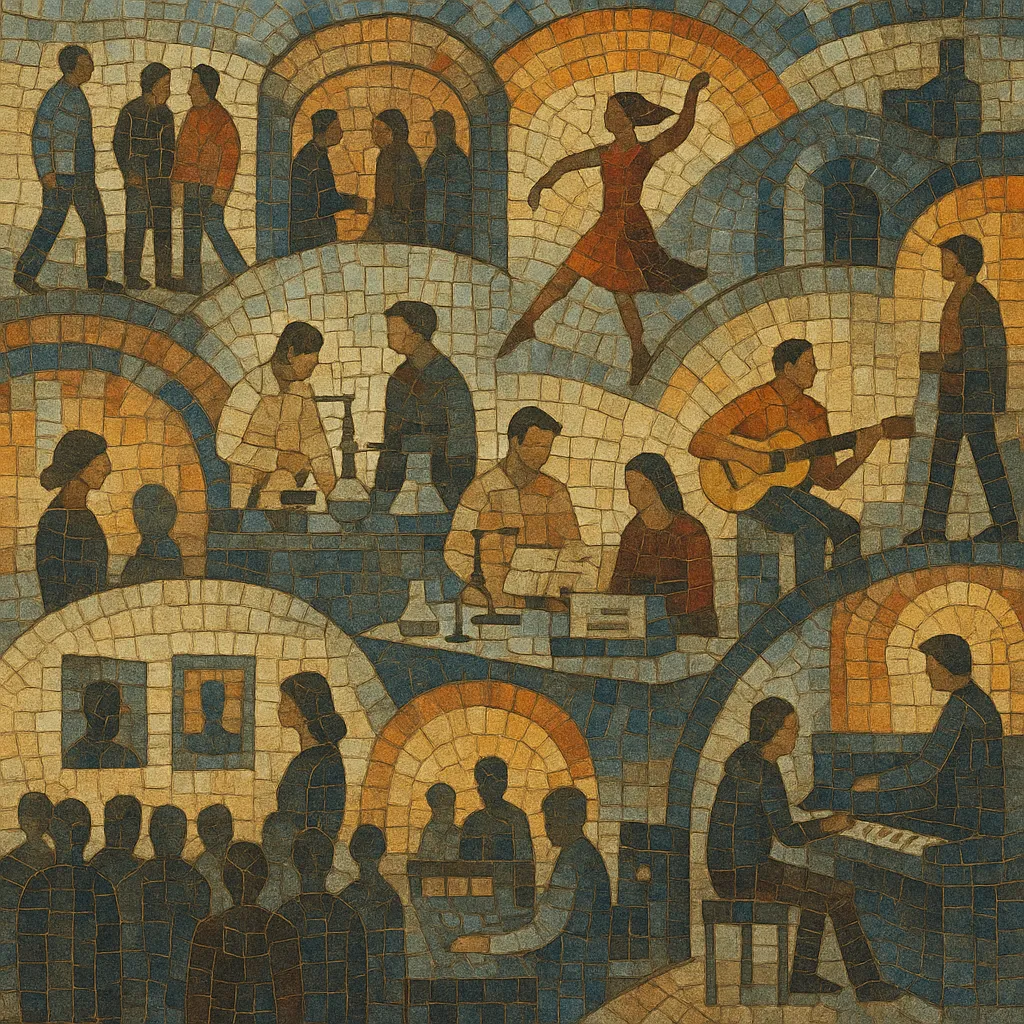
“Scenes & movements” is an umbrella label used for music that is defined as much by a shared place, network, and ethos as by sound. A scene is typically a geographically localized cluster of artists, venues, labels, writers, and audiences who co‑create a recognizable style, story, and set of practices; a movement tends to be a self‑conscious push for aesthetic or social change that may span several locales but shares manifestos, values, and sonic markers.

In practice, these networks generate distinctive repertoires, recording techniques, performance rituals, zines/blogs, and iconography. They also create pipelines for talent development (residencies, DIY venues, indie labels), and a kind of brand—think CBGB in New York, the Haight–Ashbury counterculture, or the Bristol “sound.” Scenes and movements often cut across genre boundaries: they can be rock, hip hop, jazz, electronic, folk, or hybrid—what binds them is community, narrative, and method rather than instrumentation alone.


Sources: Spotify, Wikipedia, Discogs, RYM, MB, user feedback and other online sources

History

Early antecedents (1900s–1940s)

Music communities coalesced well before the term “scene” became standard. Early jazz circles in New Orleans and Chicago, Tin Pan Alley, and bohemian cabarets in Europe operated as proto‑scenes with hubs of venues, publishers, and critics. Cultural movements such as the Harlem Renaissance tied music to wider literary and political currents, anticipating later articulation of “movements.”

Postwar and counterculture (1950s–1970s)

Rock ’n’ roll, beatnik/folk circuits, and post‑bop jazz fostered tight local ecosystems—coffeehouses, independent labels, college radio. The 1960s counterculture birthed highly visible scene‑identities (e.g., San Francisco’s Haight–Ashbury and the Laurel Canyon community), where shared communal living, festivals, and posters forged a movement aesthetic. By the mid‑1970s, punk’s DIY infrastructure (zines, small rooms, independent pressing) offered a reproducible template for scene‑building worldwide and popularized the modern use of “scene.”

Indie, subculture theory, and globalization (1980s–2000s)

Post‑punk, hardcore, hip hop, and electronic music created self‑sufficient circuits: record pools, pirate/community radio, raves, and microlabels. Academic work on subcultures and scenes (and the language in the music press) codified the terms “scene” and “movement.” Regional brands—CBGB scene, Bristol sound, Leningrad Rock Club—became shorthand for collective aesthetics and strategies.

Digital era (2010s–present)

Streaming, Bandcamp, Discord/Reddit servers, and algorithmic playlists foster “platform scenes” that may be glocal—rooted in a city yet coordinated online. Micro‑movements self‑organize around aesthetic tags and curatorial channels, while residencies and grassroots venues remain crucial for in‑person identity. Archival reissues and scene‑focused documentaries further canonize past scenes, feeding cycles of revival and reinterpretation.

How to make a track in this genre

Define the locus and ethos
•   Identify a geographic or virtual hub (a neighborhood, venue circuit, label collective, or online server) and a shared set of values (DIY, political stance, sonic minimalism/maximalism, futurism, retroism). •   Draft a concise “story” (press blurb/manifesto) that links sound, visuals, and community practice. Scenes and movements crystallize around narrative as much as timbre.
Sonic markers and instrumentation
•   Choose recurring production traits: tape saturation or lo‑fi grit (DIY punk/indie), polyrhythmic percussion (Afro‑diasporic scenes), dub‑style space (sound‑system cultures), or specific synth/drum machine palettes (electronic schools). •   Codify performance rituals—residencies, jam sessions, cipher structures, or extended improvisation—to create recognizable formats.
Harmony, rhythm, and form
•   Harmony: agree on a shared harmonic vocabulary (e.g., modal vamps for groove‑based scenes; chromatic or quartal harmony for avant collectives; folk‑derived I–IV–V for roots‑leaning movements). •   Rhythm: settle on groove DNA (e.g., breakbeat lineage, four‑on‑the‑floor, clave‑informed patterns, halftime swagger). Consistency across releases signals the scene. •   Form: prefer reproducible song structures (strophic, verse‑chorus) or open forms (heads/solos, through‑composed) depending on the movement’s ethos.
Lyric themes and iconography
•   Align lyrics with the movement’s concerns—local life, protest, psychedelia, futurism, spiritual or communal imagery. •   Standardize visual language: flyers/posters, cover art, typography, and fashion that index the collective.
Infrastructure and dissemination
•   Release via a core of microlabels, compilations, and split singles; maintain a zine/newsletter/Discord for internal feedback. •   Anchor the calendar around residencies, showcases, and festivals; document with live tapes/field recordings and scene samplers to canonize the sound. •   Encourage cross‑pollination (shared personnel, remix culture) so the aesthetic remains cohesive yet evolves.

Top tracks

Locked
Share your favorite track to unlock other users’ top tracks

Upcoming concerts

in this genre
Influenced by
Has influenced

Download our mobile app

Get the Melodigging app and start digging for new genres on the go
© 2026 Melodigging
Melodding was created as a tribute to Every Noise at Once, which inspired us to help curious minds keep digging into music's ever-evolving genres.
Buy me a coffee for Melodigging