Your digging level
Description
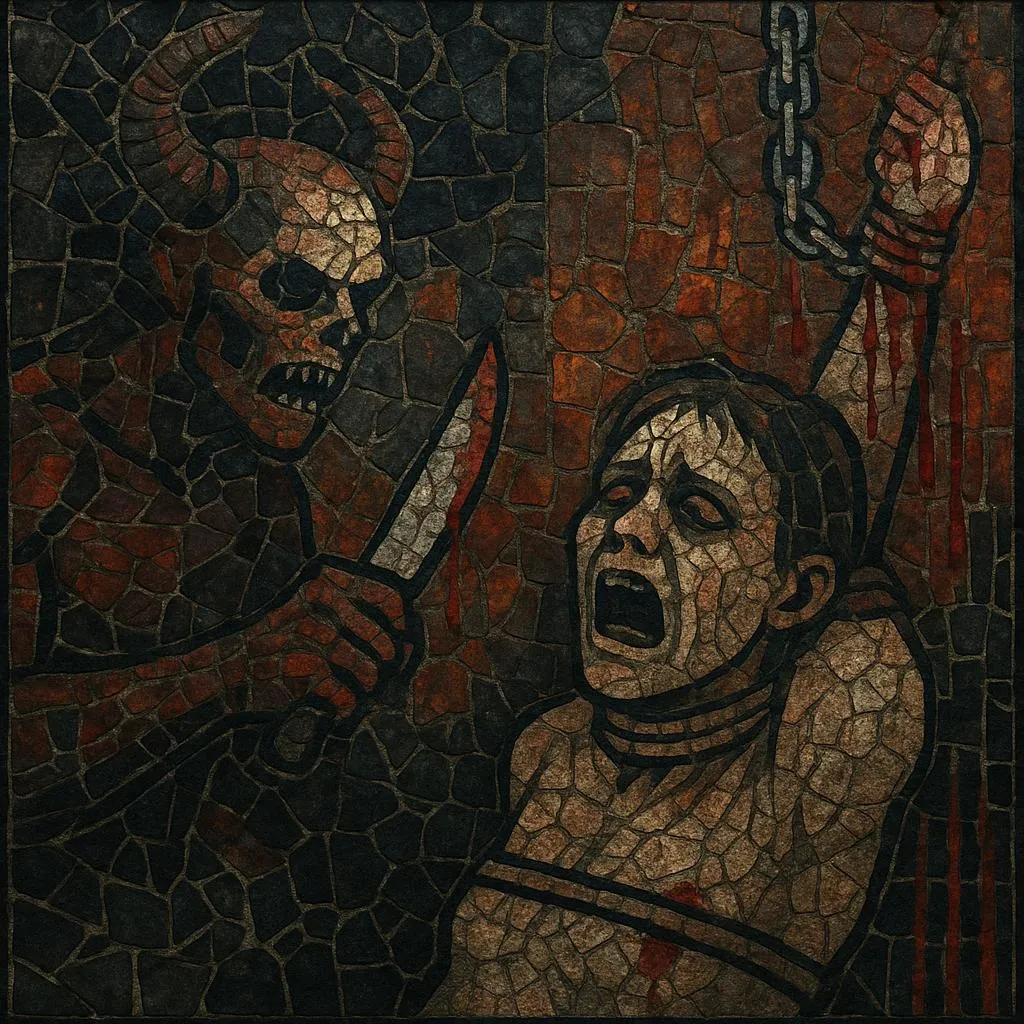
Sadistic horror is a horror film subgenre whose narratives and imagery center on captivity, cruelty, and the spectacle of bodily threat. In music terms, it favors cues that amplify dread and pain through abrasive textures, infrasonic pressure, and sudden shock stingers.
Prominently featuring scenes of torture and degradation, its scoring language leans on extended techniques for strings and winds, metallic percussion and foley, granular and spectral processing, and atonal or microtonal harmonies. The result is a claustrophobic, oppressive sound world designed to make the audience feel trapped alongside the on‑screen victims.
History
Early roots lie in exploitation and splatter cinema, whose scores departed from classical horror by using abrasive timbres, tape manipulation, and shock cuts to underline cruelty. Italian giallo and splatter cycles fed the aesthetic: rock ensembles and analog synths (e.g., Goblin, Fabio Frizzi) sat alongside avant‑garde strings and percussion to sonify sadism with jagged ostinati and eerie drones.
With video nasties and underground extreme horror, music pivoted further toward noise, industrial, and dark ambient palettes. Composers adopted atonality, clusters, and found‑sound metal, while electronic producers folded in power electronics and death‑industrial textures. The goal was less melodic identity and more sustained physiological stress.
Franchises like Saw (Charlie Clouser) and Hostel popularized a hybrid score—granular synths, processed foley (chains, tools), detuned strings, and sub‑bass swells—punctuated by brutal stingers at cut points. Mainstream studios normalized highly designed, post‑produced horror cues that sonically map confinement, pain, and countdown peril.
Contemporary sadistic horror continues to blend electroacoustic sound design, extended acoustic techniques, and spatial mixing (5.1/7.1/Atmos). Spectral smears, bowed metals, contact‑mic foley, and microtonal glissandi are common, while minimalist motifs or heartbeat pulses humanize victims or brand the antagonist. The music often borrows from dark ambient, noise, and industrial while retaining filmic hit‑point precision.