Your digging level
Description
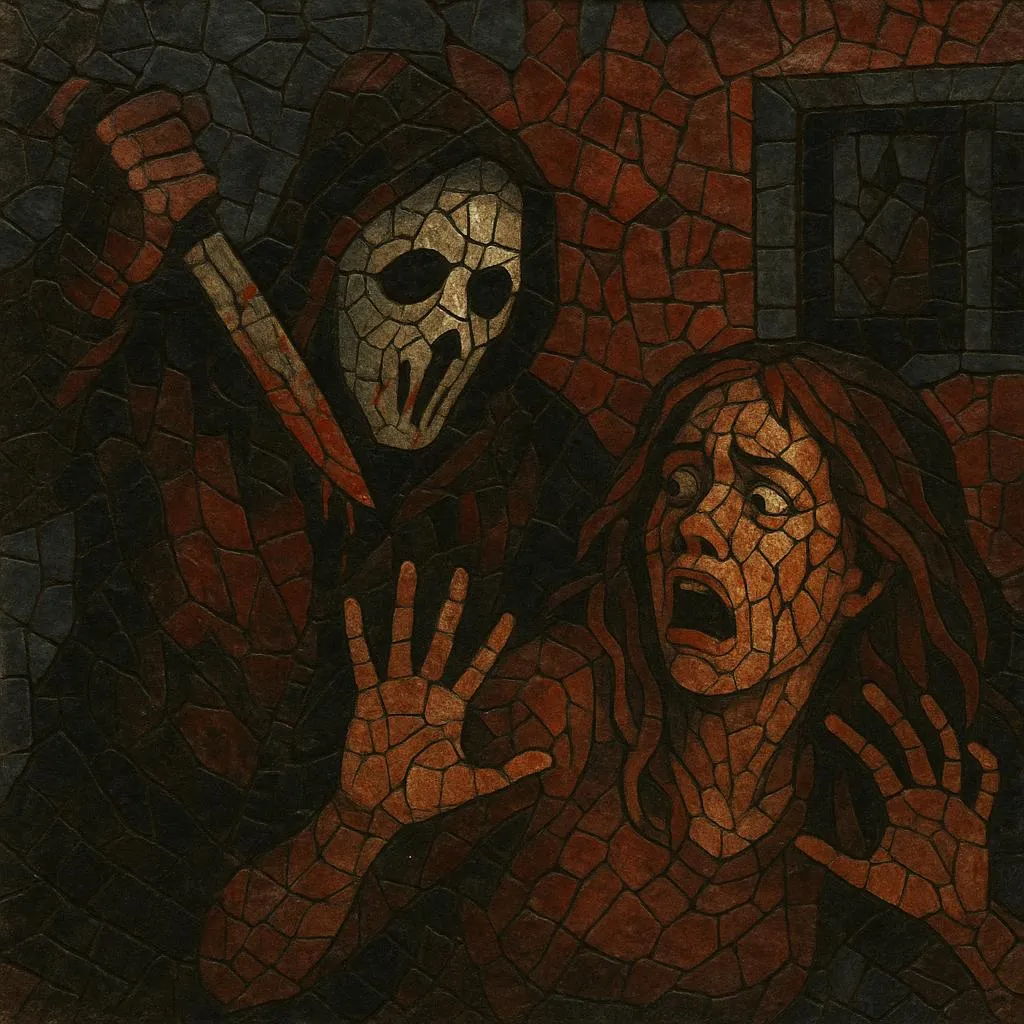
A slasher is a horror subgenre centered on a (usually) masked or otherwise anonymized killer who stalks and murders multiple victims, often with knives or blunt weapons and with graphic, suspenseful set‑pieces.
Narratives commonly follow a simple, cyclical structure—stalk, scare, kill—punctuated by jump scares, first‑person killer POV shots, and practical gore effects. Recurring tropes include the “Final Girl” who survives or defeats the killer, morally transgressive teen victims, holiday or event settings, and iconic motifs such as distinctive masks, signature weapons, and ominous leitmotifs.
Stylistically, slashers lean on economical plotting, tight editing, expressive sound design (breathing, footsteps, door creaks), and memorable musical stingers. Their tone ranges from grim and relentless to self‑aware and metatextual, but the core remains sustained dread leading to violent catharsis.
History
Alfred Hitchcock’s Psycho (1960) and Michael Powell’s Peeping Tom (1960) established key slasher building blocks: the subjective killer POV, shocking knife murders, and the focus on a human predator. In Italy, giallo films by Mario Bava (A Bay of Blood, 1971) and Dario Argento fused lurid murder mysteries with stylized violence and mystery‑killer aesthetics, directly seeding the North American slasher.
Bob Clark’s Black Christmas (1974) introduced the holiday setting, anonymous phone tormentor, and vulnerable students—all slasher hallmarks. John Carpenter’s Halloween (1978) codified the template: the masked killer (Michael Myers), suburban spaces turned hostile, a minimalist but iconic synth score, and the “Final Girl.” Sean S. Cunningham’s Friday the 13th (1980) and its sequels supercharged the teen‑camp setting and special‑effects gore. By the early 1980s, franchises (Halloween, Friday the 13th, A Nightmare on Elm Street) and countless imitators defined a golden age.
Franchise fatigue led to a lull until Wes Craven’s Scream (1996) revitalized the genre with postmodern self‑awareness, sharp dialogue, and rules‑savvy characters. It sparked a run of glossy teen slashers (I Know What You Did Last Summer, Urban Legend) that updated the formula for a new audience.
Studios revisited iconic properties (Halloween, Friday the 13th, The Texas Chain Saw Massacre) with slicker production and intensified violence. Parallel horror trends—found footage, torture‑horror, and elevated horror—diversified the landscape, but slasher DNA persisted in set‑piece design and killer iconography.
New entries blend legacy characters with social commentary, genre crossovers (comedy, whodunit, holiday horror), and fresh settings. Strong craft (practical effects, precise sound design) and character‑forward writing continue to sustain the slasher’s appeal, while streaming expands international and indie contributions.