Your digging level for this genre

0/8
🏆
Sign in, then listen to this genre to level up

Description

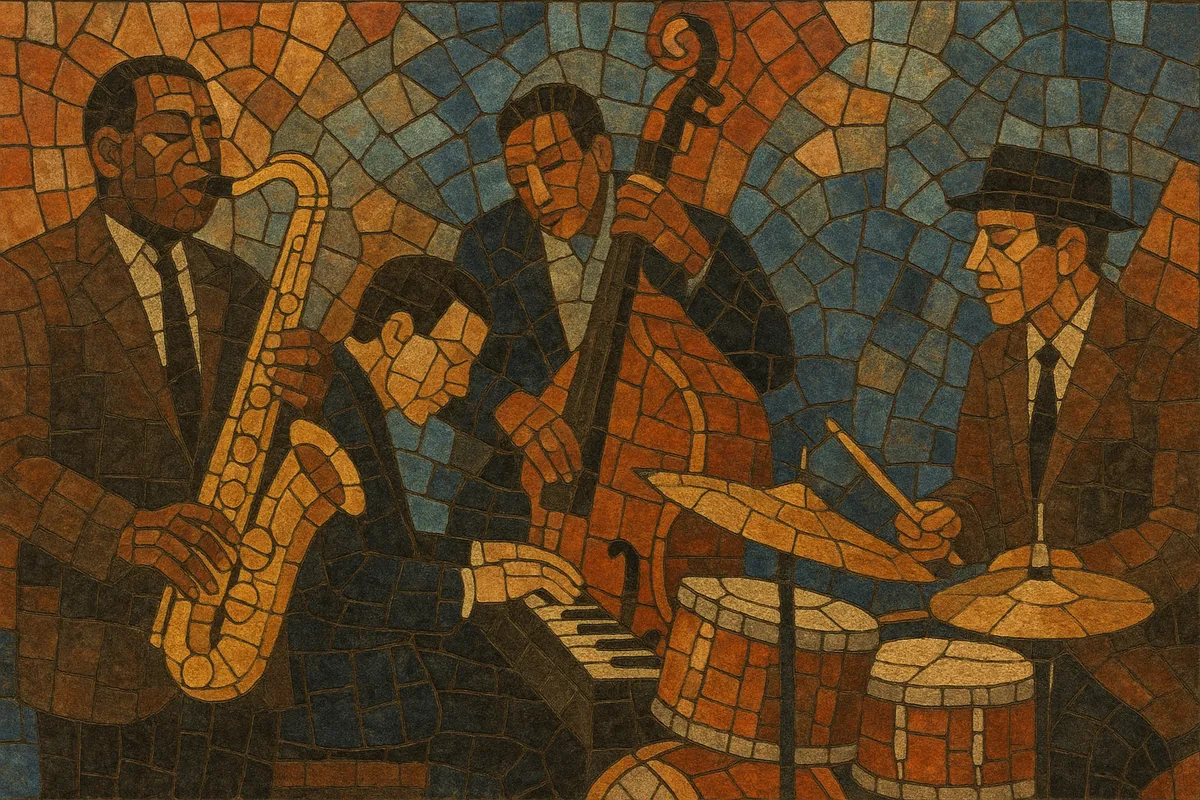
A jazz quartet is a small-ensemble format featuring four musicians, most commonly a horn (saxophone or trumpet), piano or guitar, double bass, and drums. The format emphasizes conversational interaction, spontaneous improvisation, and dynamic balance between soloist and rhythm section.

Quartets carry forward swing and bebop language—walking bass lines, ride-cymbal swing, ii–V–I harmony—while allowing the space and agility to explore modal vamps, blues forms, odd meters, and freer textures. Repertoires typically combine standards, blues, original tunes, and contrafacts, presented in the classic head–solos–trades–head arc.

Because four voices are lean yet complete, the jazz quartet became a core vehicle for postwar jazz innovation, from melodic cool-jazz lyricism and hard-bop drive to avant-garde exploration and contemporary hybrid styles.

History

Origins (1940s)

Small jazz combos existed earlier, but the modern quartet crystallized in the 1940s as bebop’s fast tempos, extended harmonies, and horn-led lines demanded agile, responsive rhythm sections. The four-piece lineup offered enough harmonic support and rhythmic drive without the density of larger swing bands.

Classic Innovations (1950s–1960s)

The quartet became a laboratory for mid‑century breakthroughs. The Modern Jazz Quartet blended chamber-music poise with blues feeling; the Dave Brubeck Quartet popularized odd meters (e.g., 5/4 in “Take Five”); the Thelonious Monk Quartet honed angular composition and spacious comping; the John Coltrane Quartet expanded modal exploration and spiritual intensity; and pianoless or vibraphone-based variants (e.g., Gerry Mulligan Quartet, MJQ) showed the format’s flexibility.

Diversification (1970s–1990s)

Quartets bridged acoustic traditions and new currents. ECM-associated groups (e.g., Charles Lloyd’s quartets; Keith Jarrett’s “Belonging” Quartet) emphasized lyrical themes, open forms, and timbral space. Meanwhile, post-bop and loft-jazz scenes used quartets to push rhythmic displacement, collective improvisation, and expanded tonal palettes, while neo-bop leaders refreshed hard-bop language within the four-piece frame.

Contemporary Scene (2000s–present)

Modern quartets synthesize swing, modal harmony, and avant approaches with global grooves, hip‑hop sensibilities, and electronics. Leaders such as Wayne Shorter (later-period quartets), Branford Marsalis, and Joshua Redman demonstrate the quartet’s enduring role as a versatile canvas for composition, interaction, and virtuosic improvisation.

How to make a track in this genre

Instrumentation
•   Core lineup: saxophone or trumpet (melodic lead), piano or guitar (harmonic comping), double bass (walking lines and counter‑melody), and drum set (ride‑cymbal pulse, comping on snare/hi‑hat, dynamic shaping). •   Variants: pianoless (e.g., baritone sax, bass, drums + another horn); vibraphone replacing piano; guitar in place of piano; occasional doubling (flute/clarinet) for color.
Harmony and Forms
•   Start with 12‑bar blues and 32‑bar AABA standards; use head–solos–trades–head with an optional coda. •   Employ ii–V–I progressions, secondary dominants, tritone substitutions, and diminished passing chords; for modal pieces, build around sustained vamps or pedal points. •   Reharmonize melodies (backdoor ii–V, Coltrane changes, modal interchange) and use guide‑tone lines to voice‑lead through changes.
Rhythm and Feel
•   Default swing: walking bass, ride “ding‑ding‑da‑ding,” comped syncopations. •   Contrast with Latin feels (bossa nova, samba), straight‑eighth ECM textures, shuffles, or odd meters (5/4, 7/4, 9/8). •   Arrange dynamic arcs: sparse intros, chorus‑by‑chorus builds, trading 4s/8s with drums, and breaks to spotlight transitions.
Improvisation and Interaction
•   Develop motifs, sequence ideas, and outline chord tones on strong beats; pivot between inside playing and tasteful chromatic/“outside” approaches. •   Pianists/guitarists comp with registral space and rhythmic variety; drummers use call‑and‑response figures and textural shifts; bassists anchor time while shaping momentum and counterlines. •   Cue endings, tags, and tempo/feel changes with eye contact and concise gestures.
Arranging and Rehearsal
•   Write concise heads, counter‑lines, and shout figures; distribute backgrounds behind solos. •   Balance setlists among blues, standards, ballads, rhythm changes, modal tunes, and original compositions to vary key centers, tempi, and textures.

Top tracks

Locked
Share your favorite track to unlock other users’ top tracks
Influenced by
Has influenced
Challenges
Digger Battle
Let's see who can find the best track in this genre
© 2025 Melodigging
Melodding was created as a tribute to Every Noise at Once, which inspired us to help curious minds keep digging into music's ever-evolving genres.
Buy me a coffee for Melodigging