Your digging level

For this genre
0/8
🏆
Sign in, then listen to this genre to level up

Description

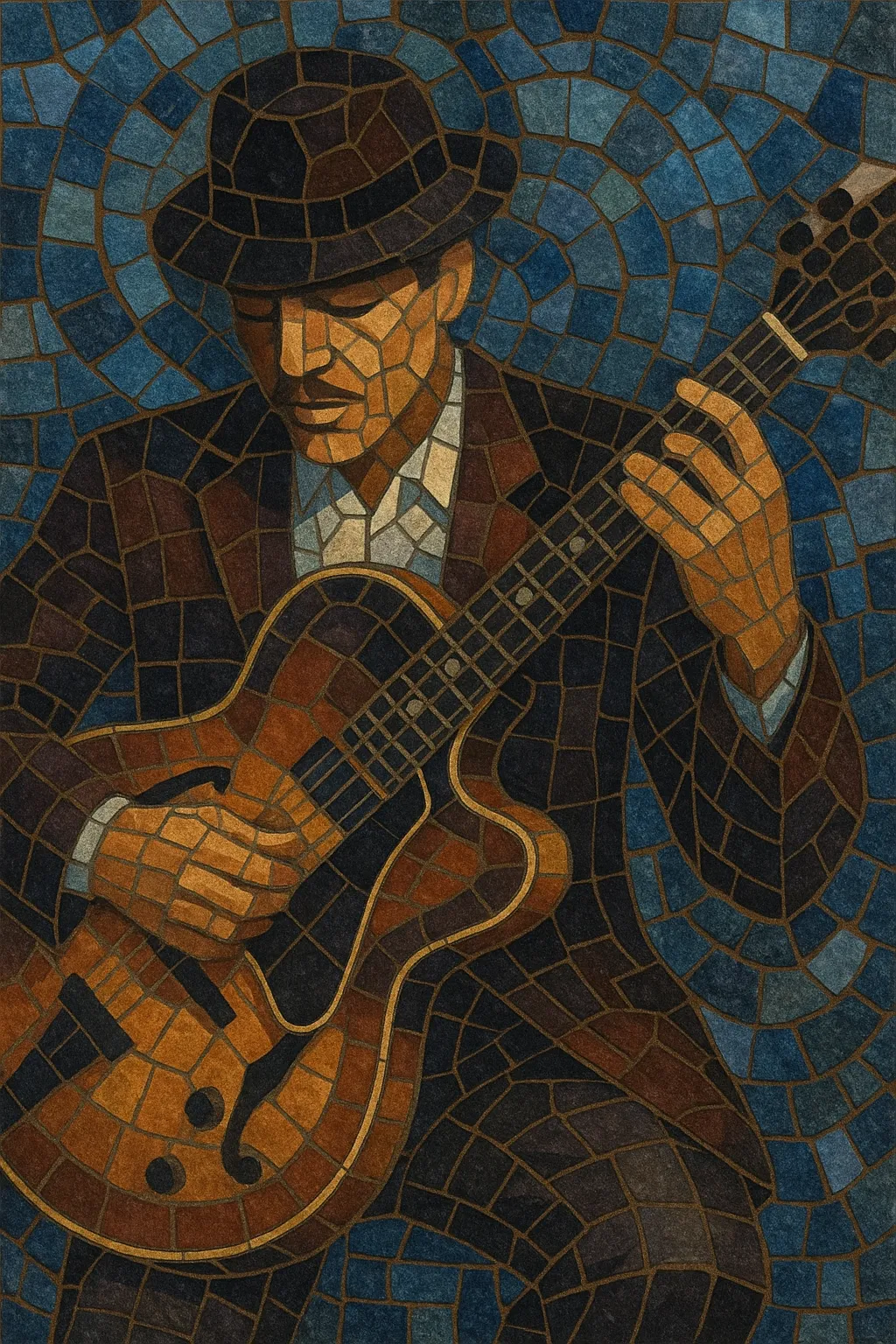
Jazz guitar is the application of jazz harmony, rhythm, and improvisation to the guitar, typically emphasizing rich chords, melodic single‑note lines, and a supple swing feel. Early players used acoustic archtops to project rhythm in big bands before the widespread adoption of electric pickups made the guitar a frontline solo instrument.

The sound palette ranges from warm, round clean tones (neck pickup, hollow or semi‑hollow body, flatwound strings) for swing, bebop, and cool jazz, to lightly overdriven or effected timbres in fusion and contemporary styles. Core techniques include comping with shell/drop‑2 chords and extensions, chord‑melody arranging, guide‑tone voice‑leading, and improvisation over functional progressions such as the ii–V–I, blues forms, and modal vamps.


Sources: Spotify, Wikipedia, Discogs, Rate Your Music, MusicBrainz, and other online sources

History

Early roots (1920s)

In the early 1920s, guitarists such as Eddie Lang and Lonnie Johnson adapted blues and ragtime phrasing to acoustic archtop guitars, providing both rhythm and melodic fills in small jazz combos. The guitar’s role was largely rhythmic due to volume limitations.

Electrification and the swing era (1930s–1940s)

The introduction of magnetic pickups and models like the Gibson ES‑150 transformed the instrument. Charlie Christian, with Benny Goodman, pioneered single‑note electric soloing, establishing bebop‑leaning phrasing and horn‑like articulation. In parallel, Freddie Green defined four‑to‑the‑bar rhythm guitar in big bands, anchoring the swing feel.

Bebop and modern harmony (1940s–1960s)

Bebop’s chromaticism and rapid harmonic movement reshaped jazz guitar language. Django Reinhardt, though acoustic and European, popularized virtuosic single‑note playing and chord voicings that influenced generations. Post‑war, players like Wes Montgomery (octaves and block chords), Jim Hall (lyricism and space), Kenny Burrell, Grant Green, and Joe Pass expanded harmonic color with extensions, substitutions, and chord‑melody techniques.

Global currents and bossa nova (late 1950s–1960s)

The Brazilian bossa nova wave, led by João Gilberto and bridged to U.S. jazz by Charlie Byrd and Stan Getz, integrated subtle syncopations and nylon‑string textures into the jazz guitar vocabulary, broadening rhythmic possibilities beyond straight swing.

Fusion and electric expansion (1970s–1980s)

Larry Coryell, John McLaughlin, and later Pat Metheny, John Scofield, and Mike Stern fused rock timbres, odd meters, and modal harmony with jazz improvisation. Effects (chorus, delay, overdrive) and solid‑body guitars became common, while studio production aesthetics shaped smoother strands that informed contemporary and smooth jazz.

Contemporary scenes (1990s–present)

Bill Frisell, John Abercrombie, and many ECM‑associated artists explored atmospheric textures, Americana, and chamber‑like interplay. Today, guitarists such as Kurt Rosenwinkel, Mary Halvorson, Gilad Hekselman, and Julian Lage synthesize bebop fluency, modern harmony, and genre‑crossing influences, supported by advances in amplification, modeling, and extended techniques.

How to make a track in this genre

Core harmony
•   Start from functional progressions (ii–V–I, rhythm changes, blues) and learn shell voicings (3rd–7th) to outline changes clearly. •   Add color tones (9, 11, 13), alterations (b9/#9/#11/b13), and common substitutions (tritone subs, backdoor dominants, diminished passing chords). •   Practice guide‑tone lines and drop‑2/drop‑3 voicings to create smooth voice‑leading; learn chord‑melody by harmonizing standards’ melodies on top voices.
Rhythm and feel
•   Internalize swing by placing a metronome on beats 2 & 4; comp with dynamic syncopation and space. •   Master key grooves: four‑to‑the‑bar Freddie Green style, bossa/samba patterns (bass‑on‑1, syncopated chords), waltz, and modal vamps. •   Typical tempos: ballads (~60–80 BPM), medium swing (120–180), up‑tempo (200+).
Melody and improvisation
•   Target chord tones on strong beats; connect changes with bebop enclosures, approach notes, and arpeggios. •   Use scales/modes contextually: major/minor, melodic minor (altered/super‑Locrian, Lydian dominant), diminished and whole‑tone over dominant chords, and modal approaches for vamps. •   Develop motifs; balance eighth‑note lines with rests, octave figures (à la Wes), and occasional double‑stops.
Tone and instrumentation
•   For classic jazz tone: hollow/semi‑hollow body, neck pickup, low gain, flatwound strings, small clean amp; roll off highs for warmth. •   For fusion/modern: consider light overdrive, compression, delay/chorus, and reverb. Keep articulation clear so harmony reads through effects.
Ensemble roles and arranging
•   Comp behind soloists with interactive rhythms; listen to drummer’s ride pattern and pianist’s voicings to avoid clutter. •   Create intros/endings: rubato chord‑melody, pedal vamps, or turnaround tags; trade fours with drums for form clarity. •   Arrange solo guitar versions by combining walking bass, inner voices, and melody (contrary motion and voice‑leading are key).
Practice roadmap
•   Learn 50+ standards in multiple keys; transpose ii–V–I drills through the cycle. •   Alternate focused tone work (right‑hand touch, pick vs. fingerstyle) with harmony studies and transcription of classic solos (Christian, Montgomery, Hall, Pass).

Top tracks

Locked
Share your favorite track to unlock other users’ top tracks
Influenced by
Has influenced
Challenges
Digger Battle
Let's see who can find the best track in this genre
© 2026 Melodigging
Melodding was created as a tribute to Every Noise at Once, which inspired us to help curious minds keep digging into music's ever-evolving genres.
Buy me a coffee for Melodigging