Your digging level
Description
Folk siciliana (Sicilian folk music) is the traditional music of Sicily, shaped by centuries of Mediterranean exchange and local rural life. It spans work songs of carters, fishermen, and sulfur miners; love serenades; devotional and festival repertoires; narrative ballads (cantastorie); and lively dance tunes.
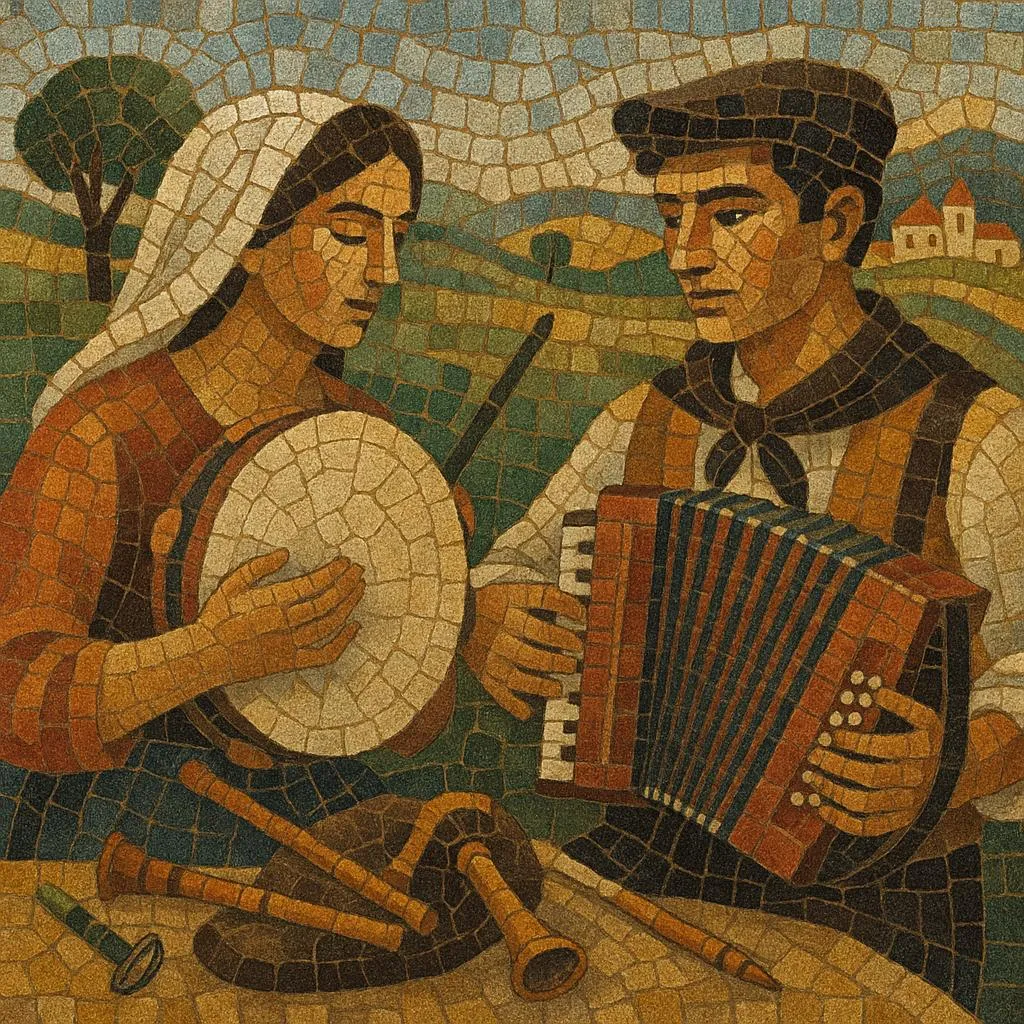
Its sound is marked by the Sicilian language and ornamented, often melismatic singing that hints at Arab and Sephardic legacies. Typical instruments include the tamburello (frame drum), marranzanu (jaw harp), friscalettu (cane flute), organetto (diatonic accordion), zampogna (bagpipe), mandolin, chitarra battente, and ciaramedda/ciaramella (shawm/pipe). Rhythms frequently use lilting 6/8 or 12/8 patterns (tarantella and “siciliana”), while modal flavors such as Dorian and Mixolydian are common.
Across the 20th century, the tradition was documented by collectors and reimagined by revivalists and contemporary artists who bring Sicilian song into dialogue with jazz, rock, and global folk, while keeping its social memory—migration, work, love, and resistance—at the core.
History
Sicily’s position at the crossroads of the Mediterranean fostered a composite folk language drawing on Byzantine, Arab, Norman, Spanish, and Italian elements. By the 18th–19th centuries, distinct repertoires had crystallized around daily life—canti di carrettieri (carters’ songs), fishermen’s chants, lullabies (ninne nanne), love serenades, and religious or festival pieces linked to processions and the Opera dei Pupi (puppet theatre).
Systematic collection began in the late 19th and early 20th centuries. The ethnomusicologist Alberto Favara compiled the landmark “Corpus di musiche popolari siciliane,” notating hundreds of melodies and preserving regional variants. Mid‑century field recordings by Alan Lomax and Diego Carpitella (1950s) further documented work songs, devotional singing, and dance tunes, capturing performance styles that notation alone could not.
From the 1960s–1970s, a folk revival brought traditional music to new audiences. Iconic voices such as Rosa Balistreri and the cantastorie Ciccio Busacca carried oral poetry and socially engaged song into theatres and records, often addressing class struggle, emigration, and women’s perspectives. Ensembles like Taberna Mylaensis and later Fratelli Mancuso explored polyphony, ancient modes, and ritual timbres.
Since the 1990s, groups including Unavantaluna, I Beddi, and artists such as Alfio Antico, Matilde Politi, Mario Incudine, and even crossover figures like Carmen Consoli have blended folk siciliana with jazz, rock, and world music aesthetics. Festivals and local processions (e.g., Sant’Agata in Catania, Santa Rosalia in Palermo) sustain the music’s communal role. Today the tradition thrives in both heritage‑focused performance and innovative fusions that keep the Sicilian language and storytelling at the center.