

Your digging level
Description
Canzone siciliane refers to the tradition of Sicilian-language popular song that blends rural folk idioms with urban balladry and Italian canzone craft. Songs are typically strophic, melodically singable, and rooted in Sicily’s dialects and imagery—sea, sun, migration, labor, love, and social satire.
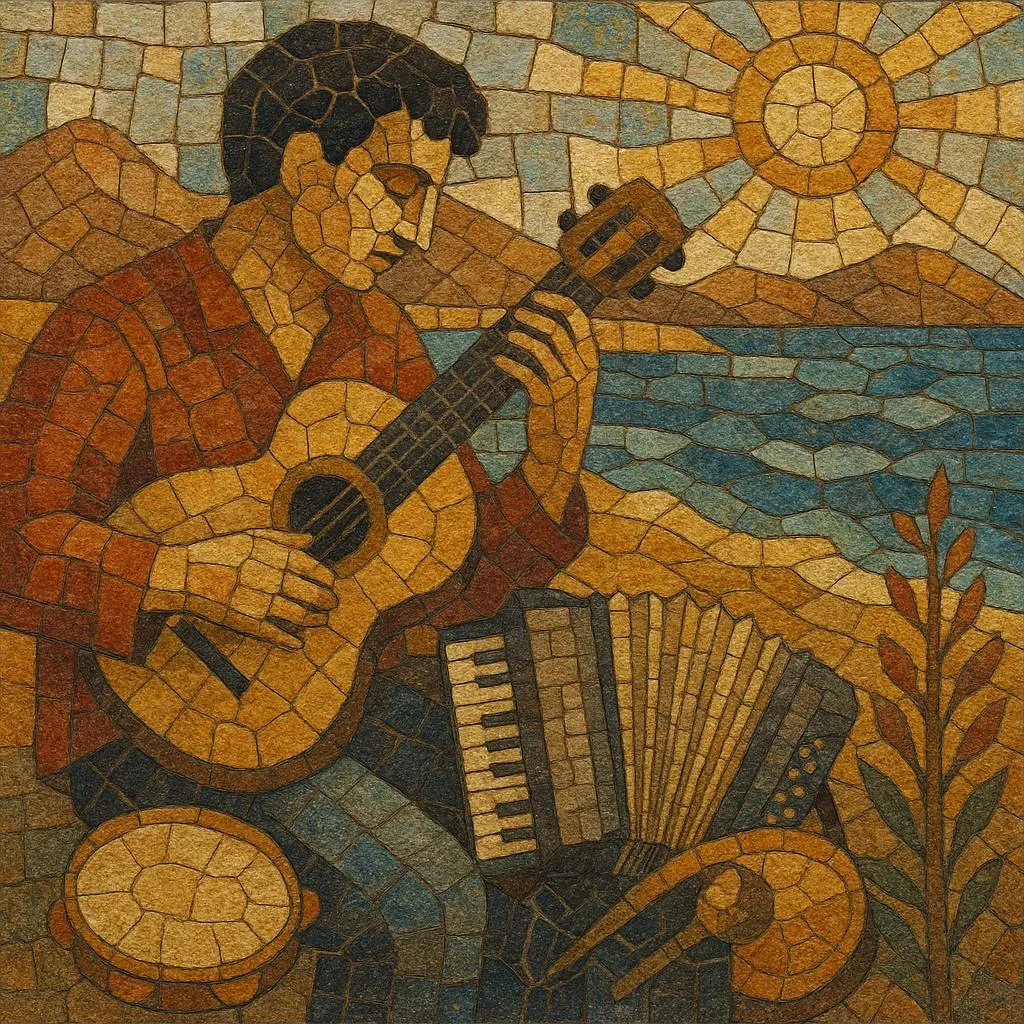
Musically, the style draws on tarantella and other 6/8 or 3/4 folk dances, simple tonic–dominant–subdominant harmonies, and characteristic ornaments and melismas in the vocal line. Acoustic guitar, accordion, tamburello (frame drum), friscalettu (reed flute), and marranzanu (jaw harp) are common colors, while modern performances may add bass, drum set, and keyboards. Lyrically, the voice of the cantastorie (singer–storyteller) remains central—ranging from tender ballads to sharp social commentary—always carried by the musicality of the Sicilian language.
History
Sicily’s song tradition emerges from peasant and maritime folk repertories—work songs, lullabies, improvised verse, and festive dances—crystallizing into the modern canzone as urban theaters, cafés-concerto, and early recording connected local styles to the broader Italian market. While never as industrialized as the Neapolitan song circuit, Sicilian-language songs circulated via sheet music, traveling performers, and the first discs.
Street and stage storytellers (cantastorie) brought news, satire, and ballad narratives to piazzas, accompanying themselves on guitar and accordion. Their repertory—love tales, fishermen’s laments, anti‑mafia denunciations—fixed many melodic formulas and the strophic, refrain-driven shape now associated with canzone siciliane. Radio and 78rpm releases helped standardize tunes while preserving dialect identity.
Postwar migration spread the style to northern Italy and immigrant communities abroad. Regional festivals, local labels, and television variety shows showcased Sicilian songs alongside Italian pop. The sound modernized—adding drum kit and electric bass—yet retained tarantella-derived meters, modal inflections, and poetic wordplay.
A new wave of singer‑songwriters and ensembles revitalized the idiom, treating Sicilian as a living literary medium. Folk/world groups fused traditional timbres (friscalettu, marranzanu) with ambient textures; indie and rock artists folded Sicilian refrains into modern arrangements; and hip‑hop acts adapted the cadences of the cantastorie to rap flows. The result is a resilient, dialect-rich song form spanning intimate balladry, protest, and dance.



