Your digging level
Description
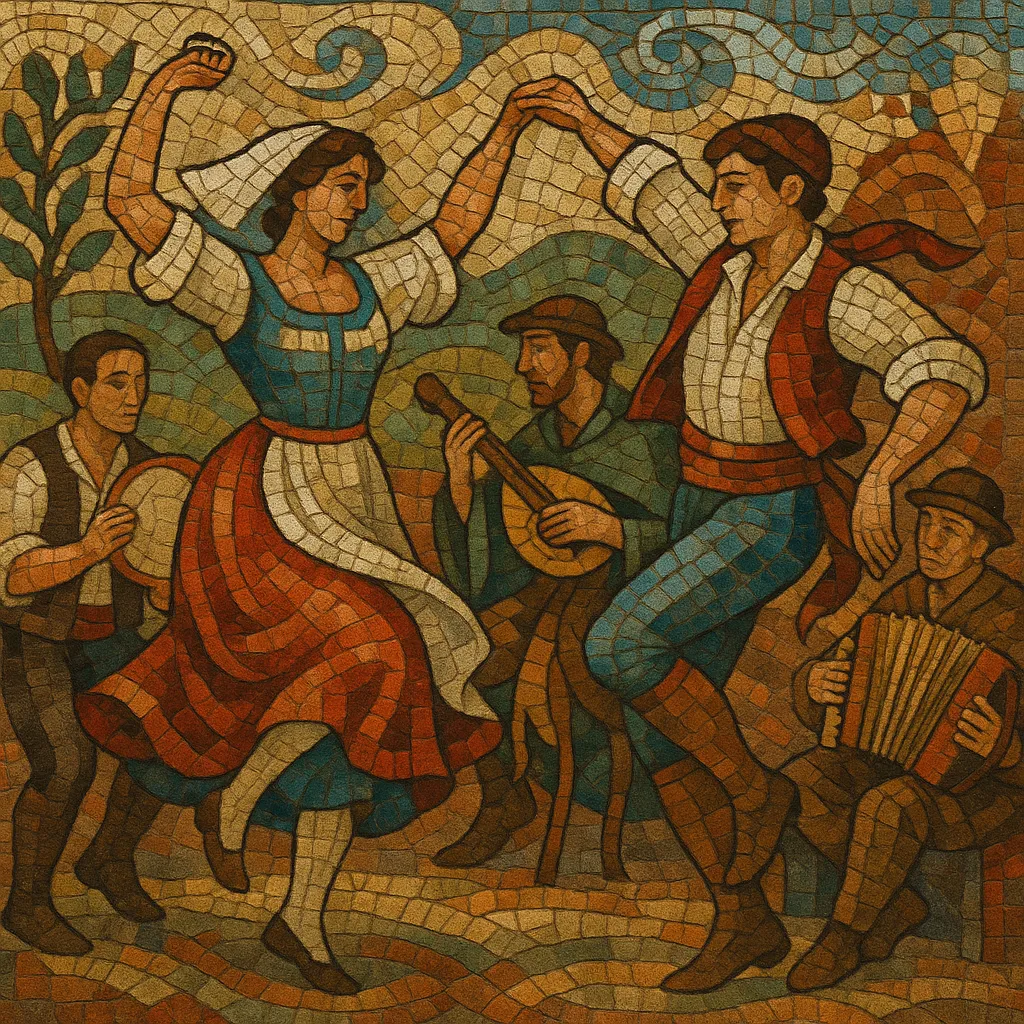
Tarantella is a family of fast, swirling southern Italian folk dances and song-forms associated with regions such as Calabria, Campania (tammurriata), Sicily, and Apulia/Salento (pizzica). In music, it is typically in compound duple meter (6/8 or 12/8), driven by the sharp rattle and rolls of the tamburello (frame tambourine), with lutes and guitars (chitarra battente), mandolin, organetto (diatonic accordion), zampogna (bagpipes), and reedy shawms (ciaramella) providing melody and drones.
Stylistically, tarantella pieces often alternate between major and minor colorations and intensify through gradual accelerando, encouraging a whirling, call-and-response dance. Historically linked to the folkloric cure for “tarantism,” the modern tarantella has become one of the most recognizable symbols of southern Italian musical identity and a staple of stage performance and festival culture across Italy, Greece, and Malta.
History
References to tarantella crystallize in the 1600s alongside the cultural phenomenon of tarantism in southern Italy, where ritual music and dance were believed to cure the venom (or melancholy) of a tarantula bite. Musicians would sustain a 6/8 ostinato while the afflicted person danced to exhaustion. Over time, regional variants formed—pizzica in Salento, tammurriata in Campania, and distinct Calabrian and Sicilian tarantelle—each with its own steps, rhythms, dialects, and instruments.
By the 1800s, tarantella had spread beyond ritual contexts into town festivities, weddings, and social dancing. Musically it stabilized around compound meters, brisk tempos, and frame-drum-driven grooves. Regional schools refined characteristic steps and melodic turns, and the genre increasingly symbolized southern Italian identity in folklore collections and salons.
European Romantic-era composers adopted the tarantella as a brilliant, perpetual-motion finale type. Piano, orchestral, and chamber tarantelle appeared as concert showpieces, cementing the dance-rhythm’s global visibility and linking folk idioms with cultivated classical traditions.
Postwar folk-revival movements in Italy researched, recorded, and reanimated local repertoires, costumes, and instruments. In the Italian diaspora, tarantella became an emblem of heritage at community events, film, and popular media—often simplified but instantly recognizable.
From the late 20th century onward, ensembles modernized tarantella with amplification, modal fusion, and contemporary arrangements, while major festivals (notably in Salento and Campania) fostered large-scale participatory dancing. Today, tarantella thrives both as living folk practice and as a concert style that bridges traditional instrumentation with modern staging.