Your digging level
Description
Andalusian folk music is the traditional music of Andalusia in southern Spain, closely associated with regional song, dance, and especially the cultural world that gave rise to flamenco.
It draws on a long historical mix of Iberian, Romani, Moorish-Andalusi, Sephardic Jewish, and broader Mediterranean influences, but in its better-known modern form it is most strongly identified with music and dance traditions developed from the 18th century onward in Andalusia.
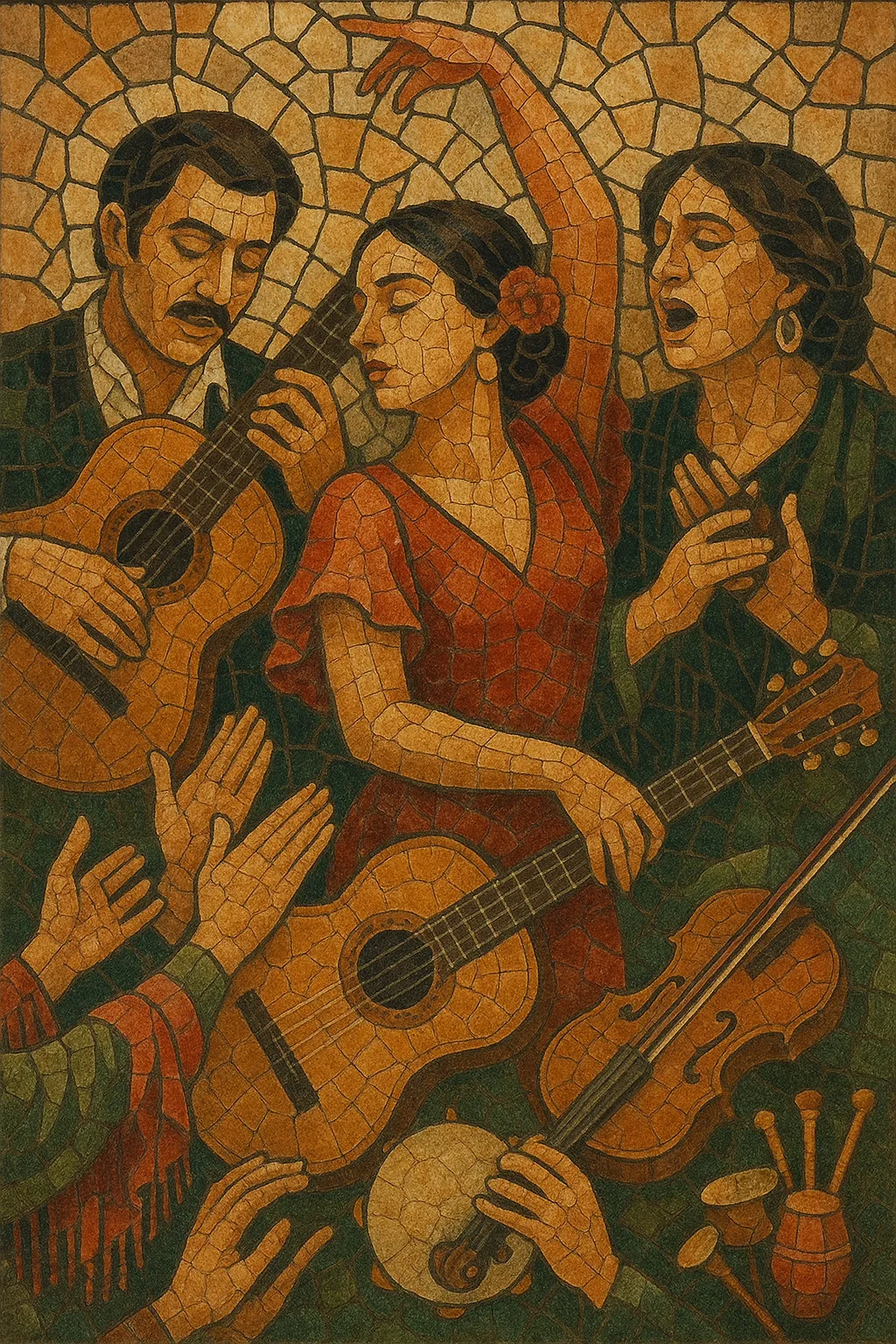
The genre is marked by expressive singing, modal melodic language, rich ornamentation, flexible rhythm, handclaps, guitar accompaniment, and strong links to dance. In many contexts, "Andalusian folk music" refers to the wider traditional musical environment of Andalusia from which flamenco emerged and within which forms such as fandangos, seguidillas, saetas, sevillanas, and other regional styles have circulated.
As reflected in the supplied external description, it is especially connected with the flamenco traditions of Andalusia and with the Romani communities of the region, known locally as gitanos, who played a major role in shaping its post-18th-century development.
History
Andalusian folk music developed in southern Spain as part of the region's broader oral and festive culture, where singing, dancing, and instrumental performance were central to everyday life, ritual, celebration, and local identity.
Although its deeper roots extend much further back through the cultural history of Iberia and al-Andalus, the musical world most people associate with Andalusian folk music today took clearer shape from the 18th century onward.
Andalusia was historically a crossroads of cultures. Christian, Muslim, Jewish, Romani, and local Iberian traditions all left traces in the region's melodic habits, poetic forms, dance practices, and performance styles.
This layered background helps explain characteristic features such as melismatic singing, modal turns, intense vocal expression, and a close connection between song and dance.
The supplied external description correctly highlights that the best-known strand of Andalusian folk music is the flamenco tradition of Andalusia, developed mostly after the 18th century and strongly shaped by the Romani people of the region, known as gitanos.
In this sense, Andalusian folk music can be understood as both a broader regional tradition and the cultural ground from which flamenco emerged. Rural songs, festive dances, religious songs, and local forms such as fandangos and seguidilla-related styles contributed to the later codification of flamenco genres.
During the 19th century, performance practices became more visible in cafés cantantes and urban entertainment spaces, where regional folk material interacted with increasingly professional flamenco performance.
Some local traditions remained communal and vernacular, while others entered staged or semi-staged settings. This period helped establish the prestige of Andalusian vocal expressivity and guitar accompaniment.
In the 20th century, collectors, scholars, and performers helped preserve regional repertoires, while flamenco's national and international fame often overshadowed the broader category of Andalusian folk music.
Even so, many traditional forms continued in festivals, brotherhood events, village celebrations, Holy Week processions, and family gatherings. Today, Andalusian folk music survives both in traditional settings and in concert, educational, and revival contexts.
Its legacy is enormous within Spanish music. It shaped flamenco directly, informed Spanish art music and guitar writing, and remains one of the most recognizable regional folk traditions in Europe.
Its continuing identity lies in the balance between locality, oral tradition, dance, poetic song, and the powerful expressive style associated with Andalusia.
Write from the perspective of song first, even if guitar or dance is central. Andalusian folk music is highly vocal in conception, and melody should feel expressive, ornamented, and emotionally direct.
Use a performance mindset rather than a purely notated one. Many phrases should sound natural for singing, clapping, dancing, and call-and-response interaction.
Favor modal or Phrygian-flavored melodies, especially those associated with southern Spanish and flamenco practice.
Use melisma, sighing turns, appoggiaturas, slides, and expressive micro-inflected ornaments where stylistically appropriate.
Let phrases breathe. A good melody often alternates between free, declamatory gestures and more rhythmically grounded sections.
Keep harmony relatively focused rather than overly chromatic in the classical sense.
The Andalusian cadence is especially important. A descending progression such as iv-III-II-I in Phrygian-inflected contexts is a common color.
Pedal tones, drone-like support, and simple harmonic frameworks can be very effective because the expressive weight often lies in the melody and rhythm.
Rhythm is central. Use handclaps, footwork, finger snaps, and guitar strumming patterns to create propulsion.
Depending on the subtype, you may use either freer rhythm or a repeating dance pulse. Triple and compound feels are common in many Andalusian traditions, especially those connected to fandangos and sevillanas.
If composing in a flamenco-adjacent idiom, pay close attention to cyclical rhythmic accents rather than just time signatures on paper.
Typical instruments include:
• Spanish guitar • Vocals • Palmas (handclaps) • Castanets in some dance-related forms • Percussive footwork • Frame percussion or light folkloric percussion where appropriateIn modern settings, you may add violin, cajón, or other accompaniment, but the arrangement should still leave space for the voice and rhythmic articulation.
Use concise, image-rich lyrics. Traditional Andalusian song often expresses longing, devotion, pride, sorrow, irony, love, place, and memory in compact poetic forms.
Religious and festive themes are also important in some substyles, including Holy Week-related song traditions.
Prioritize intensity, phrasing, and timbral character over technical polish alone.
A convincing performance should feel lived-in, communal, and expressive. Slight roughness or tension can be stylistically appropriate if it serves emotional truth.
-
•
Start with a vocal line in a Phrygian or modal color.
•Support it with Spanish guitar voicings and an Andalusian-style cadence.
•Add clapping patterns or dance pulses.
•Keep the texture open enough for vocal ornamentation.
•Shape the piece around rising emotional intensity rather than constant density.
•If desired, connect it to a regional dance or song type such as fandango, sevillana, or saeta-like declamation.