Your digging level
Description
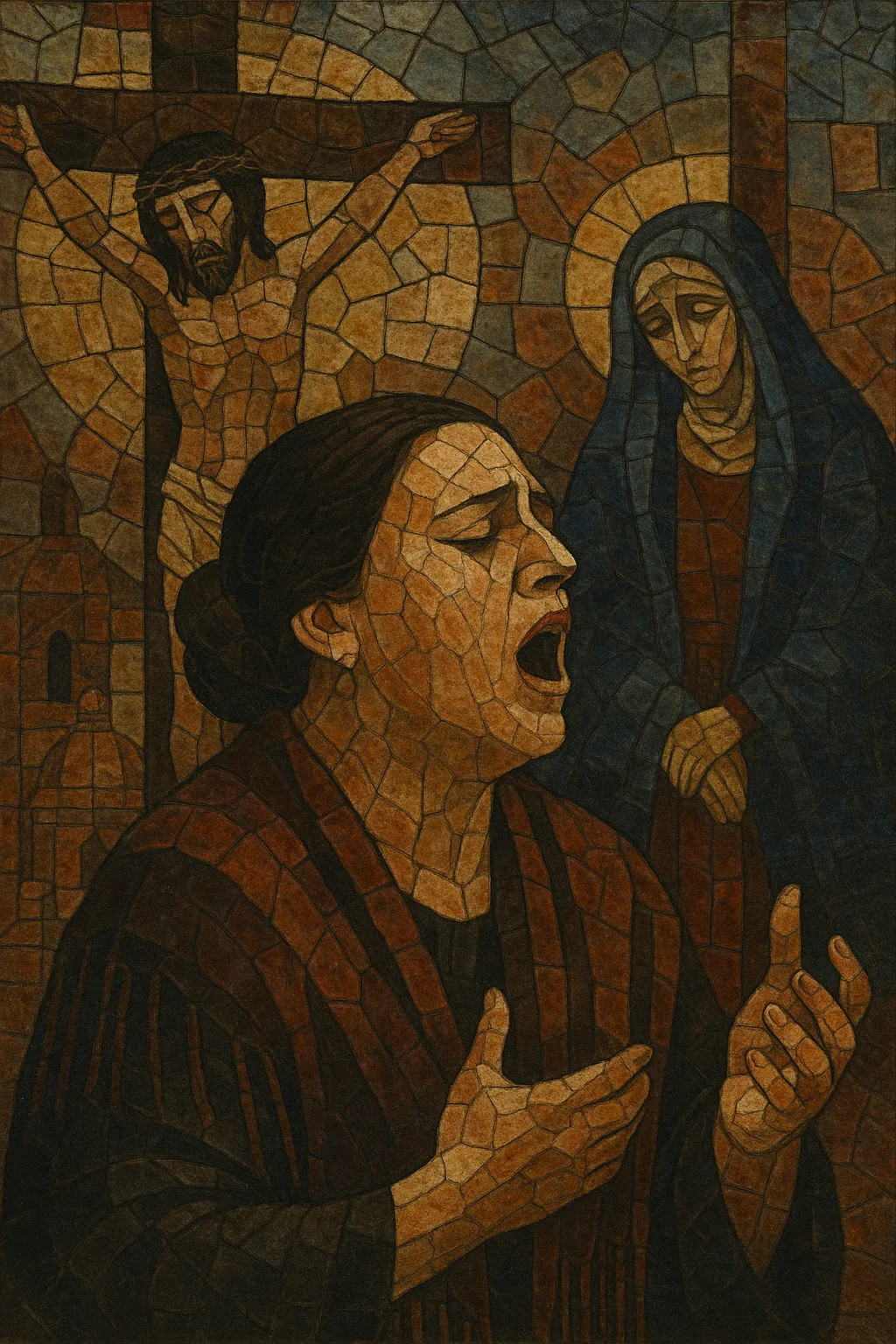
The saeta is an Andalusian religious song sung a cappella during Holy Week processions, especially in Seville, Málaga, Córdoba, and Jerez. Its name ("arrow" or "dart") evokes a piercing cry of devotion directed to images of Christ or the Virgin as they pass.
Stylistically, the saeta is highly melismatic, free-rhythm, and intensely expressive. Singers project from balconies or street corners, often beginning with a sob-like quejío (an exclamatory "¡Ay!") and building to climactic, sustained high notes before a modal cadence. Although bands march in the processions, the saeta itself is performed unaccompanied; the nearby band typically falls silent to let the voice carry.
There are two broad types: the older saeta antigua, closer to psalm-like recitation and late-medieval/early-baroque piety; and the saeta flamenca (late 19th–early 20th century), which adopts flamenco’s Phrygian-modal turns, ornaments, and the dramatic heft of cante jondo (often sung "por seguiriya" or "por martinete"). The texts are short strophic coplas that praise, implore, or lament, addressed to specific brotherhoods’ images and infused with penitential fervor.
History
The saeta’s roots reach into late-medieval devotional song in Andalusia, reflecting a vernacular practice that imitated liturgical psalmody. By the 16th century, local Jewish and Sephardic traditions of religious singing likely contributed melismatic and modal features. The form coalesced in Catholic Spain in the 17th century as an anonymous, street-facing spiritual song aligned with Holy Week processions and confraternal piety.
Through the 18th and early 19th centuries, the saeta antigua maintained a sober, psalmodic character—short stanzas declaimed with restrained ornamentation. Performance practice centered on brotherhood routes (cofradías), where singers offered spontaneous praise to specific images (e.g., Gran Poder, Macarena, Esperanza de Triana). The song’s unaccompanied, public character reinforced its identity as a living ritual rather than a staged art music.
By the late 19th and early 20th centuries, flamenco aesthetics—especially the deep song (cante jondo)—reshaped the genre into the saeta flamenca. Now sung "por seguiriya" or "por martinete," its tessitura expanded, ornaments became more intricate, cadences took on the Andalusian-Phrygian pull, and the dramatic arc intensified. Celebrated flamenco voices brought the saeta from purely devotional space into broader cultural consciousness while preserving its sacred function in processions.
Throughout the 20th century, leading flamenco and popular Andalusian singers recorded or publicly performed saetas during Semana Santa, helping canonize emblematic versions (e.g., for "El Cristo de los Gitanos"). While radio, records, and televised processions popularized the sound, the core remains unchanged: a spontaneous, unaccompanied outpouring of praise in a public, ritual context. Today the saeta endures as a signature sound of Andalusian Holy Week—simultaneously a folk-liturgical practice and a touchstone within the wider flamenco sound world.