Your digging level

For this genre
0/8
🏆
Sign in, then listen to this genre to level up

Description

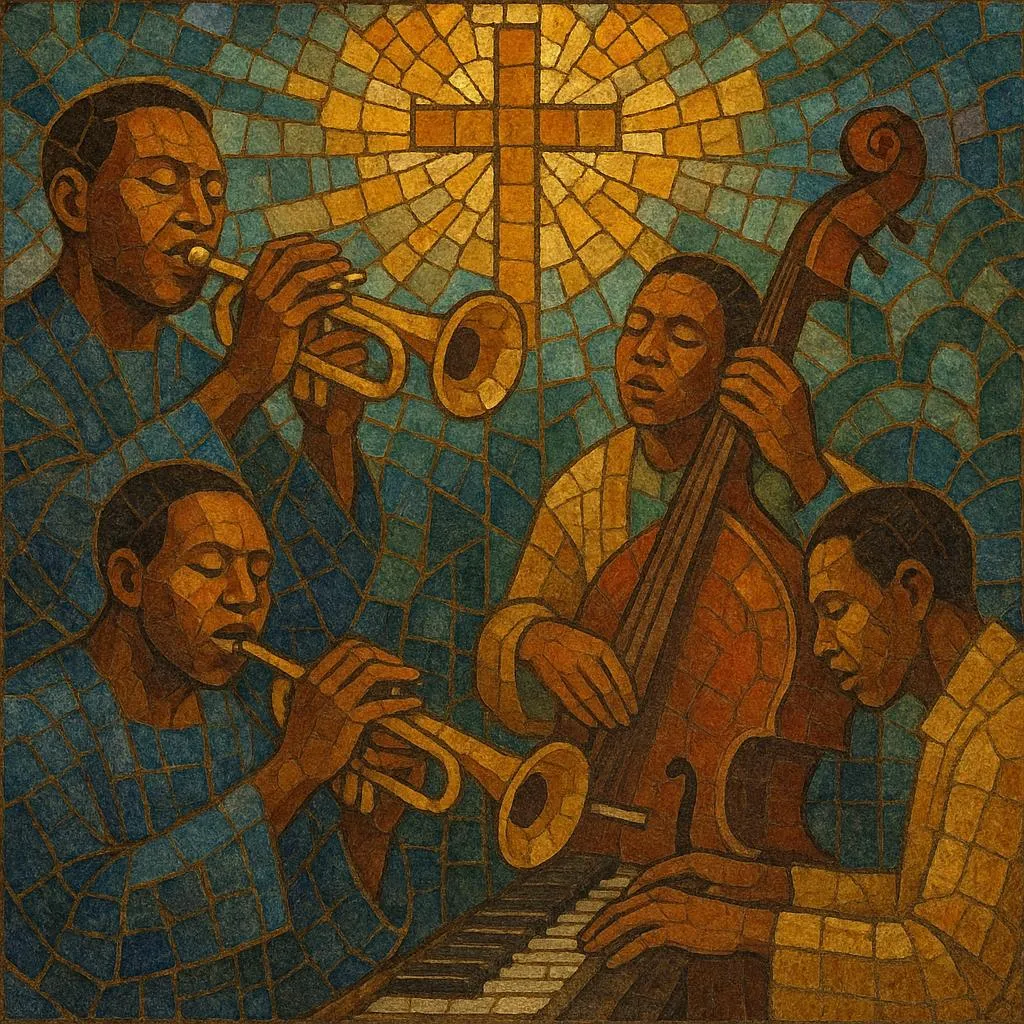
Christian jazz (often called sacred jazz or gospel jazz) blends the language of jazz—swing, improvisation, and extended harmony—with Christian hymnody, liturgy, and devotional themes.

It ranges from concert works like jazz masses and sacred concerts for choir, soloists, and big band, to small-combo arrangements of hymns performed at jazz vespers or church services. Typical textures include jazz rhythm sections supporting congregational song, instrumental reharmonizations of classic hymns, and call‑and‑response patterns borrowed from Black church traditions.

Stylistically, it embraces swing and bebop vocabulary, blues inflection, and Latin grooves (such as bossa nova or Afro‑Cuban feels), as well as smoother contemporary backbeats. The result is a reverent yet creative idiom that invites improvisation while serving worship and spiritual reflection.


Sources: Spotify, Wikipedia, Discogs, Rate Your Music, MusicBrainz, and other reputable online sources

History

Origins (1960s)

The modern identity of Christian jazz coalesced in the 1960s, when prominent jazz composers placed sacred texts and themes at the center of large-scale works. Duke Ellington’s Sacred Concerts (1965, 1968, 1973) pioneered the concert-hall model that fused big-band swing, gospel fervor, and choral writing. In 1965, Vince Guaraldi premiered his Jazz Mass at San Francisco’s Grace Cathedral, a watershed for liturgical use of jazz. Lalo Schifrin’s Jazz Mass (1968) and Mary Lou Williams’ devout projects (notably Black Christ of the Andes, 1962, and her later Mass settings) further established the idiom.

Church adoption and "jazz vespers" (1970s–1980s)

As the civil rights era reshaped American sacred music, more churches—especially in urban centers—hosted jazz vespers and sacred concerts. Jazz musicians of faith reframed hymn tunes through swing and blues, while choirs and clergy explored liturgies with improvisation and rhythm sections. Dave Brubeck’s sacred works (culminating in To Hope! A Celebration) modeled a dignified, congregationally sensitive approach.

Gospel‑jazz and smooth currents (1990s–2000s)

The 1990s saw a "gospel jazz" current align with contemporary gospel and smooth jazz. Artists like Kirk Whalum and Ben Tankard popularized devotional, radio‑friendly instrumentals and vocal features, broadening the audience beyond church services to festivals and Christian radio. Recordings paired Scripture‑inspired themes with lush, harmonic reharmonizations of well‑known hymns.

Contemporary scene (2010s–present)

Today, Christian jazz thrives in multiple formats: university sacred-jazz ensembles, church residencies, and concert-hall works such as Wynton Marsalis’ Abyssinian Mass (2008). Globalization has brought the style to Africa, Europe, and Latin America, where local rhythmic traditions inflect liturgical jazz. The idiom now ranges from small-combo hymn treatments to ambitious sacred oratorios—always preserving worshipful intent while encouraging improvisational dialogue.

How to make a track in this genre

Instrumentation and Ensemble
•   Core rhythm section: piano (or organ), double/electric bass, drums; add guitar and one or two horns (saxophone/trumpet) for melodic statements and obbligatos. •   For larger sacred works, score for choir (SATB), soloists, and big band; consider adding hand percussion or strings sparingly to expand color without obscuring text.
Harmony and Reharmonization
•   Use extended jazz vocabulary (maj9, 11, 13; altered dominants; tritone substitutions; secondary dominants) to reharmonize hymn tunes while preserving singable melodies. •   Employ modal interchange for color on cadences, and blues inflection on key phrases. Keep cadences clear when supporting congregational singing; save denser tensions for interludes and codas.
Rhythm and Groove
•   Alternate between medium swing, jazz waltz (3/4), and straight‑eighth feels. Borrow from Afro‑Cuban and bossa nova for reflective verses, and from gospel backbeats for climactic refrains. •   Use vamp introductions/outros to set tonal center, support prayers, or cue solos. A shout chorus can elevate a final verse or instrumental refrain.
Melody, Text, and Form
•   Start with a familiar hymn (AABA/32‑bar or strophic forms work well). Present a clear first verse, then introduce variations: reharmonized verses, modulated bridges, or call‑and‑response between choir/congregation and soloist. •   If writing new lyrics, draw from Scripture, liturgy, or devotional poetry; prioritize clarity, prosody, and congregational accessibility.
Improvisation and Worship Context
•   Place solos between verses or after the sermon; keep solo lengths pastoral—expressive yet proportionate to the service. Encourage responsive improvisation (e.g., horn echoing a vocal tag). •   Balance reverence and creativity: dynamic shaping, space for silence, and sensitivity to clergy cues maintain flow. In recording, favor warm, natural acoustics and articulate vocal diction.
Arranging for Choir and Band
•   Use gospel-influenced voicings (drop‑2, clusters on sustained "Amen" cadences) while keeping inner lines smooth for amateur choirs. Write clear rhythmic notation for rhythm section (slash notation with hits) and cue key modulations for congregational entries.

Top tracks

Locked
Share your favorite track to unlock other users’ top tracks
Influenced by
Has influenced
Challenges
Digger Battle
Let's see who can find the best track in this genre
© 2026 Melodigging
Melodding was created as a tribute to Every Noise at Once, which inspired us to help curious minds keep digging into music's ever-evolving genres.
Buy me a coffee for Melodigging