Your digging level

For this genre
0/8
🏆
Sign in, then listen to this genre to level up

Description

Symphonic death metal fuses the ferocity of death metal—blast beats, double‑kick barrages, down‑tuned riffing, and guttural vocals—with fully scored orchestral writing and choir textures.

Arrangements often deploy strings, brass, woodwinds, and percussion (either recorded or via high‑end virtual instruments) to create cinematic scope. Harmonically, the style favors minor keys, Phrygian and harmonic‑minor colors, ostinati, and dramatic modulations reminiscent of film music and late‑Romantic classical idioms. Lyrical themes frequently explore mythology, esoterica, antiquity, apocalyptic imagery, and grand historical narratives.

The result is a maximalist, theatrical sound where extreme metal’s weight is heightened by symphonic grandeur, yielding music that is simultaneously aggressive, dark, and epic.
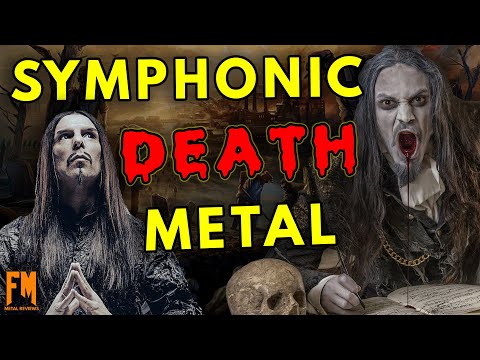

Sources: Spotify, Wikipedia, Discogs, RYM, MB, user feedback and other online sources

History

Origins (mid–late 1990s)

Symphonic death metal coalesced in the mid–1990s as artists rooted in death metal began absorbing orchestral writing and choral sonorities. The success of Scandinavian melodic death metal provided a harmonic and melodic framework, while symphonic metal and symphonic black metal demonstrated that large‑scale orchestration could sit convincingly alongside extreme guitars and drums. Early experiments blended death growls and tremolo riffing with string pads, brass stabs, and choir lines, setting the template for the style’s cinematic scope.

Consolidation and Signature Aesthetics (2000s)

In the 2000s the genre’s identity sharpened: fully scored orchestral arrangements (not merely keyboard pads) became common, choirs and percussion sections were layered with modern metal production, and albums were often conceived with conceptual or historical narratives. Compositional techniques from film scoring—leitmotifs, thematic development, and dramatic modulations—entered extreme metal songwriting, while production teams began treating the orchestra as a co‑equal ensemble to the metal band.

Global Expansion and High Production Values (2010s)

With the maturation of orchestral sampling libraries and improved hybrid recording workflows, symphonic death metal spread globally. Bands increasingly combined live orchestral sections with top‑tier virtual instruments, enabling complex, densely orchestrated arrangements at album scale. The aesthetic broadened to include neoclassical virtuosity, folk‑inflected themes, and multimedia concepts, all while retaining core death‑metal rhythmic intensity and vocal extremity.

Today

Contemporary symphonic death metal balances clarity and weight: mix engineers carve spectral space for the orchestra, choirs, and rhythm section; composers deploy modal interchange and chromatic mediants; and artists frequently present cohesive worlds—historical, mythic, or cinematic—across albums and live productions.

How to make a track in this genre

Core Ensemble
•   Guitars: Down‑tuned (C–D standard common), tight palm‑mutes, tremolo lines, and mid/low‑register rhythm stacks; add melodic counter‑lines for symphonic dialogue. •   Bass: Locked to kick patterns for impact; consider counter‑melodies in slower passages to glue orchestra and guitars. •   Drums: 180–240 BPM ranges are typical; alternate blast beats, double‑kick ostinati, and half‑time drops to pace the narrative. •   Vocals: Primarily low growls and mid screams; occasional choral/operatic cleans (often as orchestral layers rather than lead) for climactic contrast. •   Orchestra/Choir: Real players or high‑end libraries (e.g., detailed strings, brass, SATB choir, taiko/timpani/cymbals). Treat the orchestra as a full arrangement, not a pad.
Harmony & Melody
•   Favor Aeolian/Phrygian and harmonic minor; use Phrygian dominant for ancient/levantine color. •   Employ pedal points, ostinati, and chromatic mediants for cinematic lifts. •   Write thematic motives that recur in both guitars and orchestra (leitmotif technique).
Rhythm & Form
•   Structure songs in acts: Introduce a motif, escalate with layered orchestration and drum intensity, pivot with a breakdown or tempo shift, and resolve with a thematic recapitulation. •   Interleave blast‑beat sections with orchestrally driven interludes to maintain dynamic contour and listener clarity.
Orchestration & Arrangement
•   Register management: Let strings carry mid‑high ostinati; reserve brass for accents and climaxes; use low brass/contrabass to double or answer guitar chugs. •   Counterpoint: Avoid unison doubling throughout—give the orchestra independent lines to prevent masking and add depth. •   Sound design: Choirs for grandeur, tuned percussion and harp for transitions, and auxiliary percussion (timpani, taiko, gran casa) for low‑end punctuation.
Production & Mixing
•   Carve space: High‑pass strings/choirs to keep kick/bass intact; notch 200–400 Hz in dense moments; sidechain orchestral busses subtly to the kick. •   Layering: Parallel compression on drums; multiband control on rhythm guitars; automate reverb sends so orchestral tails bloom in breaks but stay tight under blasts. •   Humanization: If using libraries, vary dynamics (CC1/11), articulation, and timing; layer legato with spiccato/ostinato for realism.
Lyrics & Concepts
•   Lean into mythological, historic, and esoteric themes; align phonetic stress of growls with downbeats and cadences. •   Consider album‑length narratives; reuse musical motives associated with characters, epochs, or ideas.

Top tracks

Locked
Share your favorite track to unlock other users’ top tracks

Related labels

Upcoming concerts

in this genre
Influenced by

Download our mobile app

Get the Melodigging app and start digging for new genres on the go
© 2026 Melodigging
Melodding was created as a tribute to Every Noise at Once, which inspired us to help curious minds keep digging into music's ever-evolving genres.
Buy me a coffee for Melodigging