Your digging level
Description
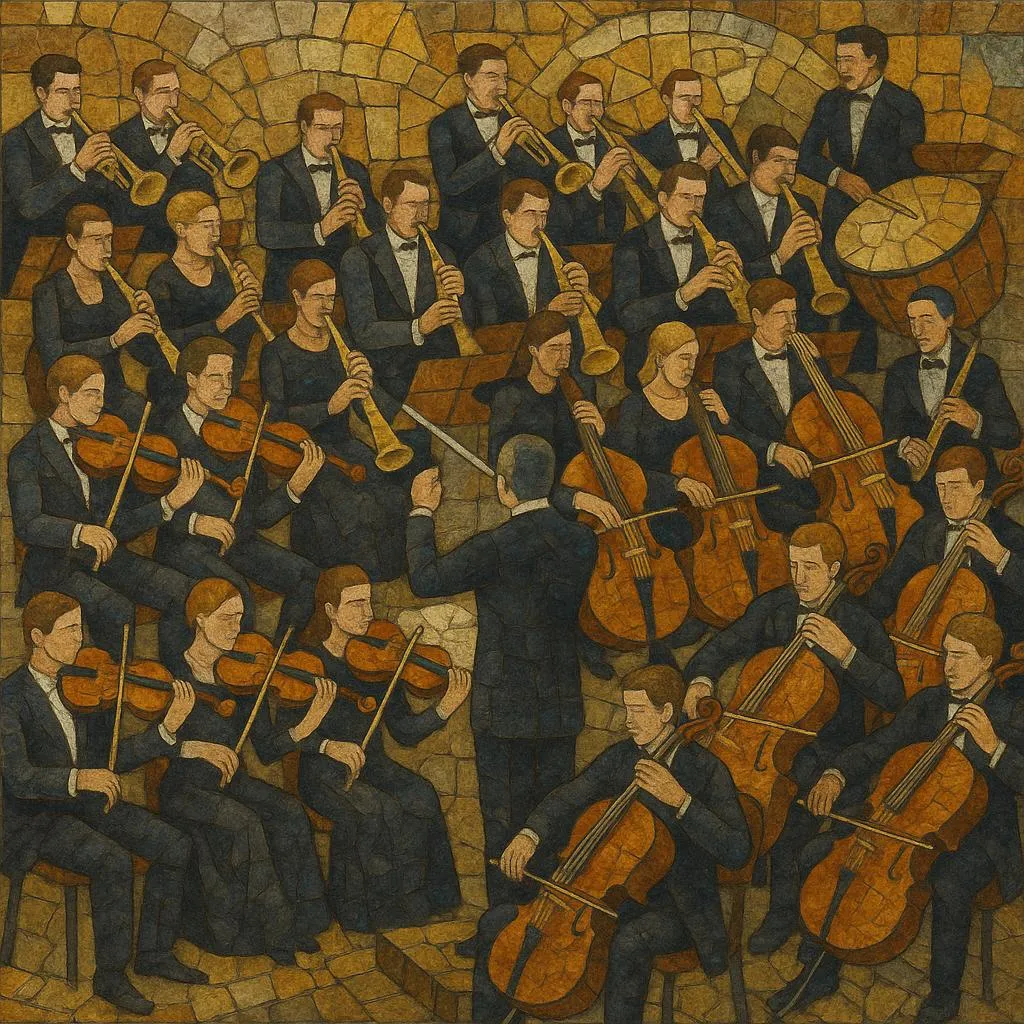
“Orkiestra symfoniczna” (symphony orchestra) is a large acoustic ensemble built around four families of instruments—strings, woodwinds, brass, and percussion—often augmented by harp, keyboards (celesta, piano), and occasionally chorus.
A typical symphony orchestra ranges from about 70 to 100+ players. Strings (first and second violins, violas, cellos, double basses) form the core; woodwinds (flutes/piccolo, oboes/English horn, clarinets/bass clarinet, bassoons/contrabassoon), brass (horns, trumpets, trombones, tuba), and percussion (timpani plus color percussion) provide color, power, and rhythmic drive. A conductor coordinates interpretation, balance, and ensemble.
The orchestra’s repertoire spans the Classical era through Romantic symphonic canvases, 20th‑century modernism, film and media scoring, and contemporary concert music. Its sound is characterized by wide dynamic range, layered textures, and an unmatched capacity for timbral blending and dramatic contrast.
History
The modern symphony orchestra coalesced in the 1750s–1770s out of Baroque court and theater ensembles. The Mannheim court orchestra (in present‑day Germany) pioneered disciplined technique (the “Mannheim crescendo”) and standardized wind/brass roles, while Classical composers (notably in the German‑Austrian sphere) established strings as the nucleus with woodwinds in pairs and horns/trumpets/timpani lending harmonic and ceremonial weight.
The Romantic era enlarged forces and color. Composers extended wind/brass sections, embraced expanded percussion, and pushed dynamic extremes. Programmatic works and innovations in orchestration manuals codified instrument capabilities. Late‑Romantic scores regularly called for massive ensembles, offstage groups, and novel timbres.
New idioms (from impressionism to avant‑garde) transformed orchestral palette—bitonality, atonality, complex rhythms, and extended techniques. The symphony orchestra became the primary vehicle for film music and broadcast concerts, integrating with recording technology and radio. Professional orchestras proliferated across Europe, the Americas, and later Asia and Africa, establishing year‑round seasons, touring, and education programs.
Today’s orchestras embrace historically informed performance for earlier repertoire while commissioning new works that may incorporate electronics, multimedia, and cross‑genre collaborations. Flexible seating, diversity initiatives, and community engagement have reshaped institutional models. The orchestra remains a central symbol of concert music, a laboratory for timbre, and a cornerstone of music education and cultural life.