Your digging level
Description
Romani music is the music of the Romani people, whose ancestors migrated from the Indian subcontinent to Europe over centuries and formed vibrant diasporic communities.
Rather than a single style, Romani music is an umbrella for many regional traditions shaped by close contact with local folk and urban musics across Europe and the Near East. Typical features include highly ornamented, melismatic melodies; flexible, expressive timing (from free‑rubato doina‑like solos to blazing fast dance sections); and a powerful performance ethos that prizes virtuosity and spontaneity.
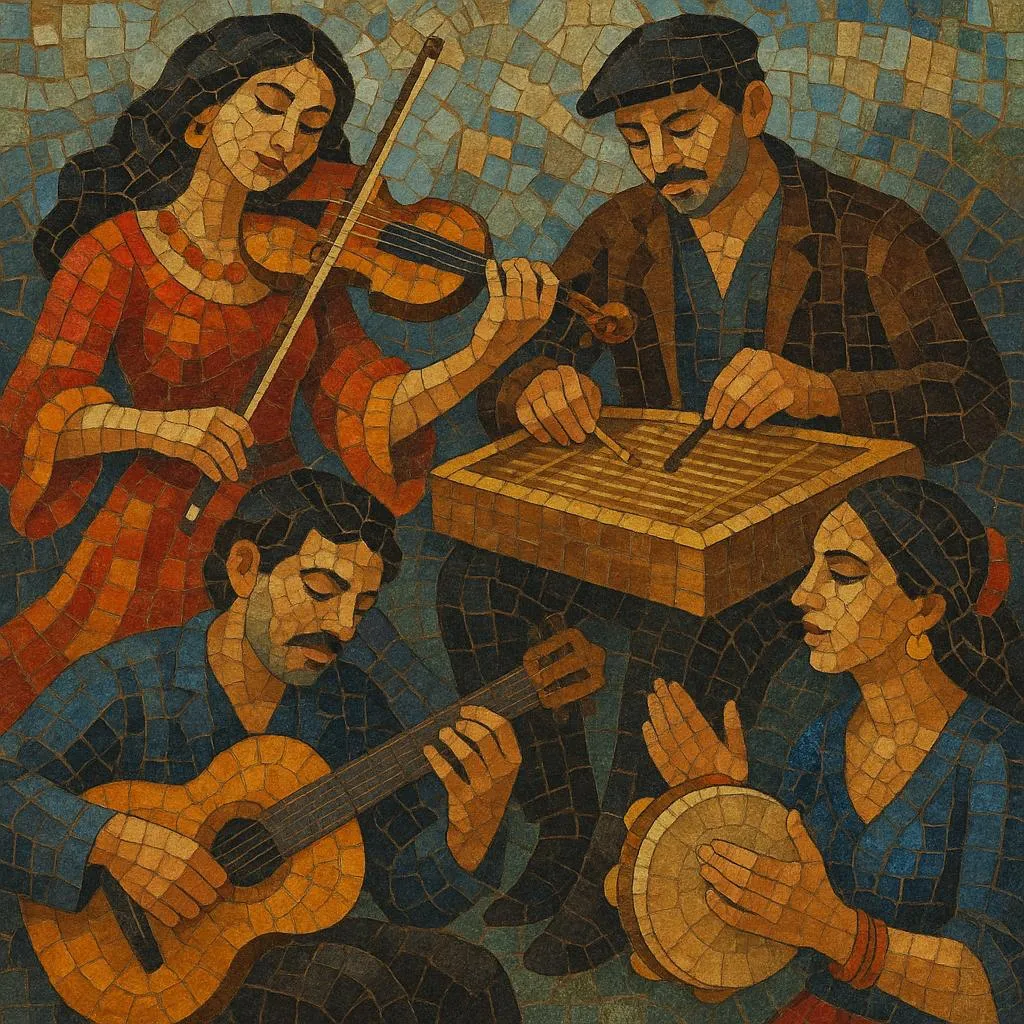
Common instruments include violin/fiddle, cimbalom (hammered dulcimer), guitar, double bass, accordion, clarinet, trumpet, tuba, hand percussion (e.g., tambourine, darbuka), and—especially in Iberia and the Balkans—intense rhythmic accompaniment via handclaps and drum patterns. Asymmetrical meters (7/8, 9/8, 11/8) are frequent in Balkan areas; “lassú–friss” slow‑fast pairings are emblematic in Central/Eastern Europe. Scales often draw on Phrygian dominant/Hijaz, harmonic minor, and the so‑called “Romanian” scale.
Note: In English, the exonym “Gypsy” has long been used for Romani people. Some embrace it, but many consider it derogatory; “Romani” or “Roma” is generally preferred.
History
Scholarly, linguistic, and genetic evidence situates the ancestors of the Roma in the Indian subcontinent. Between roughly the 10th–15th centuries, Romani groups migrated westward through Persia and the Byzantine/Ottoman spheres into Europe. Along these routes, musicians absorbed and reinterpreted regional repertoires and modal practices (e.g., from Persian, Ottoman/Turkish, and Byzantine traditions), laying the groundwork for a distinctly Romani performance aesthetic: ornamented melody, expressive rubato, and dazzling instrumental technique.
By the early modern period, Romani musicians had become indispensable professionals in courts, towns, and rural festivities, especially in Central and Eastern Europe. In the Hungarian Kingdom and Romanian principalities, Roma/Lăutari bands popularized and stylized local dance forms (e.g., verbunkos, csárdás; hora, sârba), often leading with violin and cimbalom. In Iberia, Spanish Gitanos profoundly shaped flamenco’s cante and toque. Across the Balkans, Roma brass and reed ensembles animated weddings and public celebrations, helping codify the modern Balkan brass idiom.
In the Russian Empire, Ruska Romá singers and ensembles helped define the salon/urban romance song and influenced popular taste far beyond Romani communities. Throughout Europe, Roma bands worked side‑by‑side with non‑Romani folk and popular musicians, creating a dense web of mutual borrowings that would later inform European salon music, café‑concert repertoires, and early recording catalogs.
The 20th century brought wide dissemination via records, radio, and film—alongside persecution (most tragically the Porajmos during WWII). Postwar revival and world‑music circuits in the 1990s–2000s elevated ensembles such as Taraf de Haïdouks and Fanfare Ciocărlia to international stages. Parallel currents included Manouche/“Gypsy” jazz (stemming from Django Reinhardt), Balkan brass explosions, and pop fusions (e.g., Romanian manele). Today, Romani music thrives both within community traditions and in cosmopolitan hybrids, while public discourse increasingly favors the respectful ethnonym “Romani/Roma.”