Your digging level

For this genre
0/8
🏆
Sign in, then listen to this genre to level up

Description

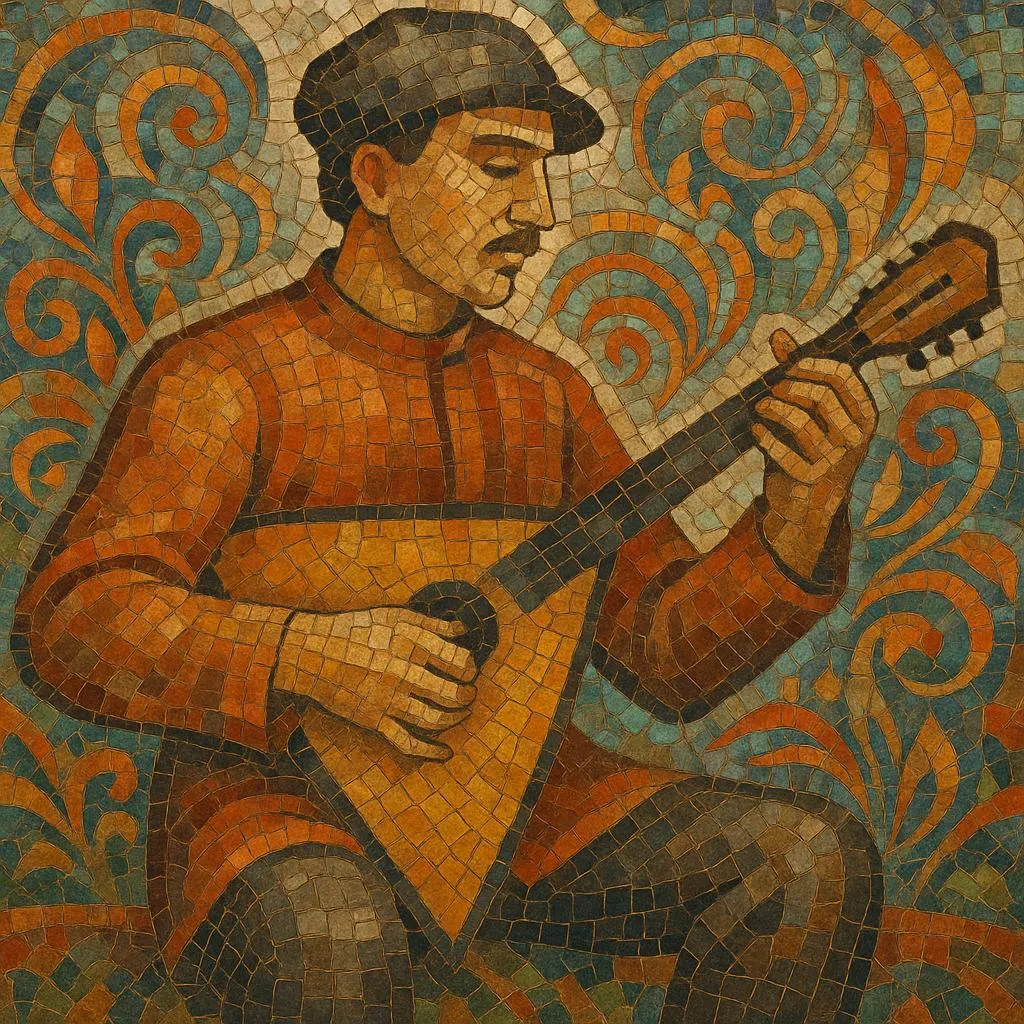
Balalaika refers to the Russian folk-music tradition centered on the triangular, three‑stringed balalaika and the ensembles and orchestras built around it.

As a performance style it features bright, percussive strumming, rapid finger tremolo, and lyrical minor‑mode melodies drawn from village songs and dance tunes. In the late 19th century the instrument family (prima, secunda, alto, bass, contrabass) was standardized, enabling orchestral textures that combine plucked strings with other Russian folk instruments (domra, bayan/accordion, gusli) and light percussion. The result ranges from exuberant dance music to nostalgic romances and instrumental showpieces.


Sources: Spotify, Wikipedia, Discogs, RYM, MB, user feedback and other online sources

History

Origins

The balalaika’s roots lie in vernacular string instruments of Russia and neighboring Slavic regions. By the 18th century, a distinct triangular, three‑string form was widespread among peasants, accompanying circle dances (khorovod), laments, and comic songs.

Standardization and the concert era (1880s–1910s)

Vasily V. Andreyev systematized the instrument in the 1880s, creating a full consort from prima to contrabass and founding a pioneering folk‑instrument orchestra. Andreyev’s work established modern technique (finger tremolo, fast rasgueado‑like strums), notation, and a mixed repertoire of arranged folk songs, dances, and newly composed concert pieces. Tours across Europe popularized the "balalaika orchestra" as a symbol of Russian musical identity.

Soviet institutionalization (1920s–1980s)

In the USSR, state conservatories and broadcasting ensembles professionalized balalaika playing. Orchestras of Russian folk instruments flourished, expanding orchestrations, commissioning new works, and recording extensively. Virtuoso soloists elevated the prima balalaika to a concert instrument capable of rapid passagework, harmonics, and expressive cantilena.

Global diffusion and contemporary practice (1990s–present)

After 1991, balalaika traditions continued in Russia and spread via diaspora and touring ensembles worldwide. Today the style spans historically informed folk performance, crossover with classical and jazz, and stage productions that highlight virtuosic balalaika solos. Educational programs, competitions, and recordings sustain the idiom while new compositions and arrangements keep the repertoire evolving.

How to make a track in this genre

Instruments and ensemble
•   Core voice: prima balalaika (melody/virtuoso solo), supported by secunda and alto (inner harmony), bass and contrabass (with leather plectra) for foundation. •   Common additions: domra, bayan/accordion, gusli, woodwinds (lightly), and hand percussion (triangle, tambourine) in orchestral settings.
Scales, harmony, and melody
•   Favor Aeolian (natural minor), harmonic minor, and Dorian flavors typical of Russian folk melodies. •   Harmony is primarily diatonic with drone pedals and open‑string sonorities; frequent tonic–dominant moves and parallel thirds/sixths. •   Melodies use narrow ranges with stepwise motion, modal inflections, and folk ornaments (grace notes, mordents, slides).
Rhythm and form
•   Dance meters: 2/4 and 4/4 for lively tunes; occasional 3/4 for songs/romances. •   Use repeated strains (A–A–B–B) or rondo‑like patterns, with accelerating codas for showpieces. •   Accompaniments alternate driving strums with arpeggiated tremolo textures.
Technique and texture
•   Prima technique: rapid index‑finger tremolo, brisk down‑up strums, harmonics, campanella‑style cross‑string fingering, and percussive golpes on the soundboard for accents. •   Arrange in choirs: melody on prima, counter‑melodies on domra/alto, off‑beat chordal pulses on secunda, and bass ostinati.
Writing/arranging tips
•   Begin with a folk tune (lament or dance), harmonize sparsely to preserve modal color, and orchestrate in layers so the prima remains clear. •   Contrast lyrical sections (sustained tremolo) with virtuosic passages (scale runs, arpeggio bursts), ending with a spirited accelerando. •   If adding vocals, set strophic verses on everyday themes (love, seasons, humor) with call‑and‑response refrains.

Top tracks

Locked
Share your favorite track to unlock other users’ top tracks

Upcoming concerts

in this genre
Influenced by
Has influenced

Download our mobile app

Get the Melodigging app and start digging for new genres on the go
© 2026 Melodigging
Melodding was created as a tribute to Every Noise at Once, which inspired us to help curious minds keep digging into music's ever-evolving genres.
Buy me a coffee for Melodigging