Your digging level
Description
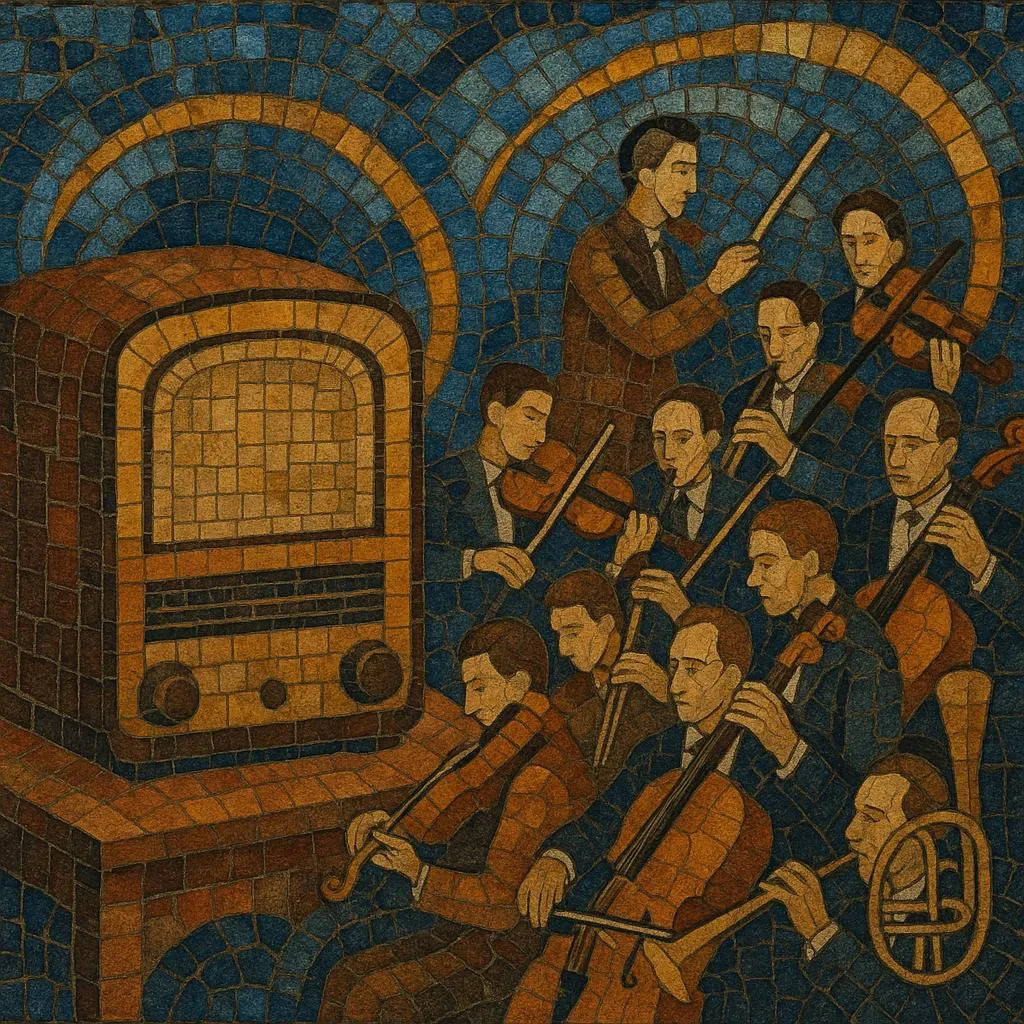
Radio symphony refers to orchestral music performed by radio-affiliated symphony orchestras and produced for broadcast and recording. The genre crystallized when national broadcasters in Europe founded full‑time orchestras to supply live and studio concerts for the new medium of radio.
While the repertoire spans the entire canon—from Baroque to contemporary premieres—its hallmark is a broadcast-oriented approach: clear balances, disciplined ensemble, and programming that alternates core symphonic works with light music, film/production cues, and newly commissioned pieces tailor‑made for airplay. The result is a distinctive sound culture that marries concert-hall orchestral traditions with the editorial, acoustic, and time-constraint realities of broadcasting.
History
With the rapid rise of radio in the 1920s, European public broadcasters created dedicated symphony orchestras to provide live and studio concerts for the airwaves. Germany, with early stations in Berlin and Frankfurt, became a pioneer, soon followed by the BBC in the United Kingdom and national broadcasters across Scandinavia and Eastern Europe. These ensembles developed a broadcasting craft: tight rehearsal schedules, reliable sight‑reading, and an ear for microphone placement and clarity.
World War II disrupted activities, yet the post‑war period saw a major rebuilding and expansion of radio orchestras. They became cultural flagships, premiering contemporary works, maintaining core symphonic repertoire, and producing archival recordings for national libraries. Technical advances in magnetic tape and improved microphones further shaped a clean, well‑balanced “broadcast sound.”
As television grew, many radio orchestras adapted, supplying studio sessions for TV, film, and production libraries, and programming “light music” and pops concerts for broader audiences. Their stable funding and in‑house studios fostered a commissioning culture that supported living composers and stylistic breadth—from late‑Romantic symphonism to modernist and filmic idioms.
In the digital era, radio symphony ensembles remain crucial: they livestream concerts, issue label-quality recordings, and provide educational content. Their dual mission—public-service broadcasting and artistic excellence—ensures a repertoire that continues to balance masterworks, national traditions, and premieres, all realized with attention to broadcast acoustics and editorial timing.
Write for a full symphony orchestra (pairs of winds, brass choir, timpani and percussion, strings, optional harp/keyboard). Keep doublings and divisi clear so that inner voices read well on microphones.
Favor concise, broadcast‑friendly forms: overtures, suites, tone poems, and single‑movement symphonic canvases of 6–12 minutes. If writing multi‑movement works, ensure each movement can stand alone with a satisfying cadence for segmenting.
Aim for lucid harmony and registral separation. Balance late‑Romantic warmth with 20th‑century color (extended tertian harmony, modal inflections, gentle bitonality). Orchestrate for transparency—avoid over-dense tutti; let lines ‘speak’ under close miking.
Maintain rhythmic clarity and articulate bowings that read distinctly on air. Favor well-defined ostinati, crisp fanfares, and measured crescendi. Use percussion for contour and color rather than sheer volume to avoid broadcast overload.
Compose with dynamic headroom and clear cue points. Provide natural ‘buttons’ (short codas or fermatas) for announcer entries. Avoid excessively long reverberant sustains that can blur under compression; prefer layered dynamics that translate at moderate listening levels.
Pair new works with familiar overtures or symphonic movements. Consider light-music interludes and filmic cues that showcase melody and timbral color. Write program notes that aid radio narration, highlighting themes, motives, and national style elements.