Your digging level
Description
Preschool children's music is a subset of children's music designed for ages roughly 2–5, prioritizing clear language, repetition, and interactive cues that support early learning and movement.
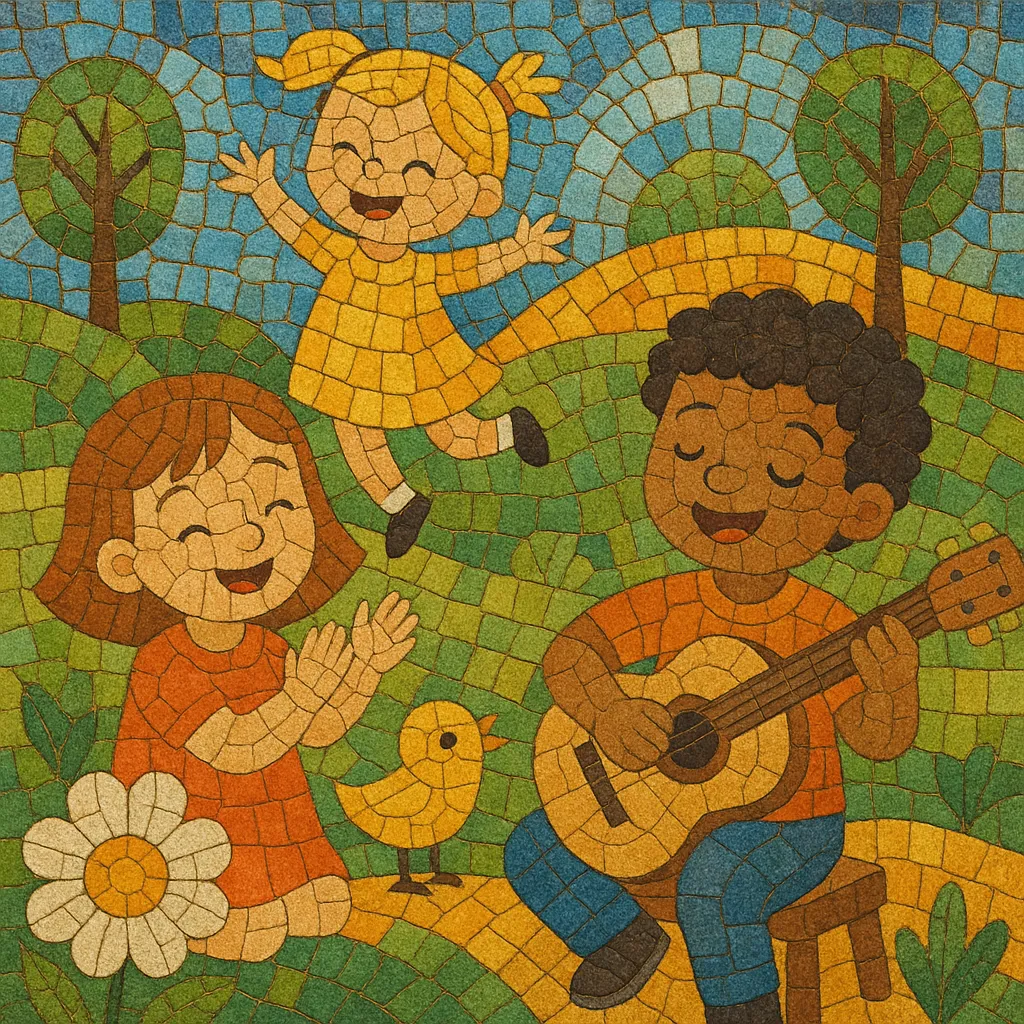
Songs are typically short (1–3 minutes), in major keys, with simple I–IV–V harmonies and memorable call-and-response or sing-along choruses. Tempos tend to be moderate (about 90–130 BPM) for easy clapping, marching, or dancing, and arrangements favor bright, soft timbres: acoustic guitar or ukulele, piano, handclaps, shakers, woodblocks, tambourine, simple drums, and friendly lead vocals with clear enunciation. Lyrics emphasize concrete topics (animals, colors, counting, the alphabet, daily routines, social skills), and often include movement prompts ("jump," "spin," "freeze") and predictable rhymes to aid language development.
As a practical format used in homes, classrooms, libraries, and early education programs, it balances entertainment with pedagogy, drawing from nursery rhymes, folk sing-alongs, show tunes, and educational TV to build early musical and literacy skills in a safe, cheerful sound world.
History
Preschool children's music traces its DNA to traditional nursery rhymes and folk songs that were sung to and with young children for language, memory, and social play. These repertoire strands provided the simple meters, repetitive phrasing, and topic focus that still define the genre.
With the rise of children’s record labels and 78/45 RPM singles, labels issued sing-alongs and narrated songs for very young listeners. The 1950s solidified a market for child-focused audio—often featuring friendly narrators, simple orchestration, and clear didactic aims.
Programs such as Sesame Street and Mister Rogers’ Neighborhood integrated music with early-childhood pedagogy—phonemic awareness, counting, social-emotional learning—setting a durable template for catchy, instructive songs with movement cues and call-and-response.
Artists like Raffi, Sharon, Lois & Bram, Greg & Steve, and Ella Jenkins recorded high-quality, classroom-ready material. Independent labels and classroom publishers expanded distribution to schools, libraries, and parents, refining production toward soft timbres, concise forms, and clear diction for preschoolers.
DVDs, YouTube channels, and streaming services (e.g., Super Simple Songs, Pinkfong, Cocomelon) globalized the sound and visuals. The genre absorbed bright pop production while preserving simplicity and interactivity. Viral successes (like "Baby Shark") demonstrated the power of short loops, kinetic instructions, and bright visuals in early-childhood contexts.