Your digging level for this genre

0/8
🏆
Sign in, then listen to this genre to level up

Description

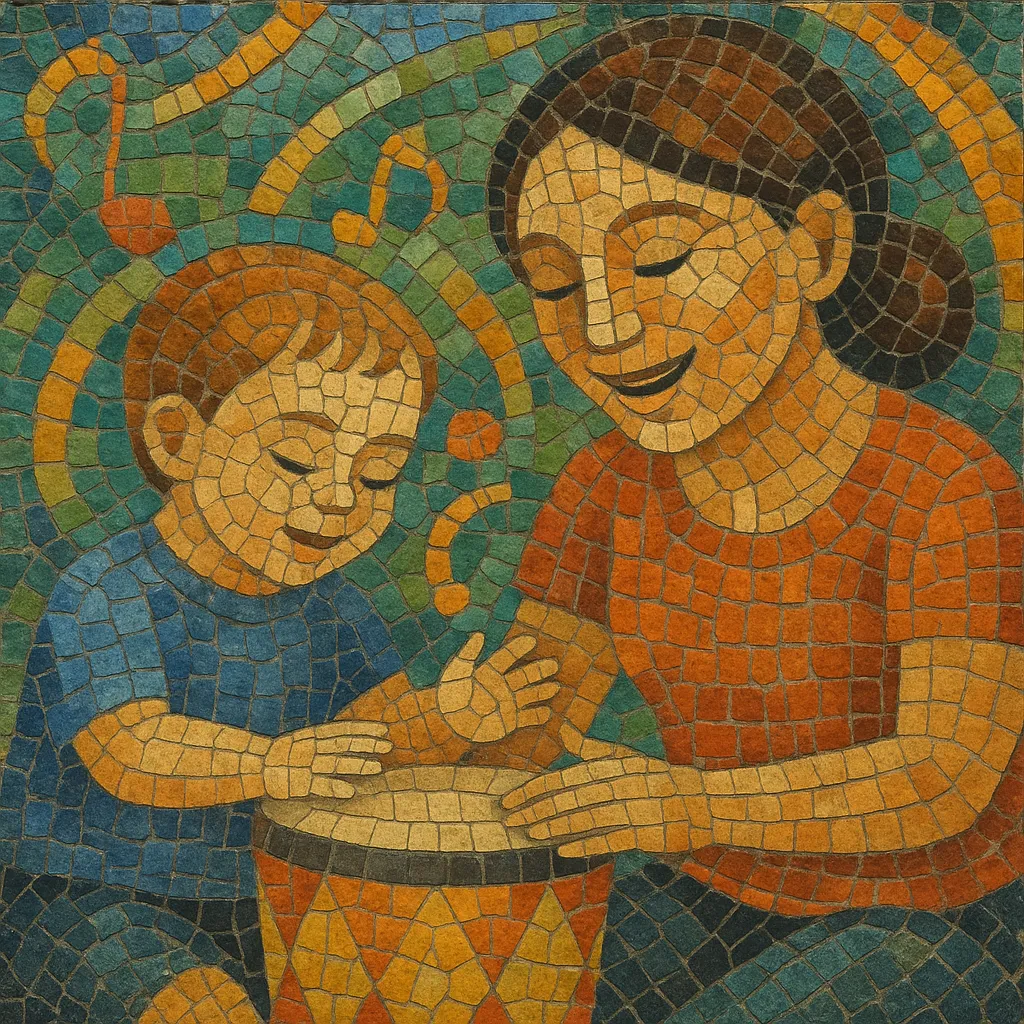
Kindermusik is a children-focused music-and-movement style designed for early childhood development.

It emphasizes simple, singable melodies; steady, accessible rhythms; and interactive call-and-response that invites participation from toddlers, preschoolers, and their caregivers. Typical sessions and recordings incorporate playful vocal cues, movement prompts, fingerplays, chants, and short instrumental interludes that support cognitive, motor, social, and language milestones.

Musically, Kindermusik draws on folk songs, lullabies, nursery material, and elementary classical textures, arranging them with bright timbres (e.g., glockenspiel, shakers, hand drums) and warm, close-miked vocals. Pedagogically, it borrows principles from Orff Schulwerk, Kodály, Dalcroze, and Suzuki, favoring pentatonic tone-sets, narrow ranges, and repetitive forms that make musical ideas easy to imitate, remember, and move to.

History

Origins (1970s)

Kindermusik emerged in the late 1970s as a formalized approach to early childhood music education. While its name is German for "children’s music," the modern program coalesced in the United States, adapting and packaging ideas pioneered in European pedagogies (Orff Schulwerk, Kodály, Dalcroze, and Suzuki). The goal was to create developmentally sequenced, family-participatory music experiences centered on singing, movement, and simple instrument play.

Growth and Studio Era (1980s–1990s)

Through licensed teachers and community studios, Kindermusik expanded across North America and internationally. Carefully produced recordings—songs, rhymes, and soundscapes—paralleled in-class activities, reinforcing steady beat, echo singing, gross/fine motor skills, and emergent literacy. Arrangements favored acoustic timbres, clear diction, and repetition to maximize engagement and comprehension.

Digital Distribution and Global Reach (2000s–present)

With CDs giving way to downloads and streaming, Kindermusik’s catalog became widely accessible for at-home use. The approach influenced broader preschool music programming by normalizing caregiver-inclusive classes, movement prompts embedded in songs, and curriculum-aligned sequencing. Today, Kindermusik-aligned music remains a staple in early education settings, blending global folk materials, lullabies, and light classical textures into developmentally appropriate, play-centered repertoire.

How to make a track in this genre

Core Musical Materials
•   Use pentatonic or diatonic melodies within a narrow vocal range (about a 6th–8ve), with clear tonic-dominant grounding. •   Favor simple meters (2/4, 4/4, or gentle 3/4) at child-friendly tempos (≈70–120 BPM for songs; slower for lullabies). •   Keep forms short and repetitive (A-A-B-A, echo phrases, call-and-response) to aid memory and participation.
Instrumentation and Timbre
•   Prioritize bright, non-intimidating timbres: ukulele, acoustic guitar, piano, glockenspiel, handbells, shakers, claves, frame/hand drums, tambourine. •   Record vocals closely and warmly; ensure lyrics are clearly articulated and paced to allow imitation.
Rhythm and Movement Integration
•   Embed movement cues in the lyrics ("clap," "stomp," "tiptoe"); align strong beats with actionable gestures. •   Include steady-beat activities and echo-clap sections; alternate between locomotor (walking, marching) and non-locomotor (clapping, patting) tasks.
Harmony and Texture
•   Keep harmony transparent (I–IV–V, occasionally vi) with sparse voicings; avoid dense counterpoint. •   Use ostinatos and drone tones to stabilize pitch for young singers.
Lyrics and Themes
•   Choose concrete, age-relevant topics: animals, weather, daily routines, body parts, colors, counting. •   Employ rhyme, alliteration, and predictable refrains; keep sentences short and affirmative.
Arrangement and Flow
•   Start with a simple a cappella or single-instrument pickup to set pitch. •   Sequence songs to alternate energy levels (active song → fingerplay chant → quiet listening/lullaby). •   End with a calming piece to facilitate transition.
Classroom/Family Use
•   Provide echo sections for teacher/caregiver modeling. •   Offer prop prompts (scarves, hoops, simple percussion) that match musical phrasing and dynamics.

Top tracks

Locked
Share your favorite track to unlock other users’ top tracks
Influenced by
Has influenced
No genres found
Challenges
Digger Battle
Let's see who can find the best track in this genre
© 2025 Melodigging
Melodding was created as a tribute to Every Noise at Once, which inspired us to help curious minds keep digging into music's ever-evolving genres.
Buy me a coffee for Melodigging