Your digging level
Description
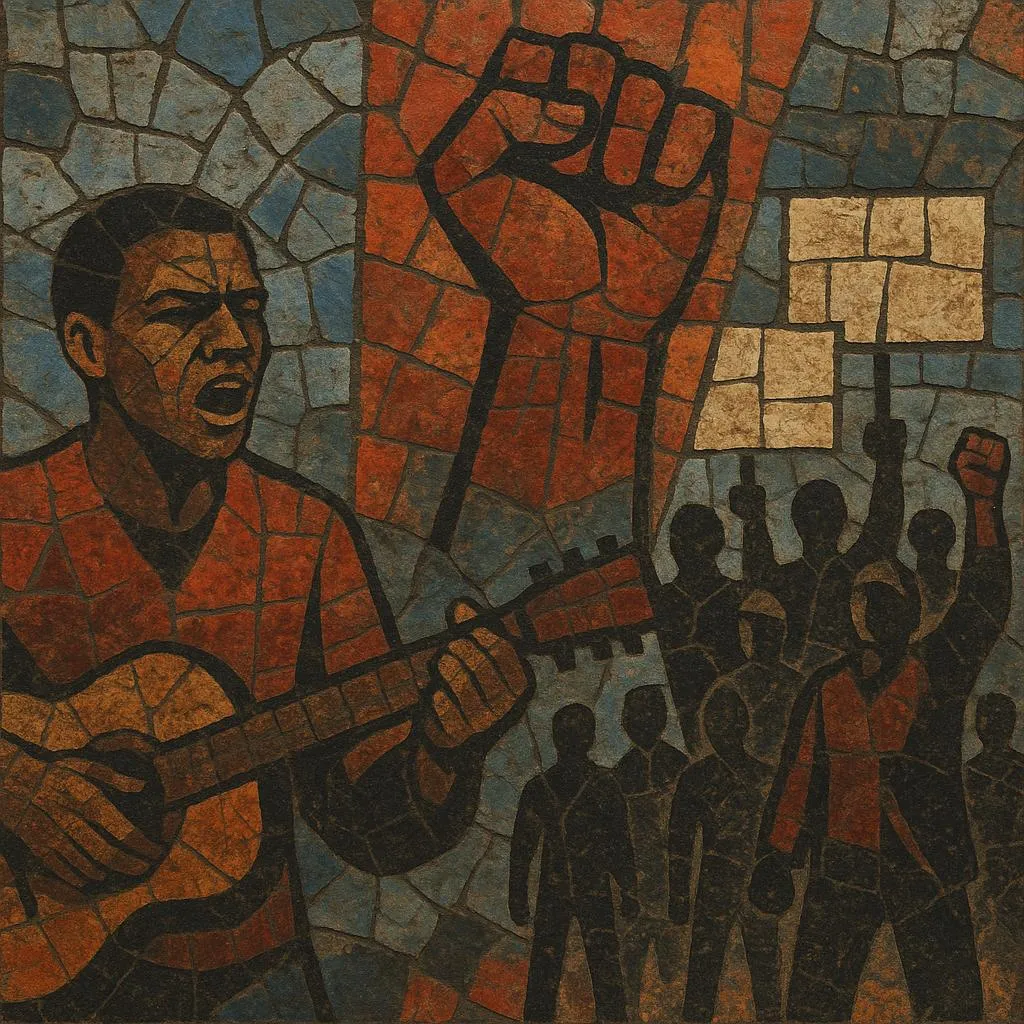
Political music is music made with explicit political content, whether to protest, mobilize, celebrate, satirize, or propagandize. It foregrounds lyrics and messaging, often using slogans, calls‑and‑responses, and narrative testimony to address issues such as war and peace, civil rights, class, gender, environment, and national identity.
Although songs with political themes are ancient, the modern popular form of political music coalesced in the 1960s, when mass media, social movements, and youth culture converged. Political music cuts across styles—from folk ballads and anthems to punk, reggae, Afrobeat, and hip hop—but retains a core emphasis on collective voice, social critique, and action.
History
Political song predates recorded history: work songs, spirituals, ballads, and anthems carried social memory and dissent. In the 19th and early 20th centuries, labor movements and suffrage campaigns popularized topical songbooks and union choruses. The recording era captured these traditions in blues, gospel, and folk, giving them wider circulation.
The 1960s Civil Rights and anti‑war movements in the United States helped crystallize “political music” as a recognizable stream in popular culture. Folk revivalists such as Pete Seeger, Bob Dylan, and Joan Baez brought protest songs to mass audiences; soul and jazz artists including Nina Simone and Max Roach embedded political urgency in new musical forms. Television and radio amplified both message and counter‑message.
Beyond the U.S., political music flourished: Fela Kuti’s Afrobeat critiqued Nigerian authoritarianism; reggae—from The Wailers to later “roots” and “dub”—linked Rastafarian consciousness with anti‑colonial politics. In Latin America, nueva canción (e.g., Víctor Jara, Violeta Parra) tied indigenous and folk idioms to socialist and human‑rights causes. Punk (The Clash, Crass) injected confrontational, DIY polemic into rock.
Hip hop became a primary vehicle for political storytelling and critique—Gil Scott‑Heron’s spoken word prefigured Public Enemy, KRS‑One, and later artists addressing policing, mass incarceration, and geopolitics. In rock and metal, Rage Against the Machine fused rap, hardcore, and agit‑prop stagecraft. Riot grrrl catalyzed feminist punk communities and zine networks.
Social media, streaming, and protest livestreams globalized political music’s reach. Artists deploy rapid-response singles, community choirs, and grassroots compilations to soundtrack uprisings (Arab Spring, Black Lives Matter, climate marches). Styles vary—trap, singer‑songwriter, grime, Afro‑fusion—but the genre’s center remains: collective address, testimony, and mobilization.